
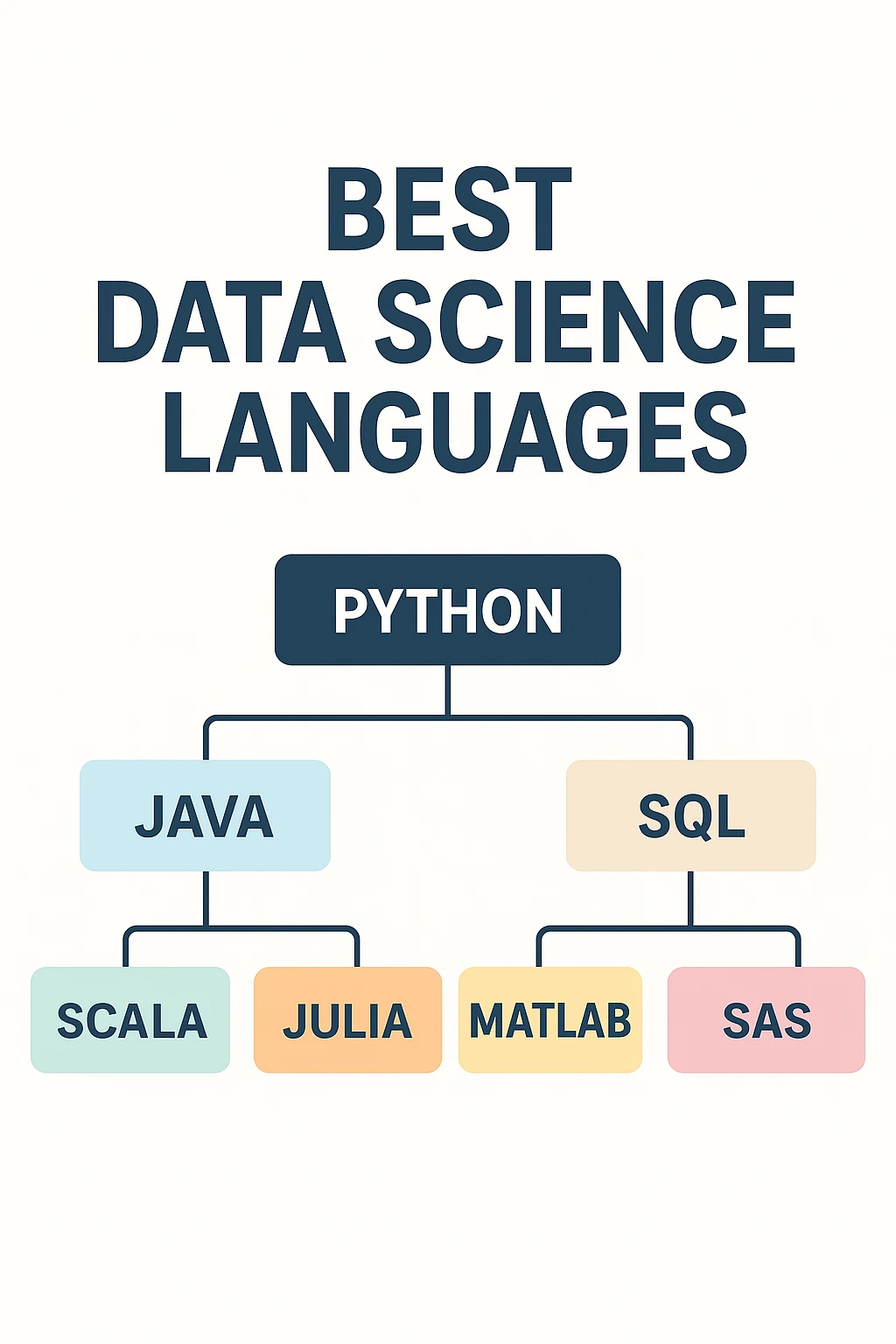
Choosing the best programming language for data science is one of the most common questions asked by beginners, students, and professionals entering the world of analytics. With so many languages available today—Python, R, SQL, Julia, Scala, Java, and more—it can feel confusing to understand which one truly stands out. The truth? No single language is perfect for every task. But some languages are undeniably more flexible, popular, and powerful within the data science ecosystem.
This article breaks down the strengths of each major language used in data science so you can confidently choose the one that fits your goals.
Why Your Programming Language Choice Matters
Data science involves many different tasks—data cleaning, statistical modeling, machine learning, data visualization, automation, and deployment. The programming language you choose will determine:
- How easily you can learn and perform tasks
- The libraries and tools available to you
- Your speed and efficiency
- Your job opportunities
- How well you can work with big data or machine learning frameworks
A great language should be easy to learn, widely supported, and equipped with strong libraries for advanced analytics.
1. Python — The Most Popular Language for Data Science
Python is the clear winner for most data science applications. It’s simple, readable, and extremely versatile. If data science was a toolbox, Python would be the tool that can do almost everything.
Why Python Dominates Data Science
- Easy to learn: Even beginners can understand Python quickly.
- Huge ecosystem: Thousands of data libraries make work faster and easier.
- Perfect for machine learning: Widely used in AI, deep learning, NLP, and automation.
- Great for production: Python integrates well with real-world applications.
Essential Python Libraries for Data Science
- NumPy: For numerical calculations
- Pandas: For data cleaning and analysis
- Matplotlib & Seaborn: For data visualization
- Scikit-learn: For machine learning models
- TensorFlow & PyTorch: For deep learning
Best For: Beginners, machine learning engineers, data analysts, AI developers, and anyone seeking an all-rounder language.
2. R — The Best Language for Statistics and Research
R is built by statisticians for statisticians. If your work involves heavy statistical analysis, data experiments, or academic research, R might be your best choice.
Why R Stands Out
- Unmatched statistical power
- Exceptional data visualization libraries (ggplot2, Shiny)
- Great for reports and dashboards
- Trusted in academia, research, and healthcare
When to Choose R
- Complex statistical modeling
- Data exploration
- Bioinformatics
- Academic research
Best For: Statisticians, researchers, and analysts focused on data exploration rather than production deployment.
3. SQL — The Most Essential Language for Data Handling
SQL is not a full programming language like Python or R, but no data scientist can survive without it.
Why SQL Matters
- Used to extract and manage data in every database
- Perfect for large datasets
- Fast querying and filtering
- Works with all major databases (MySQL, PostgreSQL, SQL Server, Oracle, etc.)
If data is the heart of data science, SQL is the bloodstream that keeps it moving.
Best For: Anyone who works with data — beginners to professionals.
4. Julia — The High-Performance Language for Scientific Computing
Julia is fast—almost as fast as C—and designed specifically for high-performance numerical work.
Why Julia Is Rising
- Blazing-fast speed
- Great for large-scale mathematical and scientific simulations
- Easy syntax similar to Python
But Julia’s ecosystem is still growing, which makes it less practical for beginners.
Best For: Researchers, mathematicians, physicists, and high-performance computing tasks.
5. Scala — The Big Data Powerhouse
Scala is widely used in big data environments, especially where Apache Spark is involved.
Why Scala is Popular in Big Data
- High performance
- Works natively with Spark
- Great for distributed computing
If your work involves real-time data, huge datasets, or distributed architectures, Scala is an excellent option.
Best For: Big data engineers and enterprise-level applications.
6. Java — The Enterprise Choice
Java is one of the most stable and secure languages. While not as beginner-friendly as Python, it’s widely used in enterprise-grade data systems.
Why Consider Java for Data Science?
- Strong performance
- Excellent for large production systems
- Works well with big data tools like Hadoop
Best For: Enterprise-level data engineering and large backend systems.
Python vs R — Which One Should You Choose?
| Feature | Python | R |
|---|---|---|
| Ease of Learning | Very easy | Moderate |
| Machine Learning | Excellent | Limited |
| Statistics | Good | Excellent |
| Visualization | Good | Outstanding |
| Industry Use | Widely used | Popular in academics |
Verdict:
- Choose Python if you want to work in tech, AI, or machine learning.
- Choose R if your work is heavily statistical or research-oriented.
Which Language Should Beginners Start With?
If you’re new to data science, the best language to start with is Python.
It’s simple, powerful, and used in almost every company—from startups to Google.
Learn Python first, then SQL, and you can pick up other languages depending on your specialization.
Which Language is Best for Machine Learning and AI?
Without question: Python.
Its ecosystem (TensorFlow, PyTorch, Scikit-learn) dominates the AI industry.
Which Language is Best for Big Data?
Scala and Java are the strongest choices, especially when working with Apache Spark or Hadoop.