
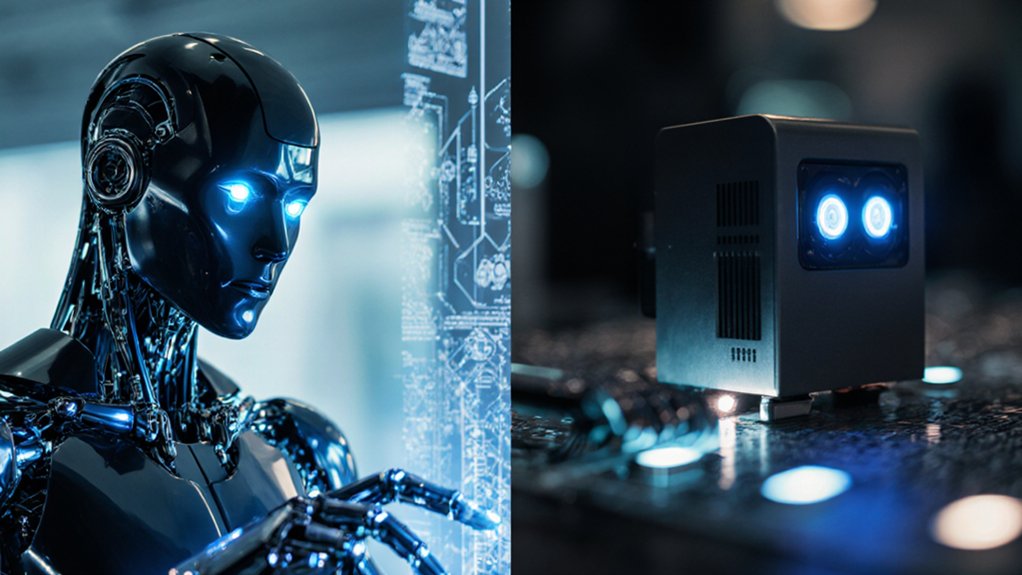
The distinction between Strong AI and Weak AI is essential in understanding the future of artificial intelligence. Strong AI aims to replicate human-like cognition, while Weak AI excels in specific, predefined tasks. This difference shapes their applications and potential impact on society. As advancements continue, the implications of these technologies become more significant. What challenges and opportunities might arise from the evolution of Strong AI?
Key Takeaways
- Strong AI possesses human-like cognitive abilities, while weak AI focuses on specific, predefined tasks without genuine understanding.
- Weak AI relies on algorithms to perform set functions, whereas strong AI can learn and adapt across various domains.
- Strong AI aims for general intelligence and emotional understanding, in contrast to weak AI’s limited operational scope.
- Weak AI excels in automation and efficiency, while strong AI offers potential for creative problem-solving and real-time decision-making.
- Ethical considerations for strong AI include accountability and autonomy, which are less pronounced in weak AI applications.
What Is Weak AI and How Does It Work?
While many people associate artificial intelligence with the idea of machines thinking like humans, weak AI, also known as narrow AI, focuses on performing specific tasks without genuine understanding or consciousness. This type of AI excels at handling defined functions, such as natural language processing, image recognition, and data analysis. Weak AI operates on algorithms that process inputs to generate outputs, relying on pre-programmed responses rather than learning from experiences. Examples include virtual assistants like Siri and chatbots that efficiently answer customer inquiries. These systems lack the ability to generalize knowledge or comprehend context beyond their programmed tasks. By streamlining operations in various industries, weak AI demonstrates its practical applications, enhancing efficiency and productivity without mimicking human-like intelligence.
What Is Strong AI, Anyway?
Strong AI refers to artificial intelligence that possesses the ability to understand, learn, and apply knowledge in a way indistinguishable from human cognition. It’s characterized by its capacity for reasoning, problem-solving, and emotional understanding. Unlike weak AI, which performs specific tasks, strong AI aims for general intelligence across various domains.
Definition Of Strong AI
The concept of strong AI, often referred to as artificial general intelligence (AGI), represents a pivotal goal in the field of artificial intelligence. Unlike weak AI, which is designed for specific tasks and operates under limited parameters, strong AI aims to replicate human cognitive abilities across a wide range of activities. This means it can understand, learn, and apply knowledge in various contexts, much like a human would. Strong AI isn’t just about performing tasks; it involves reasoning, problem-solving, and emotional understanding. Fundamentally, it seeks to create machines that possess consciousness and self-awareness, enabling them to function autonomously and adapt to new situations. Achieving strong AI could revolutionize numerous fields, from healthcare to education, fundamentally altering how humans interact with technology.
Characteristics Of Strong AI
As researchers explore the domain of strong AI, several key characteristics emerge that distinguish it from its weaker counterparts. Strong AI possesses the ability to understand, learn, and apply knowledge across various contexts, mimicking human cognitive functions. It can reason, solve problems, and adapt to new situations without pre-programmed responses. Unlike weak AI, which is designed for specific tasks, strong AI exhibits general intelligence, effectively handling a wide range of challenges. Additionally, it can experience self-awareness and consciousness, enabling it to reflect on its own thoughts and actions. This level of intelligence allows strong AI to engage in complex social interactions, making decisions based on ethical considerations, much like a human would. These traits highlight strong AI’s potential transformative impact on society.
Key Differences Between Strong AI and Weak AI
While many people use the terms Strong AI and Weak AI interchangeably, they define fundamentally different concepts in artificial intelligence. Strong AI refers to systems that possess human-like cognitive abilities, capable of understanding, reasoning, and learning across various tasks. These systems can replicate human thought processes, making them theoretically self-aware. In contrast, Weak AI focuses on specialized applications. These systems perform specific tasks without genuine understanding or consciousness, such as voice assistants or recommendation algorithms. Another key difference lies in their adaptability; Strong AI can learn and adapt in real-time, while Weak AI relies on pre-programmed algorithms. Ultimately, Strong AI aims for general intelligence, while Weak AI excels in narrow domains, reflecting their distinct roles in the AI landscape.
Why Is Weak AI Important?
Weak AI plays an essential role in everyday life by powering tools that enhance efficiency and convenience. From virtual assistants to recommendation systems, these applications help users make better decisions quickly. As society increasingly relies on these technologies, understanding their significance becomes vital.
Practical Applications In Daily Life
In today’s fast-paced world, weak AI plays an essential role in enhancing everyday experiences. From simplifying tasks to improving efficiency, it’s now deeply woven into daily life. Here are four key applications:
- Virtual Assistants: Tools like Siri and Alexa help with scheduling, reminders, and information retrieval.
- Recommendation Systems: Platforms like Netflix and Amazon use weak AI to suggest movies and products based on user preferences.
- Smart Home Devices: Thermostats and security cameras can learn user habits, automatically adjusting settings for comfort and safety.
- Chatbots: Businesses employ chatbots for customer service, providing quick responses and support without human intervention.
These applications showcase how weak AI enhances convenience and accessibility, making life easier for everyone.
Enhancing Human Decision-Making
As technology evolves, weak AI becomes crucial in enhancing human decision-making by providing valuable insights and streamlining processes. Organizations leverage weak AI tools to analyze vast amounts of data quickly, revealing patterns and trends that might go unnoticed. For instance, in finance, weak AI systems assist analysts in predicting market shifts, enabling informed investment choices. In healthcare, these tools help doctors by offering diagnostic suggestions based on patient data, ultimately improving patient outcomes. Additionally, weak AI automates routine tasks, freeing professionals to focus on more critical decisions. By integrating weak AI into various sectors, individuals and teams can make better-informed choices, thereby increasing efficiency and effectiveness in their respective fields. This synergy between technology and human judgment is crucial for progress.
What Could Strong AI Mean for Society?
While many experts debate the timeline for achieving strong AI, its potential impact on society is already a pressing concern. The emergence of strong AI could reshape various aspects of daily life, leading to significant changes, including:
- Job Displacement: Automation may replace many traditional jobs, requiring a shift in workforce skills.
- Healthcare Advancements: Strong AI could revolutionize diagnostics and personalized treatment options.
- Ethical Dilemmas: The rise of self-aware machines raises questions about rights, responsibilities, and moral accountability.
- Enhanced Decision-Making: With superior data processing, strong AI could lead to improved governance and policy-making. Furthermore, strong AI could enhance data analysis training by providing sophisticated tools to interpret large datasets.
These factors illustrate the profound implications strong AI could have, demanding careful consideration and proactive planning from society.
Limitations of Weak AI: What Can’t It Do?
Strong AI’s potential benefits often overshadow the capabilities of weak AI, which is currently the most prevalent form of artificial intelligence. Weak AI is designed for specific tasks and lacks general cognitive abilities. It can’t understand or process information beyond its programmed functions, limiting its adaptability. For instance, it can’t engage in true conversation or exhibit emotional intelligence like humans. Weak AI also struggles with creativity; it can’t generate original ideas or solutions outside its pre-defined parameters. In addition, it can’t learn from experiences in a broad sense, meaning it can’t apply knowledge across different domains. Ultimately, while weak AI excels in automation and efficiency, it remains fundamentally incapable of human-like reasoning and understanding.
What Lies Ahead for Strong AI?
What lies ahead for strong AI? The future promises exciting developments that could reshape industries and society. Researchers are optimistic about several key advancements:
- Enhanced Learning Capabilities: Strong AI could learn and adapt much like humans, improving efficiency across various sectors.
- Creative Problem Solving: With advanced reasoning, strong AI might tackle complex challenges in fields like healthcare and environmental science.
- Human-AI Collaboration: The integration of strong AI in workplaces could lead to innovative teamwork, enhancing productivity and creativity.
- Personalized Experiences: Strong AI could tailor services and products to individual preferences, revolutionizing customer interactions.
As technology progresses, the potential applications seem limitless, paving the way for a new era of intelligent systems. Furthermore, the incorporation of practical applications in AI training will be essential for developing robust systems that can address real-world challenges effectively.
Ethical Considerations in Developing Strong AI
As the development of strong AI progresses, ethical considerations become increasingly important. Developers must address concerns about autonomy, accountability, and the potential for bias. Ensuring strong AI operates under ethical guidelines is essential for its acceptance and integration into society.
Below is a summary of key ethical considerations:
| Ethical Concern | Description | Potential Impact |
|---|---|---|
| Autonomy | The degree of decision-making power AI possesses | Risk of dehumanization |
| Accountability | Assigning responsibility for AI actions | Legal and moral dilemmas |
| Bias | The potential for AI to reflect societal prejudices | Reinforcement of inequality |
Conclusion
In summary, while Weak AI excels in specific tasks and enhances efficiency, it lacks true understanding and adaptability. Strong AI, on the other hand, promises a future where machines can think and reason like humans, raising both exciting possibilities and ethical dilemmas. As society navigates these advancements, it’s essential to balance innovation with responsibility, ensuring that the development of Strong AI aligns with our values and benefits humanity as a whole.