
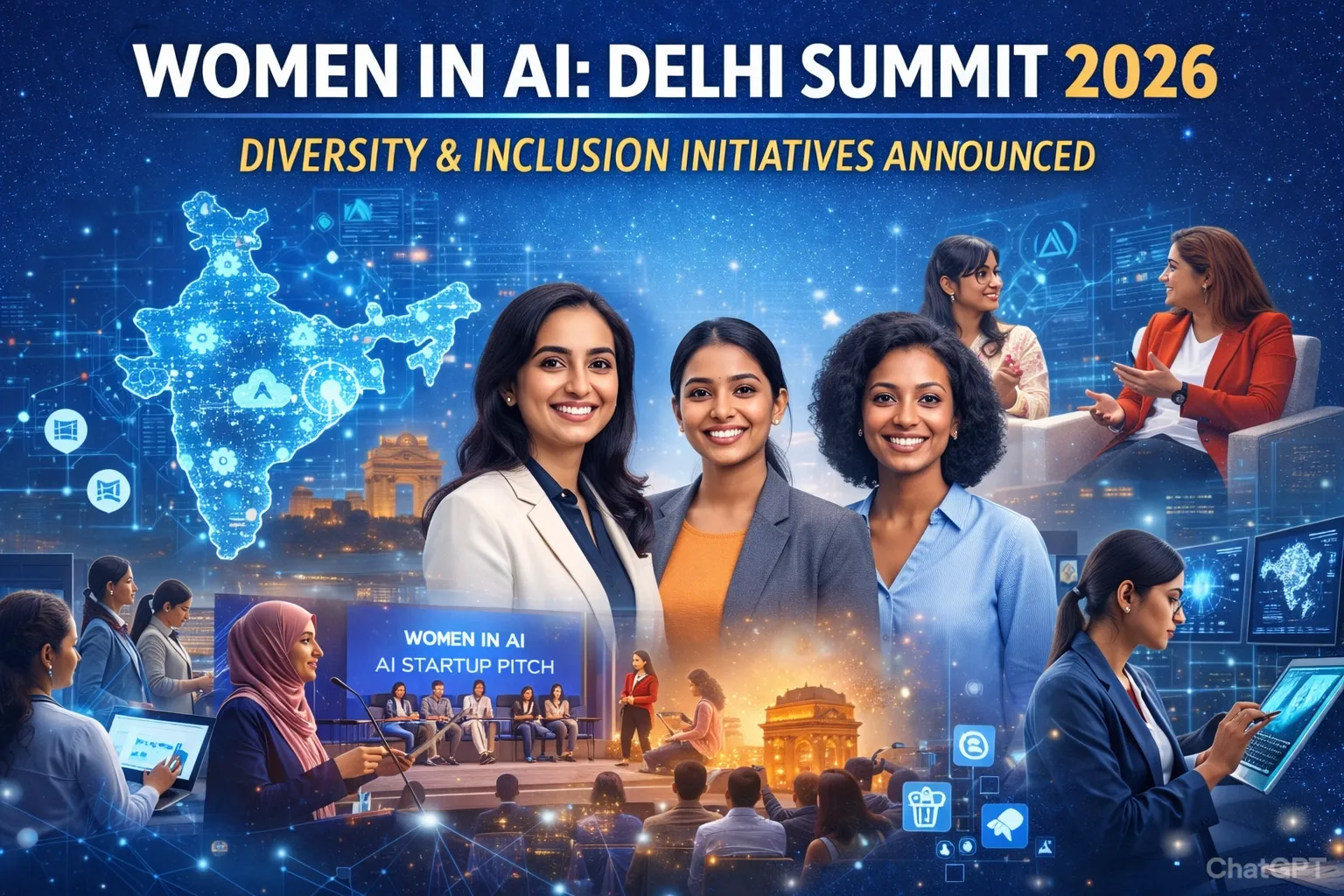
A Historic Spotlight on Women in AI at Delhi AI Summit 2026
The Delhi AI Summit 2026 marked a defining moment for diversity, equity, and inclusion in India’s rapidly expanding artificial intelligence ecosystem. Hosted in New Delhi, the summit went beyond technology announcements and infrastructure expansion to spotlight a powerful theme: empowering women in AI. For the first time at such a large-scale national technology event, diversity was not treated as a side panel discussion but as a central strategic priority embedded across policy, startup funding, workforce planning, and leadership commitments.
The event recognized a critical reality — while India is emerging as a global AI hub, women remain underrepresented in advanced AI research, leadership roles, and deep-tech entrepreneurship. The summit’s diversity agenda aimed to address structural barriers and unlock the full potential of India’s female talent pool in artificial intelligence, machine learning, robotics, and data science.
Government-Led Diversity Policies Strengthening Women’s Participation
One of the strongest announcements at the summit came from policymakers expanding the scope of national AI programs to actively support women in technology. Under initiatives aligned with IndiaAI Mission and Digital India, special funding windows and scholarship programs were announced for women pursuing AI education and research.
These policy changes aim to ensure that financial constraints do not become a barrier for talented female students aspiring to enter AI careers. Subsidized certification programs, AI research grants for women scholars, and startup seed funding dedicated to women founders were introduced as part of the broader inclusion strategy.
By integrating diversity targets into national AI policy rather than treating them as optional commitments, the government signaled that inclusive innovation is fundamental to India’s AI growth story. This structural approach is expected to influence universities, public institutions, and private enterprises to adopt measurable diversity benchmarks.
Corporate Commitments: Private Sector Driving Inclusive AI Ecosystems
Major technology companies participating in the summit reinforced their commitment to improving gender representation in AI research and leadership. Corporations, including Microsoft and Google, announced expanded mentorship networks, returnship programs for women professionals re-entering the workforce, and AI leadership fellowships exclusively designed for women.
These programs focus on mid-career acceleration, addressing one of the biggest gaps in technology industries — the drop-off in female participation at senior technical and managerial levels. By investing in leadership development and mentorship pipelines, private firms are attempting to create sustainable career growth pathways rather than entry-level hiring boosts alone.
The summit also highlighted commitments to eliminate algorithmic bias in AI systems by increasing diversity within AI development teams. Industry experts emphasized that inclusive teams produce more equitable and globally scalable AI solutions.
Women-Led AI Startups: Funding and Acceleration Support
A significant portion of the Delhi AI Summit 2026 was dedicated to showcasing women-led AI startups that are solving real-world challenges in healthcare, fintech, climate technology, and education. Special startup pitch sessions were organized exclusively for female founders, providing direct access to venture capitalists and government innovation funds.
Dedicated AI incubators announced reserved funding quotas and mentorship tracks for women entrepreneurs. These initiatives aim to close the investment gap that often prevents women-led startups from scaling at the same pace as their male counterparts. By aligning public funding with private venture capital participation, the ecosystem is gradually shifting toward a more balanced startup environment.
Beyond funding, structured support such as legal advisory, compliance guidance, global market access, and technology partnerships was also offered to ensure the long-term sustainability of women-founded AI ventures.
AI Education & Skilling Programs Focused on Female Talent
Skill development emerged as a cornerstone of the summit’s diversity framework. Several universities and edtech platforms partnered with government agencies to launch AI certification programs specifically targeting female students from tier-2 and tier-3 cities.
Scholarships covering advanced courses in machine learning, deep learning, and data engineering were announced to encourage participation from economically diverse backgrounds. Bootcamps and AI hackathons focused on women innovators were integrated into the summit’s outreach strategy to build confidence and exposure.
By strengthening access to AI education at grassroots levels, the summit aimed to create a sustainable pipeline of women professionals entering the AI workforce over the next decade. This long-term talent strategy aligns with India’s ambition to become a global AI talent hub.
Responsible AI and Gender Bias Mitigation
Another critical discussion during the summit focused on gender bias in AI systems. Experts emphasized that AI models trained on biased datasets can unintentionally reinforce social inequalities. Increasing women’s participation in AI development teams was presented as a practical solution to improving fairness in algorithm design.
Policy updates discussed at the summit encouraged transparency audits, bias testing protocols, and ethical review boards within AI-driven organizations. By embedding inclusion into technical governance frameworks, India is attempting to ensure that AI technologies reflect diverse social realities rather than narrow perspectives.
The summit reinforced the idea that gender diversity is not just a moral or social objective but a technological necessity for building accurate, inclusive, and globally reliable AI systems.
Leadership Panels: Amplifying Women’s Voices in AI Strategy
High-impact leadership panels at the summit featured prominent women technologists, policymakers, researchers, and entrepreneurs sharing their experiences in building AI solutions. These sessions served not only as inspiration but as strategic dialogues influencing future policies and funding priorities.
The visibility of women leaders in high-level AI conversations sends a powerful signal to students and young professionals considering careers in artificial intelligence. Representation at decision-making tables ensures that diversity initiatives are designed by those who understand real challenges firsthand.
Industry-Academia Collaboration for Inclusive Innovation
Collaborative agreements between universities and corporations were announced to support women pursuing doctoral research and advanced AI projects. Sponsored research labs and fellowship programs aim to increase female representation in AI research publications, patents, and intellectual property creation.
These partnerships ensure that diversity initiatives are embedded not only in corporate hiring but also in academic innovation pipelines. By strengthening female participation in AI research, India aims to create a balanced ecosystem from foundational research to enterprise deployment.
Long-Term Impact: Building an Inclusive AI Future for India
The diversity and inclusion initiatives announced at the Delhi AI Summit 2026 represent more than symbolic gestures. They form a multi-layered strategy involving policy reform, corporate accountability, startup funding, skill development, and ethical AI governance.
If executed effectively, these initiatives could significantly reshape India’s AI workforce demographics over the next decade. Greater female participation will not only expand the talent base but also enhance innovation quality, global competitiveness, and societal trust in AI technologies.
The summit made one message clear: India’s rise as a global AI leader will be sustainable only if it is inclusive. Empowering women in AI is not a parallel goal; it is central to the country’s technological transformation. By embedding diversity into infrastructure, education, funding, and governance frameworks, India is building an AI ecosystem that reflects the strength and diversity of its population.