
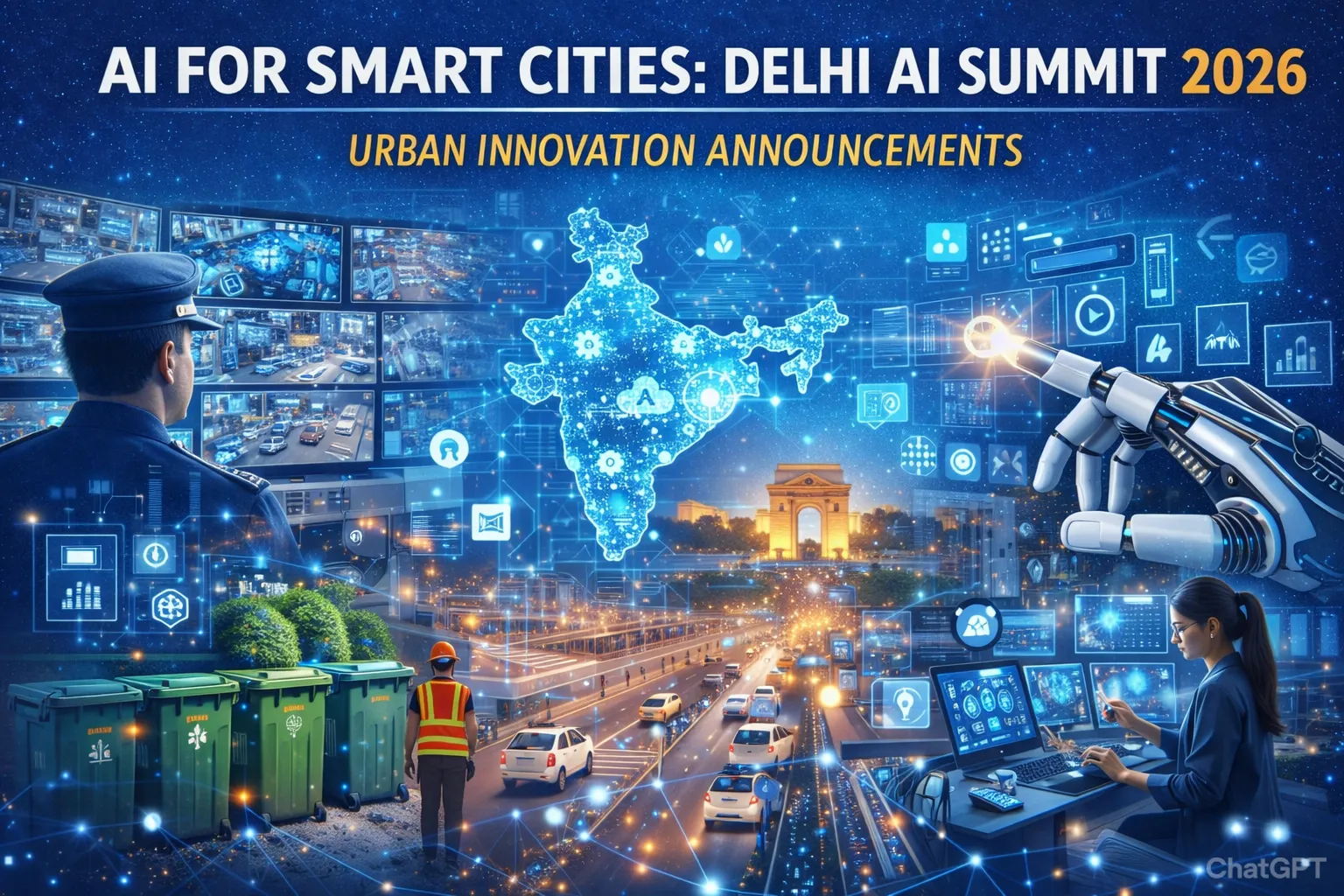
Delhi AI Summit 2026: A New Vision for AI-Powered Urban India
The Delhi AI Summit 2026, hosted in New Delhi, marked a turning point in India’s urban transformation journey. While artificial intelligence discussions often focus on startups, research models, and digital platforms, this summit placed a strong spotlight on AI for smart cities. Government officials, urban planners, global technology companies, and infrastructure leaders jointly unveiled a roadmap for AI-powered urban ecosystems that promise safer streets, efficient transportation, sustainable energy systems, and data-driven governance.
India’s rapid urbanization has created immense pressure on infrastructure, public services, and environmental systems. The announcements at the summit made it clear that AI will be central to managing this growth. Smart cities powered by artificial intelligence are no longer futuristic concepts; they are strategic national priorities designed to improve the quality of life for millions of citizens.
Government-Led Smart City AI Framework Announced
A major highlight of the summit was the expansion of AI integration within the Smart Cities Mission. Policymakers announced an AI-first upgrade to existing smart city infrastructure, focusing on real-time data analytics, predictive urban planning, and automated public service management.
The government outlined plans to create centralized AI command centers in major metropolitan areas. These centers will use machine learning models to analyze traffic patterns, public transport usage, air quality levels, and emergency response data. By combining AI with Internet of Things (IoT) sensors already deployed in urban spaces, city administrations will gain predictive capabilities rather than reactive control systems.
This structured integration demonstrates a shift from isolated digital initiatives to comprehensive AI-driven governance models.
AI-Powered Traffic Management and Mobility Solutions
Urban congestion remains one of the biggest challenges in Indian cities. At the summit, several partnerships were announced between municipal corporations and private technology providers to deploy AI-based traffic optimization systems.
These systems will analyze live camera feeds, GPS data from public transport, and historical traffic patterns to dynamically adjust signal timings and reduce bottlenecks. Predictive analytics models will also assist in route planning for emergency vehicles, significantly reducing response times.
By leveraging AI algorithms, cities aim to reduce fuel consumption, minimize travel delays, and cut carbon emissions. The summit highlighted pilot programs where AI-managed traffic signals resulted in measurable improvements in commute times, setting the stage for nationwide implementation.
AI for Urban Safety and Smart Surveillance
Public safety emerged as another critical theme in the smart city discussions. AI-enabled surveillance systems equipped with facial recognition, anomaly detection, and crowd monitoring capabilities were introduced as part of integrated urban safety platforms.
Authorities emphasized the importance of balancing safety with privacy through strict governance protocols and responsible AI guidelines. AI systems will assist law enforcement agencies by identifying suspicious patterns, detecting unattended objects, and analyzing crime data to predict high-risk zones.
The summit underscored that AI-driven surveillance is not about mass monitoring but about improving response efficiency and proactive risk mitigation in densely populated urban centers.
Sustainable Energy Management Through AI Integration
Energy efficiency and sustainability were central to the smart city vision presented at the summit. AI-based grid management systems were announced to optimize electricity distribution, predict peak demand periods, and integrate renewable energy sources seamlessly.
Urban local bodies are expected to deploy AI-powered analytics to monitor energy consumption in public buildings, street lighting systems, and water treatment facilities. By automating demand forecasting and energy allocation, cities can reduce wastage and lower operational costs.
These innovations align with India’s broader sustainability goals, positioning AI as a tool for environmental stewardship rather than merely technological advancement.
AI in Waste Management and Urban Cleanliness
Waste management remains a persistent challenge in rapidly growing cities. The summit showcased AI-driven waste segregation systems capable of identifying recyclable materials using computer vision technology.
Smart bins integrated with AI sensors will notify municipal authorities when collection is required, optimizing waste collection routes and reducing fuel usage. Data analytics platforms will track waste generation patterns across neighborhoods, enabling better planning and targeted awareness campaigns.
By automating and optimizing waste processes, AI-powered systems promise cleaner cities with improved public health outcomes.
Data-Driven Urban Planning and Infrastructure Development
AI’s role in long-term city planning was strongly emphasized during the summit. Advanced simulation models can now analyze demographic growth, migration trends, land-use patterns, and infrastructure stress levels.
Urban planners will use AI-powered digital twins — virtual replicas of cities — to simulate development scenarios before executing physical projects. This approach reduces cost overruns, prevents planning errors, and ensures more resilient infrastructure development.
By incorporating predictive analytics into policy decisions, governments can anticipate urban challenges years in advance rather than responding after problems escalate.
Public-Private Partnerships Driving Smart City Innovation
The success of AI-powered smart cities depends heavily on collaboration. The summit featured multiple public-private partnership announcements involving global cloud providers, domestic IT firms, and infrastructure companies.
Private sector technology providers will offer AI platforms, cloud infrastructure, and cybersecurity solutions, while government bodies provide regulatory clarity and access to public datasets. This collaborative model ensures scalability, cost efficiency, and continuous innovation.
By combining technological expertise with administrative authority, India is building a hybrid smart city ecosystem that balances innovation with governance oversight.
AI for Citizen Services and Digital Governance
Beyond infrastructure, the summit highlighted AI-powered citizen engagement platforms. Intelligent chatbots integrated into municipal portals will handle service requests, grievance redressal, and information dissemination in multiple languages.
Predictive service delivery models will help city administrations allocate resources more effectively, ensuring timely maintenance of roads, water supply systems, and public facilities. AI dashboards will provide real-time performance indicators to urban administrators, enhancing accountability and transparency.
This digital governance approach strengthens trust between citizens and municipal authorities, creating more responsive urban systems.
Challenges, Ethics, and Responsible Urban AI
While the summit celebrated technological advancements, it also addressed concerns related to data privacy, cybersecurity risks, and ethical AI deployment in urban environments. Experts emphasized the need for transparent data governance policies and citizen consent frameworks.
AI audit mechanisms and bias testing protocols were proposed to ensure fair deployment across different communities. Urban AI systems must be inclusive and accessible, preventing digital divides from widening.
By integrating responsible AI guidelines into smart city strategies, India aims to build technologically advanced yet socially equitable urban ecosystems.
Long-Term Impact: Transforming India’s Urban Future
The announcements made at the Delhi AI Summit 2026 reflect a long-term commitment to transforming India’s urban landscape through artificial intelligence. From intelligent traffic systems and energy-efficient grids to AI-driven governance and sustainable waste management, the vision is comprehensive and interconnected.
If implemented effectively, AI-powered smart cities will improve productivity, enhance public safety, reduce environmental impact, and elevate living standards for millions of citizens. The summit made it clear that AI is not just an innovation tool but a foundational layer for next-generation urban development in India.
As cities continue to expand, the integration of artificial intelligence into infrastructure, governance, and citizen services will determine the success of India’s urban future. The Delhi AI Summit 2026 has positioned the nation firmly on the path toward building intelligent, sustainable, and inclusive smart cities powered by AI.