
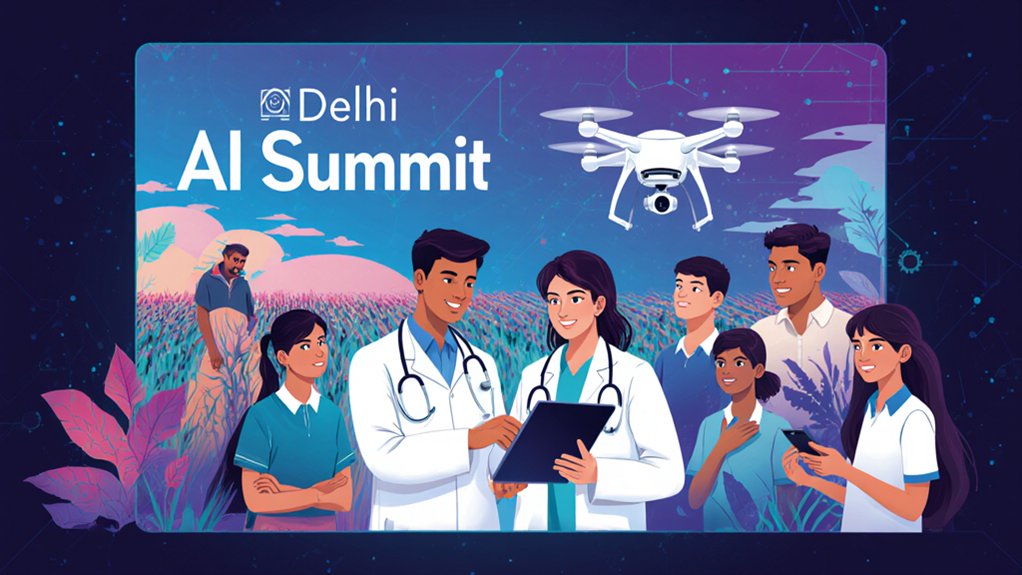
At the Delhi AI Summit, you witnessed how artificial intelligence is reshaping key sectors like healthcare, agriculture, and education. With innovative solutions enhancing patient care, optimizing farming practices, and personalizing learning experiences, the potential for transformation is immense. But what challenges lie ahead as these technologies integrate into everyday life? Exploring these implications could shed light on the future of AI in our society.
Key Takeaways
- The Delhi AI Summit showcased AI-driven tools enhancing patient monitoring and diagnostic accuracy in healthcare, leading to improved patient outcomes.
- Precision agriculture techniques were highlighted, using AI for crop monitoring, yield prediction, and predictive pest management to optimize farming efficiency.
- Adaptive learning technologies demonstrated at the summit tailored educational experiences to individual student needs, refining teaching approaches through data-driven insights.
- Ethical challenges in AI, including data privacy, algorithmic bias, and accountability, were emphasized as critical considerations for responsible integration across sectors.
- The summit underscored the importance of transparency and collaboration among stakeholders to ensure AI benefits are equitable and trustworthy in healthcare, agriculture, and education.
Transforming Patient Care: AI Innovations in Healthcare
As technology advances, AI is reshaping the way you experience healthcare, making patient care more personalized and efficient. With AI-driven tools, patient monitoring becomes seamless; you can track your health metrics in real-time, ensuring timely interventions when necessary. These innovations enhance diagnostic accuracy, allowing healthcare providers to make informed decisions faster. Algorithms analyze vast amounts of data, identifying patterns that human eyes might miss. You’ll benefit from quicker diagnoses and tailored treatment plans, improving outcomes considerably. Plus, AI helps reduce human error, creating a safer environment for your care. Embracing these technologies means you’re not just a patient but an active participant in your health journey, equipped with the best resources for ideal well-being. The AI course focuses on real-world applications to prepare students for careers that leverage such innovations in various fields, including healthcare.
How AI Is Revolutionizing Agriculture: Smart Farming Techniques
While farmers face increasing challenges from climate change and resource scarcity, AI is stepping in to transform agriculture through innovative smart farming techniques. You can leverage precision agriculture to optimize your farming practices, ensuring maximum efficiency. With advanced crop monitoring systems, you’ll keep a close eye on plant health, while soil analysis helps you understand nutrient needs. AI-driven yield prediction tools can guide your planting decisions, allowing for better resource optimization. Additionally, AI enhances pest management by predicting outbreaks before they occur, minimizing crop loss. As you embrace technology integration, you’ll find your farm adapts more effectively to climate changes, ensuring sustainability and productivity. By implementing these smart techniques, you’re not just farming; you’re revolutionizing agriculture.
Tailored Learning Experiences: AI Tools for Personalized Education
In today’s educational landscape, AI tools are transforming how you learn by providing tailored experiences just for you. With adaptive learning technologies, these systems adjust to your individual needs, ensuring you grasp concepts at your own pace. Plus, data-driven insights help educators refine their approaches, making learning more effective and engaging. Additionally, the integration of data science training is becoming essential for educators to harness the power of AI in developing personalized learning strategies.
Adaptive Learning Technologies
Adaptive learning technologies revolutionize education by tailoring experiences to meet individual needs. With these tools, you can engage in adaptive assessments that adjust to your skill level, ensuring you’re always challenged but not overwhelmed. This personalized approach allows you to progress at your own pace, making learning more effective and enjoyable. As you navigate through lessons, you’ll receive personalized feedback that highlights your strengths and areas for improvement, guiding you toward mastery of the subject matter. These technologies not only enhance your learning experience but also promote a deeper understanding of concepts. Embracing adaptive learning means you’re no longer just a passive recipient of information; you’re an active participant in your educational journey, equipped with the tools to succeed.
Data-Driven Insights
How can data-driven insights transform your learning experience? By leveraging AI tools, you can enjoy tailored learning experiences that cater to your unique needs. Data visualization helps you grasp complex concepts quickly, while predictive modeling forecasts your learning trajectory, ensuring you stay on track.
Here’s how these insights can be structured:
| Feature | Benefits | AI Tools |
|---|---|---|
| Data Visualization | Simplifies information | Tableau, Power BI |
| Predictive Modeling | Anticipates learning gaps | IBM Watson, Google AI |
| Personalized Feedback | Tailored guidance | Edmodo, Knewton |
| Adaptive Assessments | Customized evaluations | Smart Sparrow, DreamBox |
| Learning Analytics | Tracks progress | Learning Catalytics, BrightBytes |
Embrace these innovations to enhance your educational journey!
How Can Predictive Analytics Improve Hospital Decisions?
While hospitals face increasing pressures to provide quality care efficiently, predictive analytics emerges as a powerful tool to enhance decision-making. By utilizing predictive modeling, you can analyze vast amounts of patient data, enabling you to anticipate needs and allocate resources effectively. This not only improves operational efficiency but also enhances clinical outcomes. For instance, by predicting patient admission rates, you can staff adequately and reduce wait times. Furthermore, predictive analytics helps identify patients at risk of complications, allowing for timely interventions that can save lives. By integrating these insights into daily operations, you can foster a proactive approach to healthcare, ultimately leading to better patient satisfaction and improved health outcomes. Embracing predictive analytics is essential for modern hospitals.
Robotics in Farming: AI Solutions for Agricultural Automation
Robotics is transforming farming with innovative AI solutions that streamline agricultural automation. You’ll find that robotic automation enhances efficiency by performing tasks like planting, watering, and harvesting with remarkable precision. These robots utilize sensors and AI algorithms to optimize crop yields, making precision agriculture a reality.
As you embrace these technologies, you’ll notice reduced labor costs and increased productivity on your farm. Drones equipped with AI can monitor crop health, providing real-time data to help you make informed decisions. With robotic systems managing repetitive tasks, you can focus on strategic planning and improving sustainability. Ultimately, integrating robotics into your farming practices not only boosts efficiency but also supports a more sustainable and productive agricultural future. Moreover, the integration of advanced data analysis techniques in farming can lead to smarter decision-making and enhanced operational strategies.
AI Tools for Customized Learning: Enhancing Student Engagement
What if you could tailor your learning experience to fit your unique needs? With AI tools, you can! Interactive platforms allow you to engage with content that resonates with your interests and learning style. Imagine diving into subjects that capture your attention, making the process enjoyable and effective. Gamified learning takes this a step further by incorporating game-like elements, turning lessons into exciting challenges. You’ll not only grasp concepts better but also stay motivated and enthusiastic to learn. These AI-driven solutions adapt to your progress, ensuring you’re always challenged just enough. Embracing customized learning through AI tools can revolutionize your educational journey, enhancing your engagement and making learning a truly personal experience. Moreover, the Machine Learning Course offers hands-on practical sessions that can further complement AI tools in providing an interactive learning environment.
Ethical Considerations: Addressing AI Challenges in Key Sectors
As you explore the impact of AI in healthcare, agriculture, and education, you’ll encounter important ethical challenges that can’t be ignored. Data privacy concerns, algorithmic bias, and the need for accountability and transparency are critical issues that affect how AI is implemented. It is crucial to address these challenges to guarantee AI benefits everyone fairly and responsibly.
Data Privacy Concerns
Data privacy stands at the forefront of ethical considerations in the integration of AI across healthcare, agriculture, and education. You need to be aware that the collection and use of personal data raise significant concerns about data protection and compliance with privacy regulations. As AI systems analyze vast amounts of information, ensuring that sensitive data remains secure is paramount. You must advocate for robust protocols and transparency to maintain user trust. Implementing strong cybersecurity measures and regularly reviewing practices can help mitigate risks. Furthermore, staying informed about evolving privacy regulations will enable you to navigate this complex landscape effectively, ensuring that innovations in AI don’t come at the expense of individuals’ rights and freedoms.
Bias in Algorithms
While ensuring data privacy is essential, another pressing issue in AI’s integration into healthcare, agriculture, and education is the bias present in algorithms. These biases can lead to unfair outcomes, affecting vulnerable populations disproportionately. You must prioritize algorithmic fairness to create equitable solutions in these sectors. This means actively identifying and addressing sources of bias within datasets and models. By implementing techniques for mitigating bias, you can enhance the reliability of AI applications, ensuring they serve all users fairly. Collaboration among technologists, ethicists, and industry stakeholders is vital in developing best practices that promote fairness. Ultimately, addressing bias not only improves AI’s effectiveness but also fosters trust and acceptance among the communities it aims to benefit.
Accountability and Transparency
How can we guarantee that AI systems are held accountable and operate transparently in healthcare, agriculture, and education? Implementing robust accountability frameworks is essential. These frameworks must define who is responsible for AI decisions, ensuring that stakeholders can be held liable for any adverse outcomes. You should also advocate for transparency measures that allow users to understand how AI systems make decisions. This includes clear documentation of algorithms and data sources, enabling users to trust the technology. Regular audits and independent assessments can reinforce these efforts, ensuring compliance with ethical standards. By prioritizing accountability and transparency, you can help foster a more ethical AI landscape, ultimately benefiting society while mitigating risks in these critical sectors.
Conclusion
In summary, the Delhi AI Summit has illuminated the transformative power of AI across healthcare, agriculture, and education. By embracing these innovations, you can improve patient care, boost agricultural productivity, and create personalized learning experiences. As you explore these advancements, it’s essential to evaluate the ethical implications and challenges they present. With careful implementation, AI has the potential to drive efficiency and positive outcomes, making a significant impact on society as a whole.