
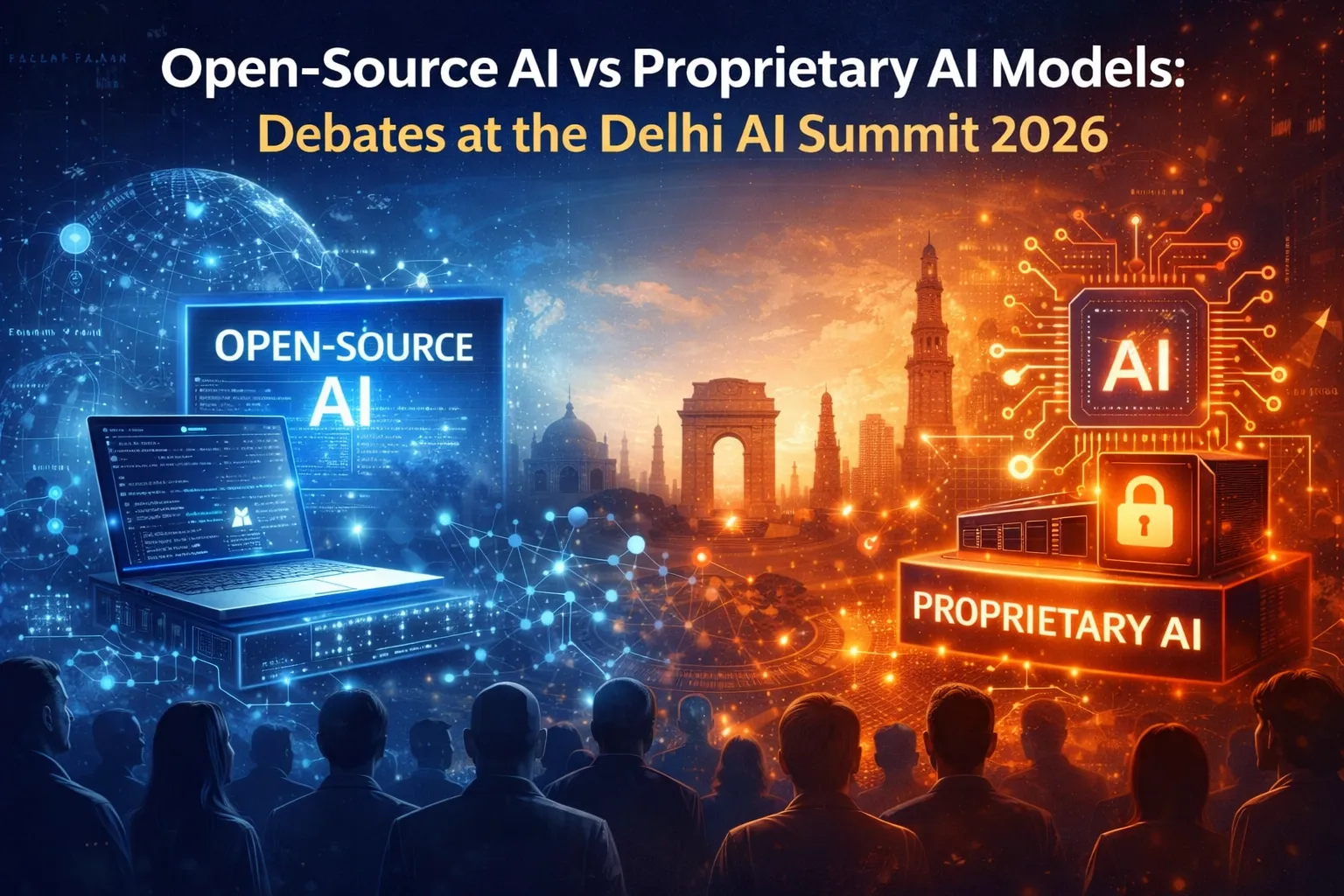
Introduction: A Defining AI Debate in 2026
The Delhi AI Summit 2026 emerged as one of the most influential technology gatherings in Asia, bringing together policymakers, startup founders, global AI researchers, enterprise leaders, and investors. At the heart of the discussions was a powerful and timely debate: Open-Source AI vs Proprietary AI Models. As artificial intelligence becomes the backbone of digital transformation across industries, the question of accessibility, control, innovation, and regulation has never been more critical. The summit highlighted how this debate is not merely technical; it is economic, ethical, geopolitical, and strategic for nations like India aiming to become global AI leaders.
Understanding Open-Source AI Models
Open-source AI models are systems whose architecture, codebase, and sometimes training methodologies are publicly accessible. Developers worldwide can modify, improve, and deploy these models without restrictive licensing. Proponents at the Delhi AI Summit 2026 emphasized that open-source AI democratizes innovation. It allows startups, academic institutions, and emerging economies to experiment and build solutions without the heavy financial barriers associated with proprietary AI platforms. Open ecosystems accelerate collaboration, transparency, and community-driven improvement, making them particularly attractive for research and public-sector applications.
What Defines Proprietary AI Models?
Proprietary AI models, on the other hand, are owned and controlled by private corporations. Their architecture, training data, and optimization techniques remain confidential intellectual property. These models often require paid access through APIs or enterprise licensing. Supporters at the summit argued that proprietary AI models deliver higher reliability, stronger security controls, enterprise-grade scalability, and structured accountability. Large organizations frequently prefer proprietary AI because of dedicated support, compliance alignment, and predictable performance benchmarks.
Innovation Speed: Collaboration vs Controlled Development
One of the most compelling arguments at the Delhi AI Summit 2026 revolved around innovation velocity. Open-source advocates highlighted how community-driven ecosystems accelerate experimentation. Thousands of contributors can identify bugs, optimize performance, and expand applications faster than centralized teams. However, proprietary AI defenders countered that controlled environments ensure consistent quality, reduce fragmentation, and allow focused investment into high-performance infrastructure. The debate underscored a fundamental difference: distributed innovation versus structured corporate R&D.
Cost Efficiency and Market Accessibility
For emerging startups and academic institutions, cost remains a decisive factor. Open-source AI significantly reduces entry barriers, allowing small teams to build scalable solutions without heavy licensing costs. During the summit, Indian startup founders shared how open-source large language models enabled rapid MVP development and AI-powered SaaS solutions. Conversely, enterprise leaders pointed out that proprietary AI models, while expensive, often reduce hidden operational risks and long-term maintenance costs due to vendor-backed reliability and compliance frameworks.
Data Privacy, Security, and Regulatory Concerns
Another major debate at the Delhi AI Summit 2026 focused on data governance. Open-source AI offers transparency, allowing developers to inspect and modify models, but it also raises concerns about misuse, malicious adaptation, and weak enforcement mechanisms. Proprietary AI systems typically operate under strict internal controls and security audits, which enterprises view as safer for sensitive sectors like banking, healthcare, and defense. Policymakers at the summit emphasized the need for balanced AI regulation frameworks that encourage innovation while preventing misuse and safeguarding citizen data.
Ethical AI and Transparency Challenges
Transparency was a central talking point during panel discussions. Open-source models provide greater visibility into architecture and functionality, potentially enabling stronger ethical oversight. However, critics argued that transparency does not automatically translate to responsible deployment. Proprietary AI firms, while less transparent in architecture, often implement structured ethical review boards, bias mitigation systems, and controlled updates. The summit made it clear that ethical AI governance depends more on accountability mechanisms than on licensing structure alone.
India’s Strategic Position in the Open vs Closed AI Ecosystem
India’s ambition to become a global AI powerhouse played a significant role in the debate. Many speakers highlighted that open-source AI aligns well with India’s startup ecosystem, public digital infrastructure, and academic research base. It empowers innovation beyond metro cities and reduces dependency on foreign AI giants. At the same time, collaboration with proprietary AI companies provides access to cutting-edge computing resources and advanced AI capabilities. The Delhi AI Summit 2026 positioned India as a potential hybrid leader , leveraging open innovation while building strategic proprietary capabilities domestically.
Enterprise Adoption Trends and Industry Perspectives
Corporate leaders at the summit shared insights into AI adoption patterns across sectors such as fintech, healthcare, e-commerce, manufacturing, and governance. Many organizations adopt a hybrid approach: using open-source AI for experimentation and innovation while relying on proprietary AI for mission-critical operations. This blended strategy allows flexibility, cost optimization, and scalability. The discussion reinforced that the debate is not binary but situational, depending on business objectives, compliance needs, and long-term strategic vision.
The Geopolitical Angle: AI Sovereignty and National Security
AI sovereignty was another dominant theme. Countries increasingly view AI infrastructure as a strategic national asset. Open-source ecosystems encourage cross-border collaboration but may also expose vulnerabilities if not regulated properly. Proprietary AI, often controlled by multinational corporations, raises concerns about technological dependency. The Delhi AI Summit 2026 highlighted the need for domestic AI model development to strengthen digital sovereignty while maintaining global collaboration.
The Future Outlook: Convergence Rather Than Conflict
While the debate was intense, a key takeaway from the Delhi AI Summit 2026 was that the future likely lies in convergence rather than conflict. Open-source AI will continue driving democratized innovation, while proprietary AI models will focus on enterprise reliability and high-performance computing advancements. Hybrid ecosystems, responsible regulation, public-private partnerships, and AI talent development will shape the next phase of growth.
Conclusion: A Defining Moment for Global AI Governance
The Open-Source vs Proprietary AI debate at the Delhi AI Summit 2026 was not about declaring a winner. Instead, it marked a pivotal moment in defining how AI should evolve—ethically, economically, and strategically. As artificial intelligence becomes integral to national development, digital economies, and global competitiveness, balanced frameworks that combine openness, accountability, security, and innovation will determine the trajectory of the AI revolution. For India and the global tech community, 2026 may well be remembered as the year when the AI governance conversation matured from competition to collaboration.