
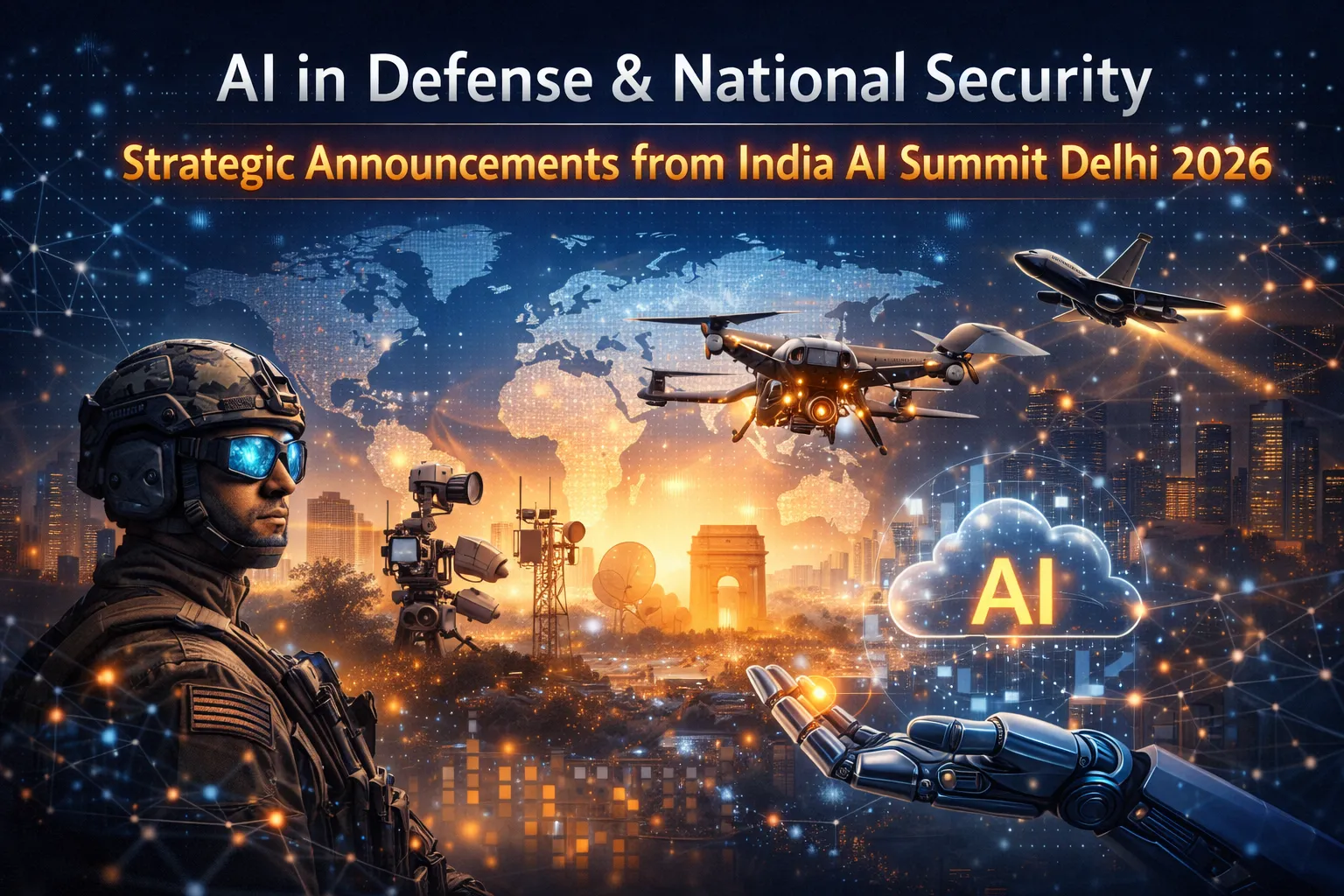
India AI Summit Delhi 2026: Redefining National Security Through Artificial Intelligence
The India AI Summit Delhi 2026 marked a historic turning point in the integration of artificial intelligence into defense and national security frameworks. While the summit focused broadly on AI innovation, one of the most significant tracks centered around AI-driven military modernization, cybersecurity infrastructure, and strategic technology partnerships. With defense officials, global AI leaders, cybersecurity experts, and policymakers present, the summit positioned India as a serious contender in next-generation defense technologies.
Artificial intelligence is no longer viewed merely as a commercial innovation tool , it is now a critical national security asset. The summit’s defense-focused announcements underscored India’s intention to build secure, intelligent, and autonomous defense systems aligned with global technological advancements.
AI-Powered Defense Modernization: Building Smart Military Capabilities
One of the key strategic announcements revolved around AI-powered modernization of India’s armed forces. Discussions highlighted the deployment of AI in surveillance systems, predictive threat analysis, drone intelligence, satellite monitoring, and autonomous logistics support.
Defense experts emphasized how AI-enabled decision-support systems can analyze vast volumes of battlefield data in real time, allowing commanders to respond faster and more accurately. AI-based simulation platforms were also introduced as part of advanced military training programs, enabling data-driven scenario planning and operational readiness.
These advancements indicate a shift from traditional defense systems to intelligent, data-centric warfare preparedness.
Autonomous Systems & Drone Intelligence Expansion
A major focus area at the summit was autonomous defense systems, particularly AI-driven drones and unmanned aerial vehicles (UAVs). Announcements included scaling indigenous drone manufacturing, integrating AI vision systems for reconnaissance, and deploying swarm drone technology for border surveillance.
AI-enabled drones equipped with object detection, terrain mapping, and threat classification capabilities are expected to significantly enhance border security and surveillance operations. Experts highlighted that autonomous platforms reduce human risk while improving operational efficiency in high-risk zones.
The summit reinforced India’s push toward indigenous defense technology under the “Atmanirbhar Bharat” initiative, with AI as a central pillar.
Cybersecurity & AI: Strengthening Digital Defense Infrastructure
Cybersecurity emerged as one of the most critical national security discussions at the summit. With increasing cyber threats targeting government institutions, defense networks, and critical infrastructure, AI-driven cybersecurity frameworks were announced to strengthen India’s digital defense.
Advanced AI systems capable of detecting anomalies, identifying malware patterns, predicting cyberattacks, and automating threat responses were presented as part of a next-generation cybersecurity architecture. These systems aim to safeguard national databases, financial systems, and strategic communication networks.
The summit emphasized that cybersecurity is now inseparable from national security, and AI plays a central role in predictive cyber defense.
AI in Intelligence & Predictive Threat Analysis
Intelligence agencies are increasingly leveraging artificial intelligence for predictive analytics and threat modeling. During the summit, experts discussed the use of AI algorithms to analyze satellite imagery, communication metadata, financial transactions, and geopolitical signals to detect early warning signs of potential threats.
Machine learning models are being developed to forecast border tensions, identify suspicious activity patterns, and enhance counter-terrorism strategies. These AI-driven insights enable proactive defense measures rather than reactive responses.
The integration of AI into intelligence frameworks represents a paradigm shift toward anticipatory security strategies.
Public-Private Partnerships in Defense AI Innovation
The India AI Summit Delhi 2026 also announced stronger collaboration between government defense bodies and private AI companies. Public-private partnerships (PPPs) are being expanded to accelerate AI research, develop indigenous defense technologies, and reduce dependency on foreign suppliers.
Indian startups specializing in robotics, AI analytics, cybersecurity, and defense simulation tools were given opportunities to collaborate with defense agencies. Global technology firms also expressed interest in joint AI research initiatives.
This collaborative ecosystem is expected to fast-track innovation while maintaining national security priorities.
Ethical AI & Defense Governance Frameworks
While military AI advancements offer strategic advantages, ethical concerns were also discussed at length. Policymakers stressed the importance of responsible AI usage in defense operations, ensuring compliance with international humanitarian laws and ethical standards.
Frameworks for accountability, human oversight, and risk management were proposed to regulate autonomous weapons systems and AI-based surveillance tools. The summit made it clear that technological superiority must align with ethical responsibility.
This balanced approach strengthens India’s global credibility as a responsible AI power.
AI-Driven Border Management & Smart Surveillance
Border security modernization was another significant announcement theme. AI-powered surveillance systems integrating facial recognition, thermal imaging, and real-time threat detection are being expanded across sensitive zones.
Smart border management systems equipped with machine learning algorithms can detect unusual movement patterns, unauthorized crossings, and potential infiltration attempts. These technologies enhance situational awareness and minimize human resource strain.
By combining AI with satellite data and IoT-enabled sensors, India is building an integrated national security grid.
Defense Manufacturing & AI Research Investments
The summit also highlighted investments in AI research labs focused on defense applications. Dedicated AI innovation hubs and defense-tech accelerators are being launched to nurture cutting-edge technologies such as quantum-resistant cybersecurity, AI-enabled naval systems, and intelligent missile guidance systems.
Increased funding allocation toward AI research in defense universities and technical institutes was announced, aiming to build a future-ready defense workforce skilled in artificial intelligence and data science.
This investment strategy reflects long-term strategic planning rather than short-term upgrades.
Global Strategic Positioning Through Defense AI
India’s defense AI initiatives place it among emerging global powers investing heavily in intelligent warfare systems. By integrating AI into military operations, cybersecurity, and intelligence networks, India is strengthening its geopolitical positioning.
The summit also opened doors for international collaboration in AI defense research, cybersecurity protocols, and data-sharing frameworks. Strategic technology alliances are expected to play a critical role in maintaining regional stability.
Conclusion: AI as the Backbone of Future National Security
The India AI Summit Delhi 2026 clearly established artificial intelligence as a cornerstone of modern defense strategy. From autonomous drones and predictive cybersecurity systems to AI-powered intelligence analytics and ethical governance frameworks, the summit showcased a comprehensive vision for AI-enabled national security.
As geopolitical complexities increase, the integration of AI into defense operations is no longer optional — it is essential. India’s strategic announcements signal a long-term commitment to building secure, resilient, and technologically advanced defense systems.
Artificial intelligence is not just transforming industries; it is reshaping the future of national security.