
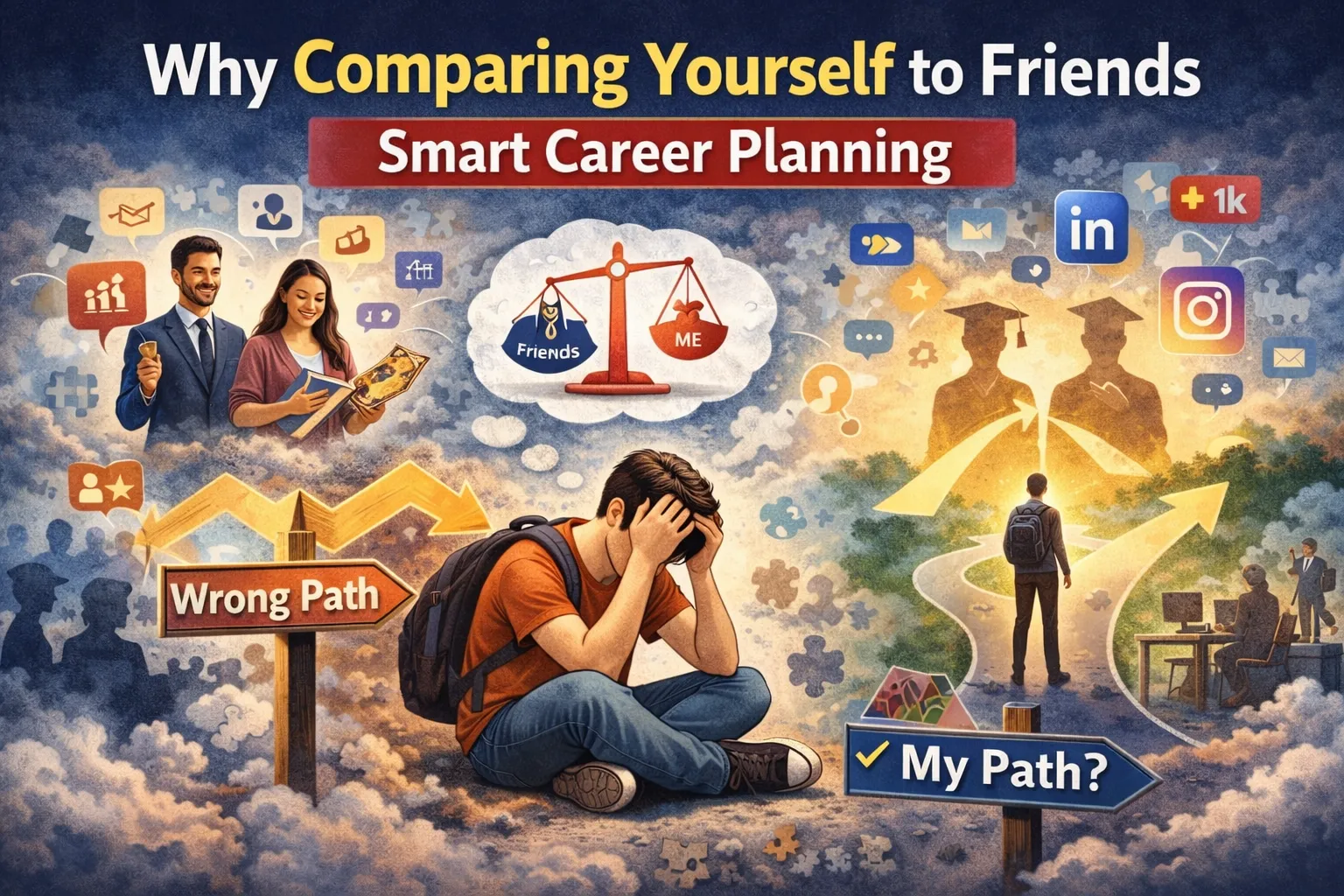
In today’s hyper-connected world, it has become almost impossible for students and young professionals to avoid comparing their career progress with friends. Whether it is exam scores, college admissions, internships, or salary packages, social comparison has quietly become a daily habit. While a little healthy competition can be motivating, constant comparison can seriously damage long-term career planning. It creates confusion, weakens confidence, and often pushes individuals toward career choices that do not truly suit them. Understanding why comparison is harmful is the first step toward making smarter, more personalized career decisions.
The Psychology Behind Social Comparison
Human beings are naturally wired to compare themselves with others. Psychologists call this the “social comparison theory,” where individuals evaluate their own success based on how others around them are performing. Among students, this tendency becomes stronger because peers usually belong to the same age group, educational background, and social environment. When a friend lands a prestigious college seat or a high-paying job, it can trigger self-doubt and anxiety. Instead of focusing on personal strengths and interests, many students start measuring their worth using someone else’s journey, which is rarely an accurate benchmark for success.
How Comparison Distorts Career Clarity
One of the biggest dangers of comparing with friends is the loss of career clarity. Career planning requires deep self-understanding — your skills, interests, values, personality, and long-term goals. However, when comparison takes over, students often begin to chase whatever path seems popular among their peer group. For example, if several friends choose engineering, medicine, or data science, others may feel pressured to follow the same route, even if their natural strengths lie elsewhere. Over time, this misalignment creates dissatisfaction, burnout, and sometimes complete career shifts later in life.
The Confidence Trap: Feeling “Behind” Too Early
Comparison creates an artificial timeline in the mind. Many students start believing they are “late” in life simply because a friend achieved something earlier. This is dangerous because career growth is rarely linear. Some people discover their strengths early, while others find their true direction later through exploration and experience. Feeling behind too early can lead to panic decisions such as choosing the wrong degree, accepting unsuitable job roles, or constantly switching paths. Confidence drops, motivation weakens, and the joy of learning disappears under unnecessary pressure.
Social Media: The Comparison Multiplier
Social media has dramatically amplified the comparison problem. Platforms like Instagram and LinkedIn often showcase highlight reels — job offers, foreign admissions, startup launches, and promotions. What students rarely see are the struggles, failures, and uncertainties behind those achievements. This curated visibility creates unrealistic expectations and fuels career anxiety. When students repeatedly consume such content, they may wrongly assume that everyone else is progressing faster, which increases stress and impulsive decision-making. Career planning done under emotional pressure is rarely strategic or sustainable.
The Risk of Following the Crowd
Another major issue with friend-based comparison is herd mentality. When too many students move toward the same “trending” careers, market saturation often follows. Fields that appear highly lucrative today may become overcrowded tomorrow. Students who choose careers purely because their friends did may find themselves competing in oversupplied job markets without genuine interest or passion to sustain long-term growth. Smart career planning requires forward thinking and individuality, not blind imitation of peer choices.
Impact on Mental Health and Motivation
Constant comparison does not just affect career decisions; it also harms mental well-being. Students who frequently compare themselves with high-performing peers often experience anxiety, low self-esteem, and chronic self-doubt. Over time, this emotional burden can reduce focus, productivity, and willingness to take healthy risks. Instead of exploring opportunities with curiosity, students begin operating from fear: fear of missing out, fear of falling behind, and fear of disappointing others. This mindset blocks creativity and prevents authentic career exploration.
Why Every Career Journey Is Unique
No two career paths are identical, even if two people start from the same classroom. Individual differences in learning speed, financial background, family support, risk tolerance, networking access, and personal interests all shape career outcomes. Some students thrive in structured corporate environments, while others excel in creative or entrepreneurial roles. Comparing outcomes without considering these variables is misleading and often unfair to oneself. Recognizing the uniqueness of your journey is essential for building a fulfilling and sustainable career.
Practical Ways to Stop Unhealthy Comparison
Breaking the comparison habit requires conscious effort. First, students should shift focus from external validation to internal growth. Setting personal benchmarks, such as skill improvement, project completion, or knowledge depth, is far more productive than tracking peer achievements. Second, limiting excessive social media exposure can significantly reduce comparison triggers. Third, maintaining a career journal to track personal progress helps reinforce self-awareness. Finally, seeking guidance from mentors, career counselors, or industry professionals provides clearer direction than relying on peer movement alone.
Building a Self-Driven Career Plan
A strong career plan begins with self-discovery. Students should invest time in identifying their core strengths, interests, personality traits, and long-term lifestyle goals. Tools like aptitude assessments, internships, skill-based projects, and informational interviews can provide valuable clarity. Instead of asking, “What are my friends doing?” the better question is, “Where can I perform at my best and grow sustainably?” When career decisions are rooted in self-awareness, confidence naturally increases, and comparison loses its power.
When Healthy Comparison Can Actually Help
It is important to note that not all comparison is harmful. When used wisely, observing peers can provide useful market awareness and motivation. The key difference lies in intention. Healthy comparison inspires learning and skill development, while unhealthy comparison creates pressure and self-doubt. Students should aim to learn from others’ strategies without blindly copying their paths. Inspiration should fuel growth, not replace personal decision-making.
Final Thoughts: Focus on Direction, Not Competition
Career planning is a long-term journey, not a short race against friends. Those who build careers based on self-awareness, skill development, and strategic thinking tend to experience greater satisfaction and stability over time. Comparison may offer temporary motivation, but long-term success comes from clarity, consistency, and confidence in your own path. Instead of worrying about who is ahead, focus on moving in the right direction. The goal is not to have the fastest start; it is to build a career that truly fits who you are and where you want to go.