
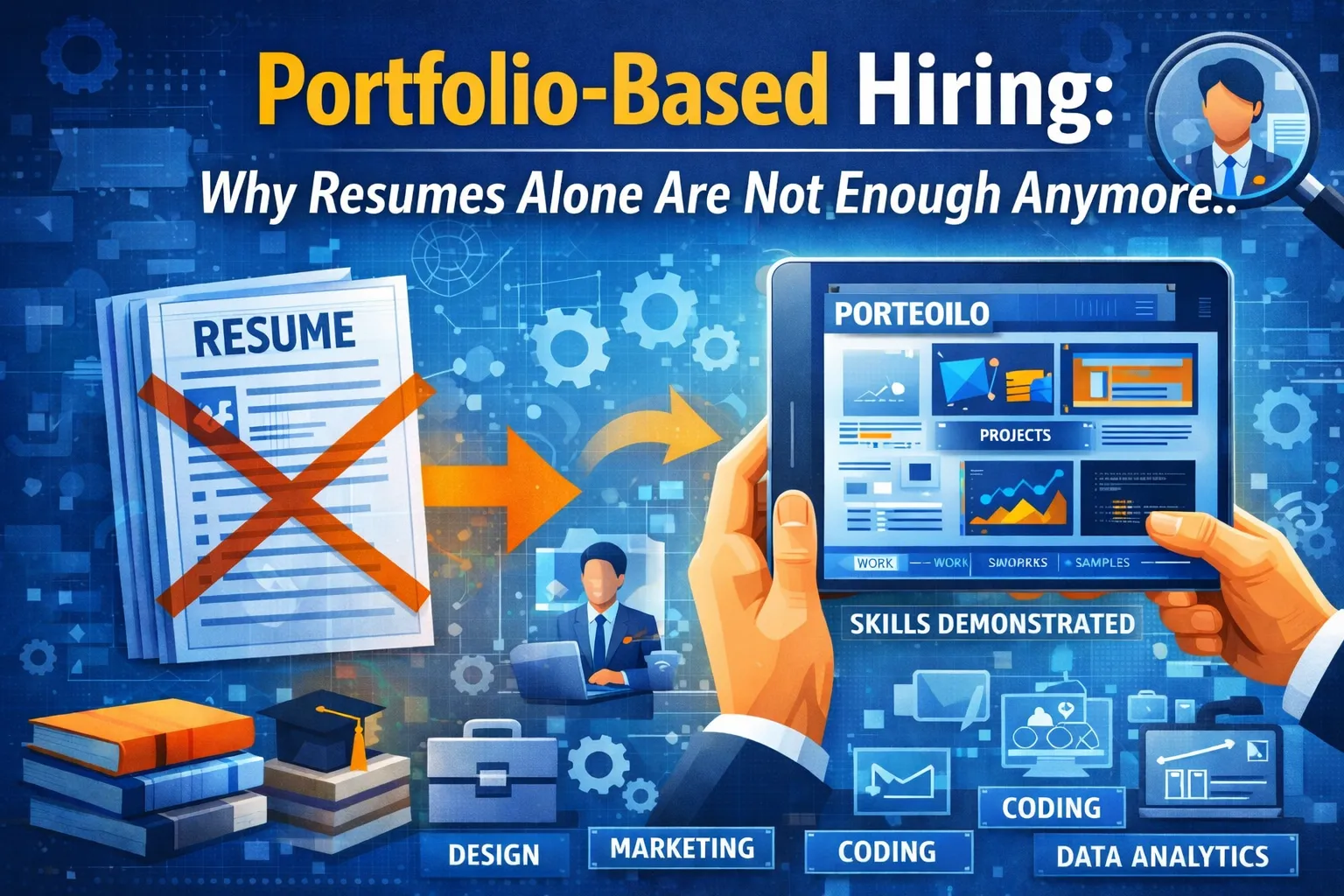
The Shift from Traditional Resumes to Skills-First Hiring
For decades, resumes have been the foundation of recruitment. They summarize education, experience, and achievements in a structured format, offering hiring managers a quick overview of a candidate’s background. However, the modern job market has evolved rapidly. With the rise of digital roles, remote work, freelance economies, and project-based assignments, employers are increasingly realizing that resumes alone cannot accurately measure real-world capabilities. Portfolio-based hiring has emerged as a powerful alternative, focusing on demonstrated skills rather than claimed qualifications.
Unlike resumes, which often rely on bullet points and self-reported achievements, portfolios provide tangible proof of work. Whether it’s a digital marketing campaign, a website design, a coding project, a content strategy, or a business analysis report, portfolios allow candidates to showcase real outcomes. This shift represents a broader transformation in recruitment: from credential-focused evaluation to performance-driven assessment.
Why Resumes Are Losing Their Effectiveness in Modern Recruitment
Resumes were designed for a different era, an era where career paths were linear, industries were stable, and job roles were clearly defined. Today, career journeys are more dynamic. Professionals frequently upskill, switch industries, work remotely, and manage multiple freelance projects simultaneously. In such a scenario, a one- or two-page resume often fails to capture depth, creativity, and adaptability.
Additionally, resumes are highly standardized, making it difficult for hiring managers to differentiate between candidates with similar qualifications. Many applicants use similar action verbs and job descriptions, leading to repetitive applications that lack originality. Automated Applicant Tracking Systems (ATS) further filter resumes based on keywords, sometimes eliminating highly skilled candidates who may not have optimized their documents for algorithms.
Portfolio-based hiring addresses these limitations by offering a comprehensive and authentic representation of a candidate’s expertise. Instead of simply reading about achievements, recruiters can directly assess problem-solving skills, creativity, analytical thinking, and execution quality.
What Is Portfolio-Based Hiring and How Does It Work?
Portfolio-based hiring is a recruitment approach that evaluates candidates primarily through their work samples, case studies, projects, and measurable outcomes rather than relying solely on resumes. A professional portfolio can be hosted on a personal website, LinkedIn profile, GitHub repository, Behance account, Google Drive folder, or even presented as a structured PDF document.
In this model, employers review actual projects to understand how candidates approach challenges, execute strategies, and deliver results. For example, a digital marketer might present campaign analytics demonstrating lead generation growth. A web developer may showcase live websites with performance metrics. A graphic designer can share branding projects with before-and-after transformations. This approach offers transparency and reduces guesswork in hiring decisions.
Portfolio-based hiring is especially valuable in creative, technical, and digital industries where output quality matters more than job titles. It enables employers to assess competence in real-world contexts rather than relying on theoretical claims.
The Rise of the Skills Economy and Outcome-Oriented Recruitment
The global workforce is increasingly driven by a skills economy. Organizations prioritize competencies, adaptability, and measurable impact over traditional credentials. As industries evolve with artificial intelligence, automation, and digital transformation, employers require professionals who can demonstrate up-to-date expertise.
Portfolio-based hiring aligns perfectly with this trend. It shifts focus from “Where did you work?” to “What can you do?” This outcome-oriented mindset encourages continuous learning and practical application. Candidates are motivated to build projects, complete certifications, experiment with tools, and showcase results publicly.
This shift also supports diversity and inclusion in hiring. Candidates without prestigious degrees or corporate experience can compete fairly by presenting strong portfolios. It democratizes opportunity and rewards talent based on merit rather than background.
Benefits of Portfolio-Based Hiring for Employers
Employers benefit significantly from adopting portfolio-based hiring strategies. First, it improves hiring accuracy. Reviewing real work samples provides a clearer understanding of a candidate’s strengths and weaknesses. This reduces the risk of hiring mismatches and decreases employee turnover.
Second, it saves time in the long run. While reviewing portfolios may initially require more attention, it prevents costly mistakes that result from resume-only evaluations. Employers can quickly identify candidates who truly understand industry tools, trends, and challenges.
Third, portfolios encourage data-driven decision-making. Hiring managers can compare measurable outcomes such as conversion rates, revenue growth, engagement metrics, design quality, or code efficiency. This allows for objective evaluation instead of relying solely on interviews or self-reported claims.
Advantages of Portfolio-Based Hiring for Job Seekers
For candidates, portfolios serve as powerful personal branding tools. In competitive job markets, especially in fields like digital marketing, data analytics, content creation, UI/UX design, and software development, portfolios differentiate professionals from the crowd.
A well-structured portfolio demonstrates initiative, creativity, and commitment to growth. It reflects not only technical skills but also communication ability, presentation quality, and strategic thinking. Instead of hoping that recruiters interpret resume bullet points correctly, candidates can directly show their value.
Moreover, portfolios remain relevant beyond job applications. They can attract freelance clients, collaboration opportunities, speaking engagements, and networking connections. In essence, a portfolio becomes a dynamic digital asset that grows alongside a professional’s career.
Industries Where Portfolio-Based Hiring Is Becoming Standard
Portfolio-based hiring is already widely adopted in creative and tech-driven sectors. Graphic design, content marketing, video production, web development, UI/UX design, data science, and digital advertising are leading examples. In these industries, visual proof and performance metrics speak louder than job titles.
However, the trend is expanding into other domains such as project management, business consulting, education, and even human resources. Case studies, strategic plans, presentations, and measurable outcomes can serve as portfolio components in almost any field.
As remote hiring continues to grow globally, portfolios play an even more critical role. Employers hiring across geographies rely on demonstrable work rather than local references or traditional networking channels.
How Companies Can Implement Portfolio-Based Hiring Effectively
Organizations looking to adopt portfolio-based hiring should begin by redefining job descriptions. Instead of focusing solely on years of experience or specific degrees, they should clearly outline expected outcomes and deliverables. Encouraging candidates to submit relevant work samples alongside their resumes can significantly improve candidate evaluation.
Companies can also incorporate practical assessments and project-based interviews. Short assignments, simulations, or case study discussions help validate portfolio claims. Additionally, structured evaluation criteria ensure fairness and consistency in reviewing portfolios.
It is essential for recruiters and hiring managers to receive training on assessing portfolios effectively. Understanding quality benchmarks, industry standards, and measurable metrics ensures informed decision-making.
Challenges and Limitations of Portfolio-Based Hiring
Despite its advantages, portfolio-based hiring is not without challenges. Reviewing detailed portfolios requires time and expertise. Smaller organizations with limited HR resources may find it difficult to evaluate multiple comprehensive submissions.
There is also a risk of unequal access to opportunities. Candidates with prior project exposure may have stronger portfolios compared to fresh graduates. To address this, companies can offer skill-based assessments or trial projects to ensure fair evaluation.
Furthermore, some industries still rely heavily on certifications and compliance standards. In such cases, portfolios should complement rather than replace traditional credentials.
The Future of Recruitment: A Hybrid Model of Hiring
The future of recruitment is likely to be a hybrid model that combines resumes, portfolios, and skills assessments. Resumes may still serve as introductory documents, but portfolios will increasingly become decisive factors in hiring decisions.
As the professional landscape becomes more digital and performance-driven, employers will prioritize real-world impact over theoretical qualifications. Portfolio-based hiring reflects a broader cultural shift toward transparency, accountability, and continuous learning.
In conclusion, resumes alone are no longer sufficient in modern recruitment. Portfolio-based hiring empowers employers to make informed decisions and enables candidates to demonstrate authentic value. In a world where skills evolve rapidly and competition is intense, showing your work is far more powerful than simply listing it.