
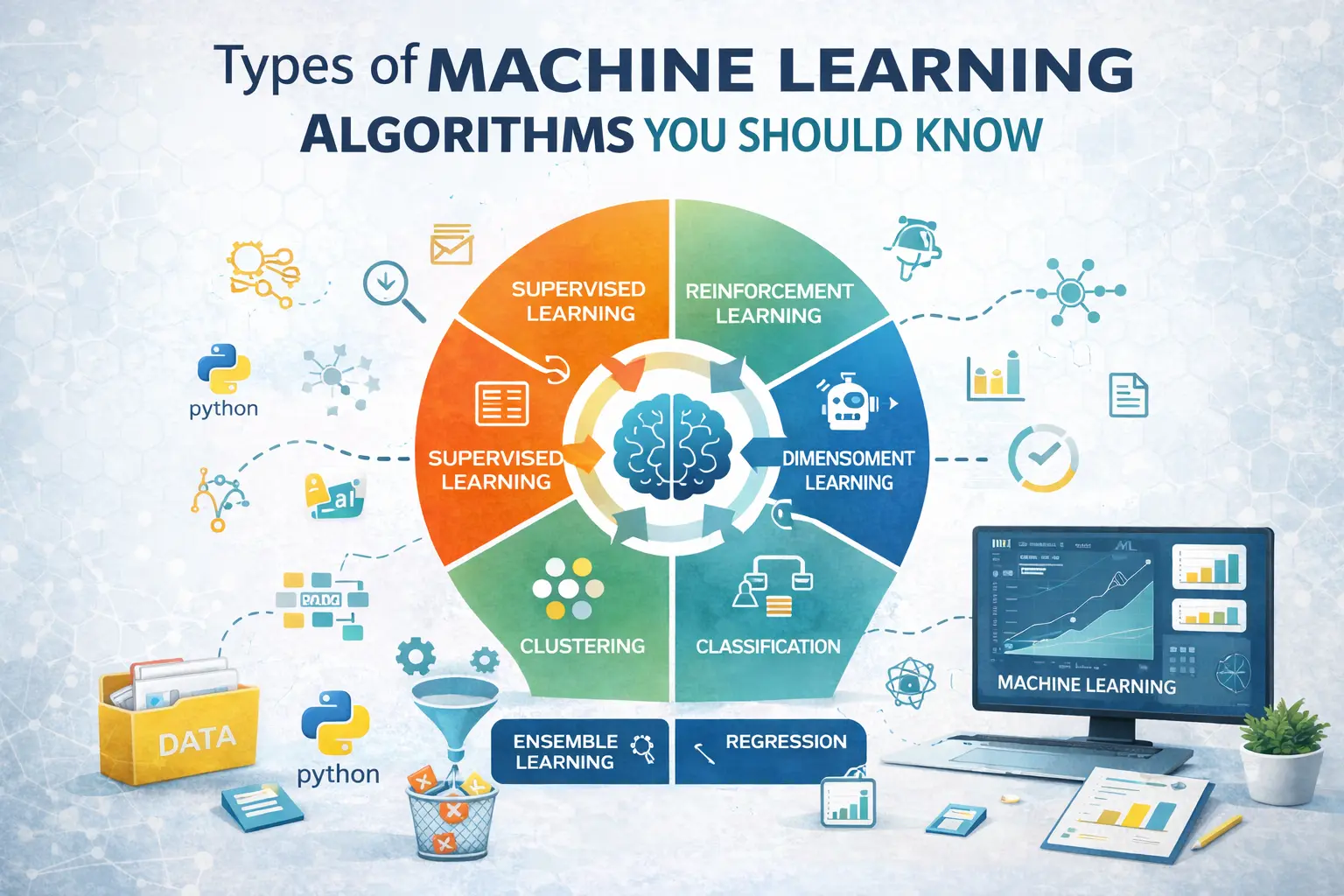
Introduction to Machine Learning Algorithms
Machine learning algorithms are the backbone of modern predictive systems, enabling computers to learn patterns from data and make decisions without explicit programming. These algorithms are widely used in Data Science and machine learning to solve complex problems such as prediction, classification, and recommendation systems.
What Are Machine Learning Algorithms?
Machine learning algorithms are sets of rules and statistical techniques that allow systems to improve performance based on experience. They analyze data, identify patterns, and make predictions. In AI and data analytics, these algorithms help businesses automate processes and gain deeper insights from their data.
Supervised Learning Algorithms
Supervised learning is one of the most commonly used types of machine learning algorithms. It involves training a model on labeled data, where the output is already known. Popular algorithms include linear regression, decision trees, and support vector machines. In Data Science and Python, supervised learning is widely used for tasks like sales prediction and customer classification.
Unsupervised Learning Algorithms
Unsupervised learning works with unlabeled data and focuses on identifying hidden patterns or groupings. Algorithms like clustering and association rules fall under this category. In AI and data analytics, unsupervised learning is useful for customer segmentation and market basket analysis.
Semi-Supervised Learning Algorithms
Semi-supervised learning is a combination of supervised and unsupervised learning. It uses a small amount of labeled data along with a large amount of unlabeled data. This approach is helpful when labeling data is expensive or time-consuming. In machine learning and Data Science, it improves model performance while reducing the need for extensive labeled datasets.
Reinforcement Learning Algorithms
Reinforcement learning focuses on training models through rewards and penalties. The algorithm learns by interacting with an environment and improving its actions over time. In AI and machine learning, this approach is commonly used in robotics, gaming, and autonomous systems.
Classification Algorithms
Classification algorithms are used to categorize data into predefined classes. Examples include logistic regression, k-nearest neighbors, and naive Bayes. In Data Science and data analytics, these algorithms are widely used for spam detection, fraud detection, and sentiment analysis.
Regression Algorithms
Regression algorithms are used to predict continuous values such as prices or sales. Linear regression and polynomial regression are common examples. In Python and machine learning, regression models are essential for forecasting and trend analysis.
Clustering Algorithms
Clustering algorithms group similar data points together without predefined labels. K-means and hierarchical clustering are popular techniques. In AI and data analytics, clustering helps in identifying patterns and segmenting customers based on behavior.
Dimensionality Reduction Algorithms
Dimensionality reduction techniques reduce the number of input variables while preserving important information. Methods like PCA help simplify datasets. In Data Science and Power BI, these techniques improve visualization and reduce computational complexity.
Ensemble Learning Algorithms
Ensemble learning combines multiple algorithms to improve performance and accuracy. Techniques like random forest and boosting are widely used. In machine learning and Data Science, ensemble methods help create robust models with better predictive power.
Conclusion on Machine Learning Algorithms
Understanding different types of machine learning algorithms is essential for building effective data-driven solutions. Each algorithm serves a specific purpose depending on the problem and data type. In fields like Data Science, Power BI, and AI, selecting the right algorithm can significantly impact performance and results.