
Introduction to Python Libraries for Data Science
Python libraries play a vital role in simplifying complex data tasks and accelerating development. These libraries provide pre-built functions and tools that make it easier to handle data, build models, and visualize insights. In fields like Data Science and Python, libraries are essential for improving productivity and delivering efficient solutions.
Why Python Libraries Are Important
Python libraries reduce the need to write code from scratch, saving both time and effort. They allow developers to focus more on solving problems rather than coding basic functionalities. In AI and machine learning, libraries provide advanced capabilities that help build intelligent systems quickly and effectively.
NumPy for Numerical Computing
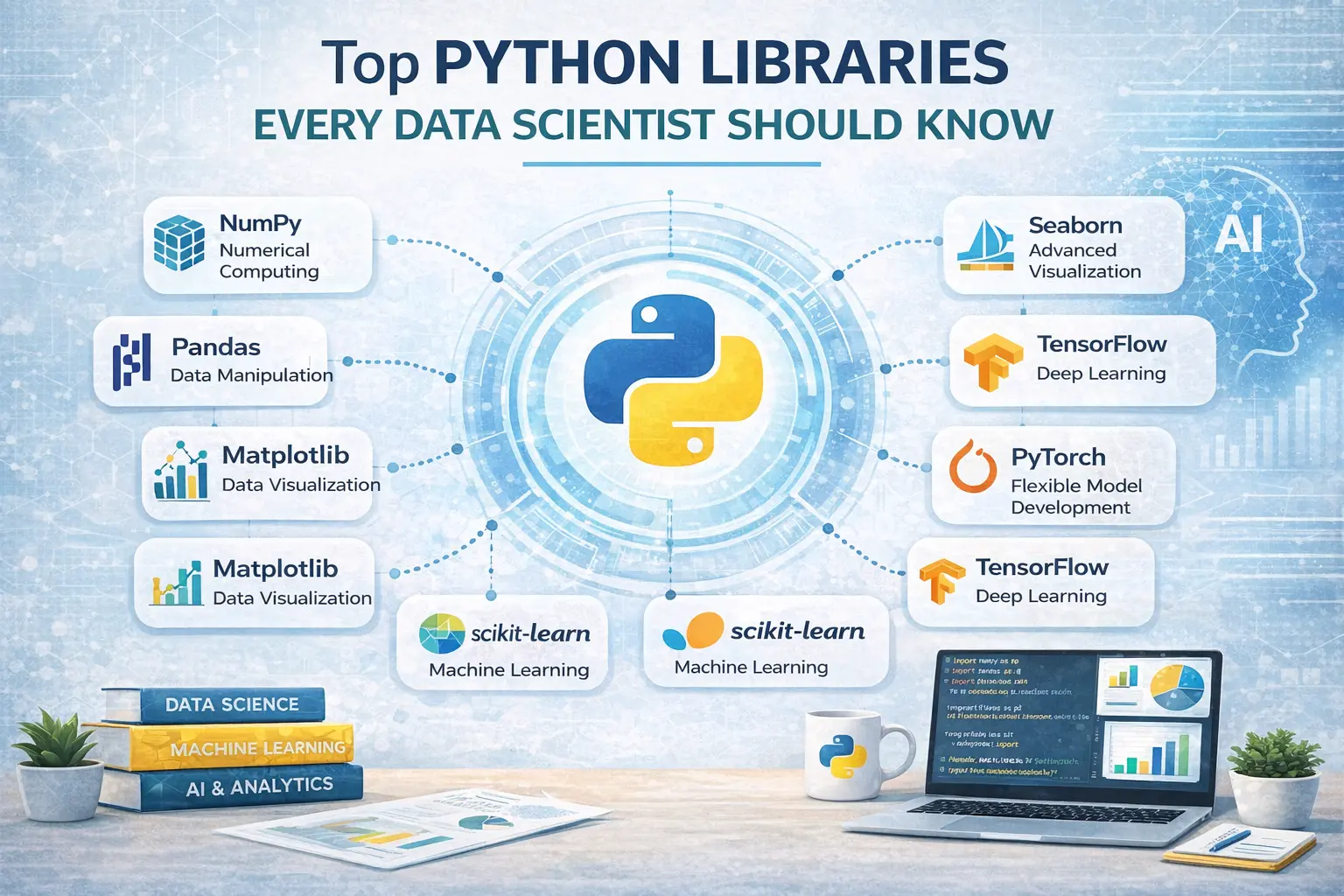
NumPy is one of the most fundamental libraries used for numerical operations. It provides support for arrays, matrices, and mathematical functions. In Data Science and data analytics, NumPy is widely used for handling large datasets and performing high-speed computations.
Pandas for Data Manipulation
Pandas is a powerful library used for data manipulation and analysis. It offers data structures like DataFrames that make it easy to clean, transform, and analyze data. In Python and Data Science, Pandas is essential for preparing datasets before applying machine learning models.
Matplotlib for Data Visualization
Matplotlib is a popular library for creating static and interactive visualizations. It helps in plotting graphs, charts, and histograms. In data analytics and Power BI environments, visualization tools like Matplotlib make it easier to understand trends and communicate insights.
Seaborn for Advanced Visualization
Seaborn builds on top of Matplotlib and provides more advanced and visually appealing charts. It simplifies complex visualizations with fewer lines of code. In Data Science and AI, Seaborn is commonly used for statistical analysis and data exploration.
Scikit-learn for Machine Learning
Scikit-learn is a widely used library for implementing machine learning algorithms. It provides tools for classification, regression, clustering, and model evaluation. In machine learning and Python, Scikit-learn helps developers build and test models efficiently.
TensorFlow for Deep Learning
TensorFlow is an open-source library developed for deep learning applications. It is used to build neural networks and handle large-scale machine learning tasks. In AI and Data Science, TensorFlow is widely adopted for creating advanced AI models.
PyTorch for Flexible Model Development
PyTorch is another popular deep learning library known for its flexibility and ease of use. It is especially preferred for research and experimentation. In machine learning and AI, PyTorch allows developers to build dynamic models and test new ideas quickly.
Integration with Business Intelligence Tools
Python libraries can also integrate with business intelligence platforms to enhance reporting and analysis. They help prepare and process data before visualization. In Power BI and data analytics, these integrations enable better decision-making through accurate insights.
Conclusion on Python Libraries for Data Science
Python libraries are essential tools that empower data scientists to work efficiently and effectively. They simplify complex processes, improve performance, and enable advanced analytics. In fields like Data Science, AI, and machine learning, mastering these libraries is crucial for building strong and scalable data solutions.