
Introduction to NumPy and Pandas
NumPy and Pandas are two of the most widely used libraries in the world of data processing and analysis. Both play a critical role in handling data efficiently, but they serve different purposes. In fields like Data Science and Python, understanding the difference between these two libraries is essential for working with data effectively.
What is NumPy?
NumPy is a powerful library designed for numerical computing. It provides support for multi-dimensional arrays and mathematical operations that are fast and efficient. In machine learning and Data Science, NumPy is often used for performing complex calculations and handling large datasets with speed.
What is Pandas?
Pandas is a library built on top of NumPy that focuses on data manipulation and analysis. It introduces data structures like DataFrames and Series, which make it easy to work with structured data. In data analytics and Python, Pandas is widely used for cleaning, transforming, and analyzing datasets.
Key Differences Between NumPy and Pandas
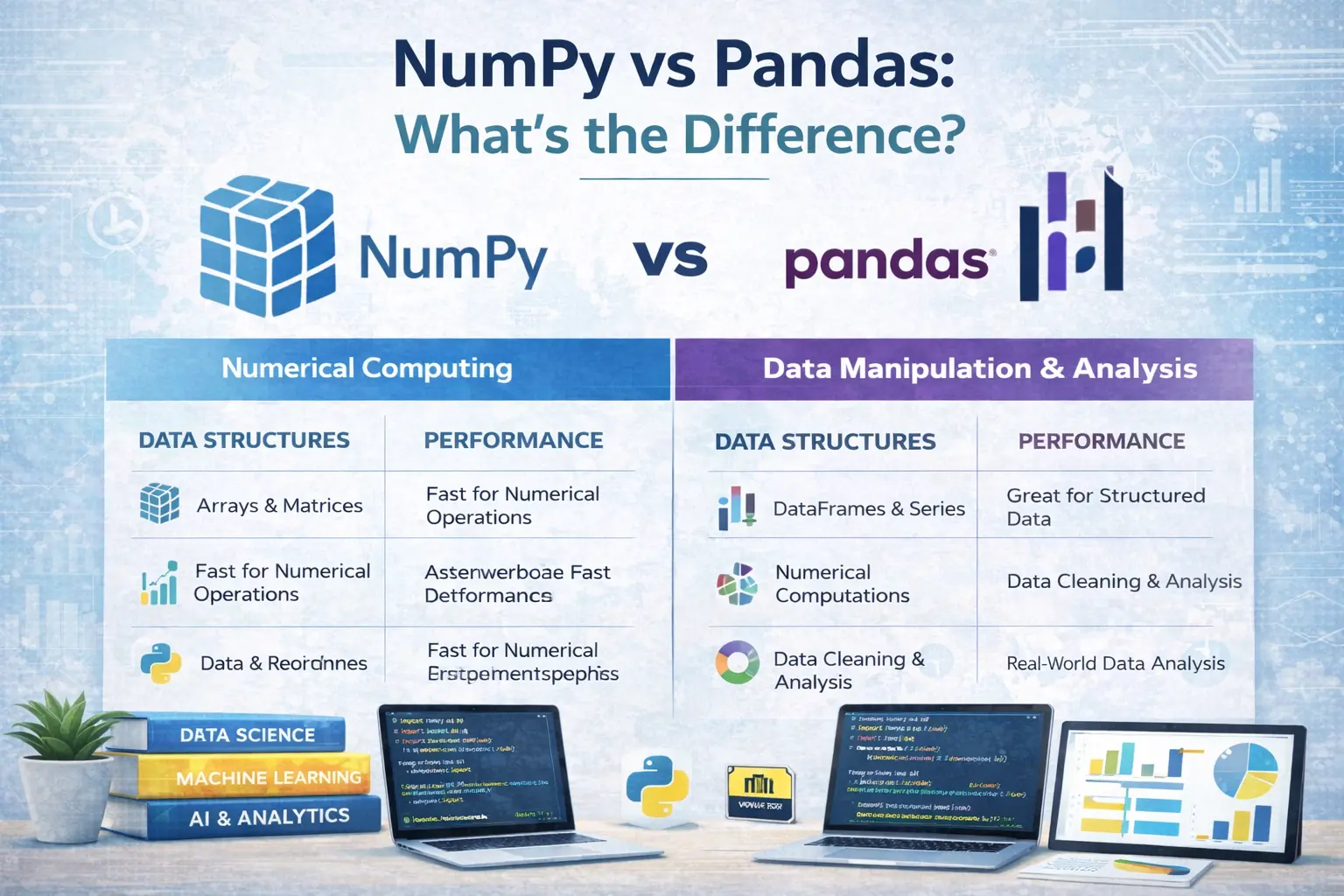
The main difference between NumPy and Pandas lies in their functionality. NumPy is primarily used for numerical operations, while Pandas is designed for handling structured data. In Data Science and AI, NumPy deals with arrays and mathematical functions, whereas Pandas provides tools for data cleaning and exploration.
Data Structures in NumPy vs Pandas
NumPy uses arrays as its primary data structure, which are efficient for numerical computations. On the other hand, Pandas uses DataFrames and Series that are more flexible and user-friendly. In Python and data analytics, these structures make Pandas more suitable for real-world data analysis tasks.
Performance Comparison
NumPy is generally faster than Pandas when it comes to pure numerical computations because of its optimized array operations. However, Pandas provides more convenience when working with labeled and structured data. In machine learning and Data Science, both libraries are often used together to balance performance and usability.
Use Cases of NumPy
NumPy is ideal for tasks that involve heavy mathematical computations, such as linear algebra, matrix operations, and numerical simulations. In AI and machine learning, it is widely used for building algorithms that require fast calculations.
Use Cases of Pandas
Pandas is best suited for data cleaning, transformation, and analysis. It helps in handling missing data, filtering rows, and merging datasets. In data analytics and Power BI, Pandas is commonly used to prepare data before visualization and reporting.
When to Use NumPy vs Pandas
Choosing between NumPy and Pandas depends on the type of task. If the focus is on numerical operations, NumPy is the better choice. If the goal is to analyze and manipulate structured data, Pandas is more suitable. In Data Science and Python, both libraries complement each other and are often used together in workflows.
Conclusion on NumPy vs Pandas
NumPy and Pandas are essential tools for anyone working with data. While NumPy excels in numerical computations, Pandas provides powerful data manipulation capabilities. In fields like Data Science, Power BI, and AI, mastering both libraries is crucial for efficient and effective data analysis.