
Introduction to Model Evaluation in Data Science
Model evaluation is a crucial step in Data Science that helps measure how well a machine learning model performs. Without proper evaluation metrics, it becomes difficult to understand whether a model is reliable or not. In real-world data analytics projects, metrics like accuracy, precision, recall, and F1 score are widely used to assess model performance and make improvements using Python-based tools.
What is Accuracy in Machine Learning?
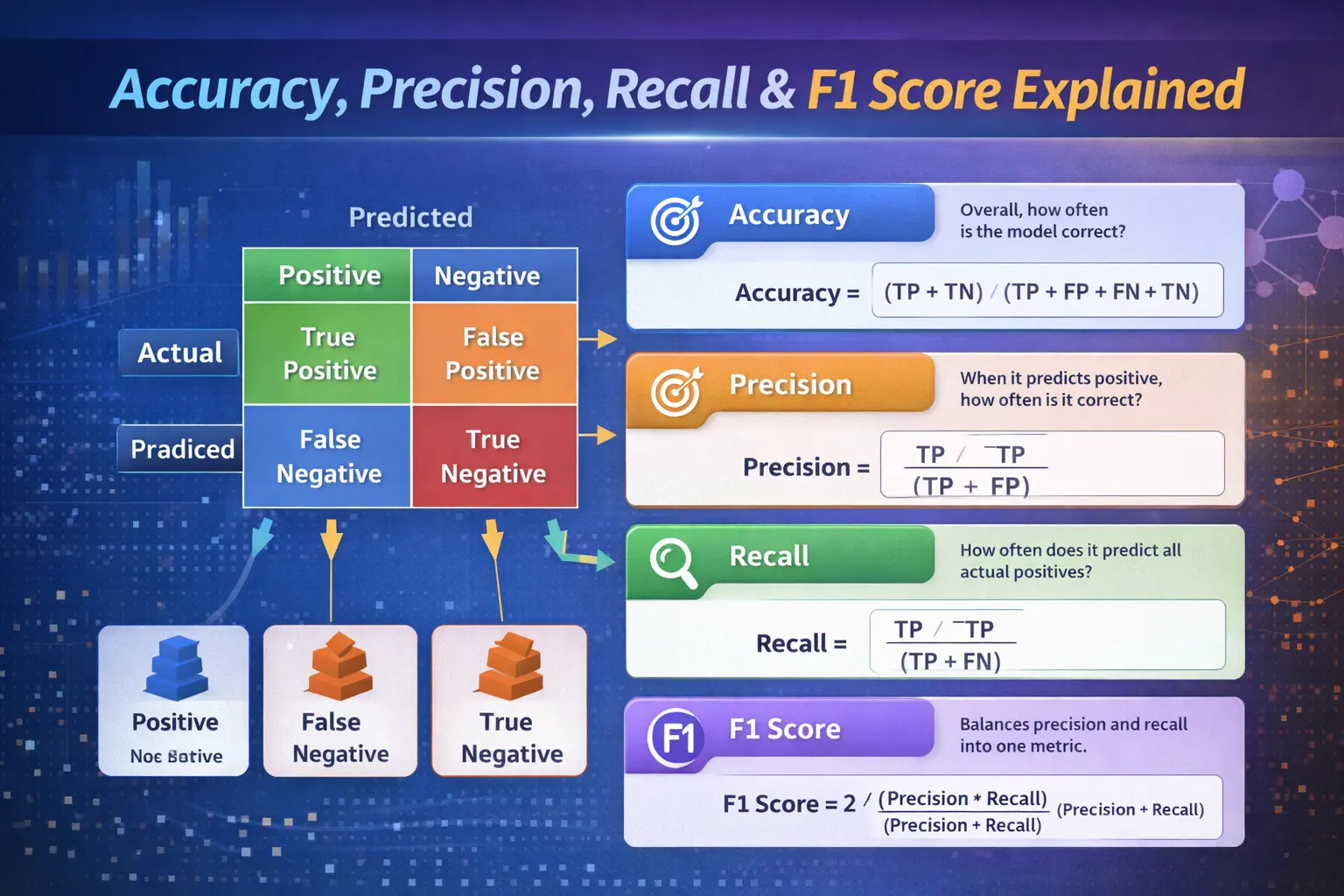
Accuracy is the most basic evaluation metric that measures the percentage of correct predictions made by a model. In machine learning, it is calculated by dividing the number of correct predictions by the total number of predictions. While accuracy is useful, it may not always give a complete picture, especially in imbalanced datasets often seen in AI applications.
Understanding Precision in Data Analytics
Precision measures how many of the predicted positive cases are actually correct. In data analytics, it is important when false positives need to be minimized. For example, in spam detection systems, precision ensures that important emails are not mistakenly marked as spam. Using Python libraries, precision can be calculated easily and is widely used in machine learning evaluations.
Understanding Recall in AI Models
Recall measures how many actual positive cases are correctly identified by the model. In AI systems, recall becomes important when missing a positive case is costly, such as in medical diagnoses or fraud detection. In Data Science, balancing recall with other metrics ensures better model performance in real-world scenarios.
What is F1 Score and Why is it Important?
F1 Score is the harmonic mean of precision and recall, providing a balance between the two metrics. In machine learning, it is especially useful when dealing with imbalanced datasets where accuracy alone is not sufficient. In data analytics, the F1 score helps evaluate models more effectively by considering both false positives and false negatives.
Difference Between Accuracy, Precision, Recall, and F1 Score
Each metric serves a different purpose. Accuracy gives an overall correctness, precision focuses on positive prediction accuracy, recall emphasizes capturing all positive cases, and the F1 score balances both precision and recall. In Data Science, understanding these differences is essential for selecting the right evaluation metric in machine learning tasks.
When to Use Each Metric
The choice of metric depends on the problem you are solving. Accuracy is suitable for balanced datasets, while precision is important when false positives are costly. Recall is useful when missing true cases is risky, and the F1 score is ideal when both precision and recall matter equally. In AI and data analytics projects, professionals often use a combination of these metrics for better insights.
Real-World Applications of Evaluation Metrics
These metrics are widely used in various industries such as healthcare, finance, and e-commerce. In Data Science, they help evaluate recommendation systems, fraud detection models, and customer segmentation. Tools like Power BI allow users to visualize these metrics effectively, making it easier to interpret results and improve machine learning models.
Conclusion: Importance of Evaluation Metrics in Model Performance
Accuracy, precision, recall, and F1 score are essential metrics in Data Science and AI for evaluating model performance. Each metric provides unique insights, helping professionals build reliable and efficient machine learning models. By using tools like Python and Power BI, analysts can effectively measure and improve their data analytics solutions.