
Introduction
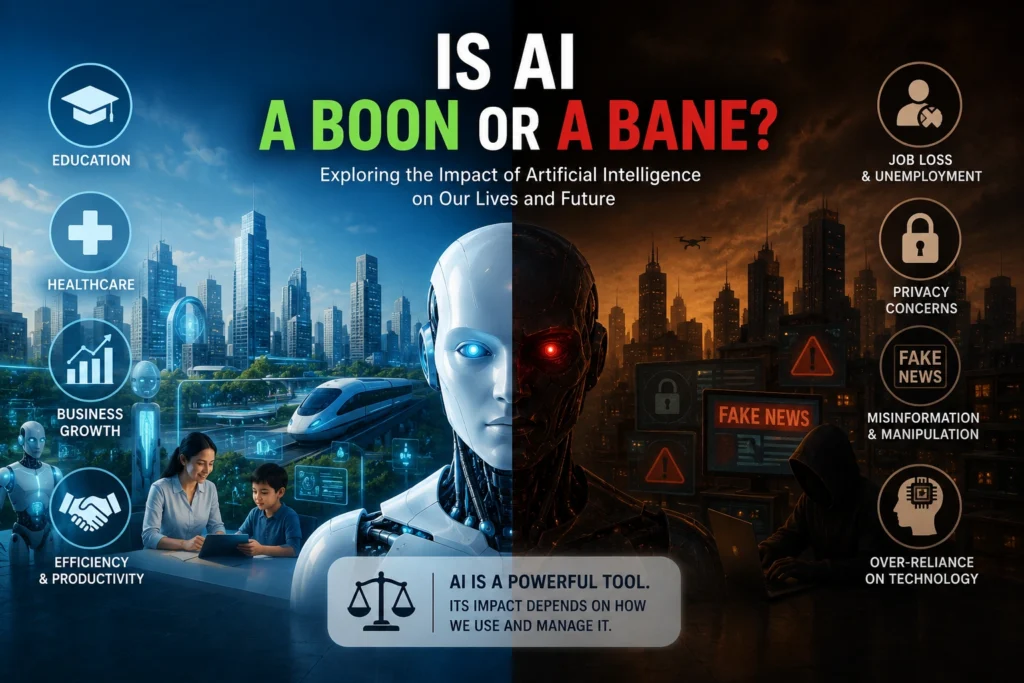
“Is AI a Boon or a Bane?” is one of the most discussed questions in today’s digital world. Artificial Intelligence, commonly known as AI, is rapidly changing the way people live, work, study, and communicate. From smartphones and chatbots to self-driving cars and smart healthcare systems, AI has become an important part of modern life. Some people believe AI is a blessing because it saves time, improves productivity, and creates new opportunities. Others think it may become dangerous because it can reduce jobs, affect privacy, and increase dependency on technology. The truth is that AI has both positive and negative sides, and its impact depends on how humans use it. This blog explains the advantages, disadvantages, challenges, and future possibilities of AI in simple and beginner-friendly language.
What Is Artificial Intelligence?
Artificial Intelligence is a technology that allows machines and computer systems to perform tasks that normally require human intelligence. These tasks include learning, problem-solving, decision-making, understanding language, and recognizing images or speech. AI is used in many daily activities, even when people do not realize it. Voice assistants, online recommendations, navigation apps, and social media algorithms are all examples of AI in action. Over the years, AI has developed quickly because of advanced computing power, large amounts of data, and improved programming methods. Today, many students and professionals are learning skills like Python, Machine Learning, and Data Science to build careers in this growing industry.
AI as a Boon in Education
AI has transformed the education sector in many positive ways. Students can now access smart learning platforms, AI tutors, and personalized study tools that help them learn at their own pace. Teachers can save time by using AI tools for grading, attendance, and lesson planning. Online learning has become easier and more interactive because AI can analyze student performance and suggest improvements. Many educational platforms also recommend courses such as Artificial Intelligence, Business Analytics, and Digital Marketing to help students prepare for future careers. AI makes education more accessible for people living in remote areas because learning materials are available online anytime and anywhere.
AI in Healthcare and Medical Science
One of the biggest advantages of AI can be seen in healthcare. AI helps doctors diagnose diseases faster and more accurately. Hospitals use AI-powered machines to analyze medical reports, detect health conditions, and recommend treatments. During emergencies, AI systems can process large amounts of medical data within seconds. This technology also supports researchers in developing medicines and improving healthcare services. Patients can now use virtual assistants and health apps for basic medical guidance and appointment scheduling. AI has improved efficiency in hospitals and reduced human errors, which can save many lives in the future.
AI and Business Growth
Businesses around the world are using AI to improve customer service, marketing, and productivity. Companies use chatbots to answer customer questions instantly and analyze customer behavior to provide better products and services. AI helps businesses make faster and smarter decisions by studying market trends and data patterns. Professionals with knowledge of Data Science, Machine Learning, and Business Analytics are in high demand because organizations need experts who can work with AI technologies. AI also helps small businesses automate repetitive tasks, allowing owners to focus on growth and innovation. This has increased business efficiency and created many new career opportunities.
The Role of AI in Everyday Life
AI has become deeply connected with everyday life. People use AI while shopping online, watching videos, using maps, or browsing social media. Streaming platforms recommend movies based on user interests, while online stores suggest products according to previous searches. AI-powered translation tools help people communicate across different languages. Smart home devices can control lights, fans, and security systems automatically. AI has made daily tasks more convenient and time-saving. Many people now depend on AI without even realizing how much it influences their decisions and habits.
The Negative Side of AI
Despite its benefits, AI also has several disadvantages. One major concern is job replacement. Machines and automated systems can perform repetitive tasks faster than humans, which may reduce employment opportunities in certain industries. Workers who lack digital skills may struggle to adapt to changing job markets. Another issue is privacy and data security. AI systems collect large amounts of personal information, and misuse of this data can create serious risks. Some experts also worry that over-dependence on AI could reduce human creativity, thinking ability, and social interaction.
Important Concerns About AI
- AI can reduce some traditional jobs through automation
- Data privacy and cybersecurity risks are increasing
- Overuse of AI may create dependency on technology
- Fake content and misinformation can spread easily using AI tools
- Ethical and legal challenges are becoming more common
These concerns show that AI must be used responsibly and carefully to avoid negative consequences.
AI and the Future of Jobs
AI is changing the job market in both positive and negative ways. While some jobs may disappear, many new careers are also being created. Industries now require professionals who understand AI tools and technologies. Students are increasingly learning Python, AI, Machine Learning, and Digital Marketing because these skills are useful in modern workplaces. Companies prefer candidates who can work with technology and analyze data effectively. The future job market will likely focus more on creativity, communication, and technical skills. People who continue learning and adapting will have better career opportunities in the AI-driven world.
Ethical Challenges of Artificial Intelligence
Ethics is another important topic in the AI debate. AI systems are created by humans, and they can sometimes reflect human bias or unfairness. For example, if AI systems are trained using incomplete or biased data, they may produce incorrect or unfair results. There are also concerns about AI being used for harmful purposes such as cybercrime, surveillance, or spreading false information. Governments and technology companies are working on rules and regulations to ensure AI is used safely and ethically. Responsible AI development is necessary to protect society and maintain trust in technology.
Can AI Replace Humans Completely?
Many people fear that AI may completely replace humans in the future, but experts believe this is unlikely. AI is powerful in performing repetitive and data-based tasks, but it still lacks human emotions, creativity, empathy, and moral judgment. Humans can think critically, understand emotions, and make complex decisions based on values and experiences. AI works best when it supports human efforts rather than replacing them entirely. In many industries, humans and AI can work together to improve productivity and innovation. Therefore, AI should be viewed as a tool that assists people instead of a technology that controls them.
How to Use AI Wisely
The future of AI depends on how responsibly humans use it. Governments, companies, teachers, and individuals all have an important role in ensuring AI benefits society. People should learn digital skills and understand how AI works so they can use it safely and effectively. Educational institutions should teach students about ethical technology use and encourage creativity alongside technical learning. Businesses should focus on transparency and data protection while using AI systems. By balancing innovation with responsibility, society can enjoy the benefits of AI while reducing its risks.
Conclusion
Artificial Intelligence is both a boon and a bane, depending on how it is used. It has improved healthcare, education, business, communication, and daily life in many ways. At the same time, it has created challenges related to jobs, privacy, ethics, and dependency on technology. AI itself is not good or bad; the real impact depends on human decisions and responsibility. If used wisely, AI can help create a smarter, faster, and more advanced future for everyone. However, careless or unethical use of AI can lead to serious problems. Therefore, society must focus on learning, innovation, and responsible technology practices to ensure AI becomes a positive force for humanity.