
Introduction
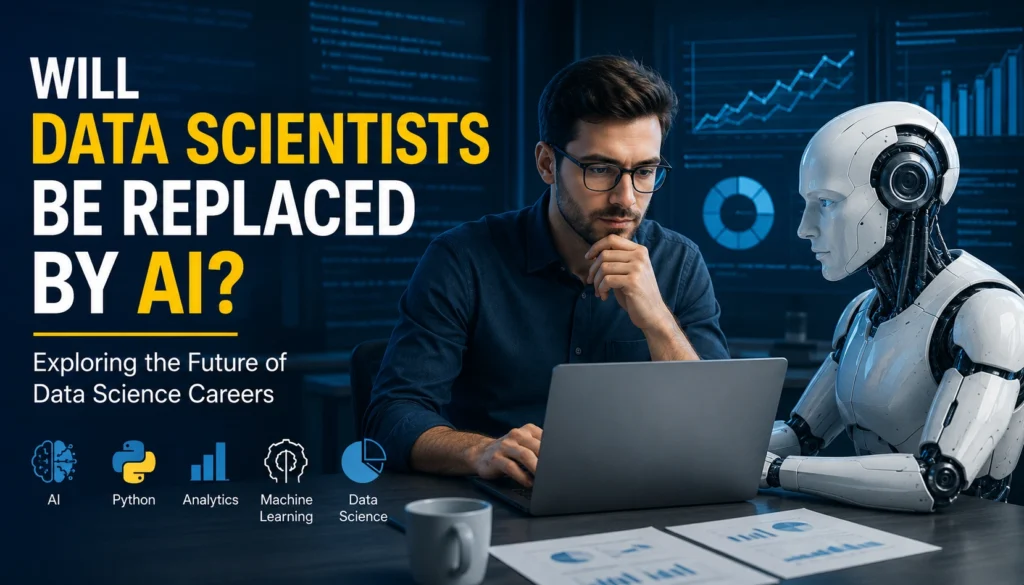
Artificial Intelligence is growing rapidly in 2026, and many people are asking whether AI will replace data scientists in the future. With advanced automation tools, smart analytics platforms, and AI-powered coding assistants becoming more common, the role of data scientists is changing quickly. However, replacing an entire profession is not as simple as automating repetitive tasks. Data scientists do much more than write code or create charts. They solve business problems, analyze human behavior, understand market trends, and make strategic decisions based on data. AI can help speed up many processes, but it still lacks human creativity, critical thinking, communication skills, and business understanding. This blog explains whether data scientists are truly at risk of being replaced by AI and how the future of the industry is evolving.
The Growing Power of AI in Data Science
Artificial Intelligence has become extremely powerful in recent years. Modern AI tools can clean datasets, generate reports, create machine learning models, and even write Python code automatically. Companies now use automated AI platforms to save time and reduce manual work. Tasks that once took hours can now be completed in minutes using intelligent software. This has made many beginners worry about the future of Data Science careers. However, these AI systems still require human supervision, direction, and interpretation to deliver meaningful results.
Why Data Scientists Are Still Important
Data scientists are not only technical experts but also problem solvers. They understand business goals and convert raw data into useful insights. AI tools can analyze numbers, but they cannot fully understand customer emotions, company strategies, or industry-specific challenges. Human experts are still needed to decide which data is useful, which models should be used, and how results should be interpreted. Businesses rely on experienced professionals to make critical decisions, and AI alone cannot replace that level of responsibility.
AI Is More Like an Assistant Than a Replacement
Instead of replacing data scientists, AI is becoming a powerful assistant. AI tools help automate repetitive tasks like data cleaning, visualization, and coding. This allows professionals to focus more on strategy, innovation, and decision-making. Many companies now expect data scientists to work together with AI systems to improve efficiency and productivity. The future workplace will likely combine human intelligence with artificial intelligence rather than choosing one over the other.
The Role of Machine Learning in Modern Careers
Machine Learning is one of the most important parts of modern Data Science. AI can create basic machine learning models automatically, but advanced projects still require human expertise. Professionals need to understand algorithms, model accuracy, ethical concerns, and business outcomes. Companies also need experts who can explain machine learning results to non-technical teams. This communication skill is something AI still struggles to achieve effectively.
Human Creativity Cannot Be Fully Automated
Creativity plays a major role in data science projects. Every business problem is unique and requires customized solutions. Data scientists often experiment with different approaches, ask creative questions, and develop innovative ideas based on business needs. AI systems usually work based on existing patterns and training data. They may struggle when facing new or unusual situations. Human imagination and innovation continue to be valuable skills that technology cannot easily replace.
The Demand for Skilled Professionals Is Increasing
The demand for skilled professionals in Data Science, AI, Python, and Business Analytics continues to grow worldwide. Companies in healthcare, finance, education, marketing, and e-commerce are investing heavily in AI technologies. However, these companies also need trained professionals who can manage AI systems, interpret results, and ensure ethical use of data. This is why learning technical skills remains highly valuable in 2026 and beyond.
Important Point
- AI may automate repetitive tasks, but it cannot fully replace human decision-making, creativity, and business understanding in Data Science.
Why Communication Skills Matter
One major responsibility of data scientists is explaining complex findings in simple language. Business leaders often rely on data professionals to help them understand trends, risks, and opportunities. AI can generate reports, but it cannot build trust, present ideas confidently, or understand emotional and organizational factors in meetings. Strong communication and presentation skills make human professionals irreplaceable in many business environments.
The Rise of AI-Powered Learning and Courses
As technology evolves, learning new skills has become more important than ever. Many students are now enrolling in courses related to Artificial Intelligence, Machine Learning, Python, Digital Marketing, Data Science, and Business Analytics to stay competitive in the job market. These skills help professionals work alongside AI rather than fear it. Continuous learning is becoming the key to career growth in the modern technology industry.
Ethical Challenges Require Human Judgment
AI systems can sometimes produce biased or incorrect results. Data scientists play an important role in checking the fairness, accuracy, and ethical impact of AI models. Human supervision is necessary to avoid problems related to privacy, discrimination, and misinformation. Businesses cannot rely entirely on automated systems when important decisions affect customers, employees, or society. Ethical decision-making is an area where human intelligence remains essential.
The Future of Data Science Careers
The future of data science is not about humans versus AI. Instead, it is about collaboration between technology and professionals. Data scientists who learn modern AI tools and adapt to changing industry trends will continue to have strong career opportunities. Companies will prefer professionals who understand both technical systems and business strategy. The role may evolve over time, but it is unlikely to disappear completely. In fact, AI may create even more opportunities for skilled data professionals in the future.
Conclusion
AI is transforming the world of Data Science, but it is not likely to replace data scientists completely. Instead, AI is changing how professionals work by automating repetitive tasks and improving efficiency. Human skills such as creativity, communication, critical thinking, ethical judgment, and business understanding remain extremely important. The future belongs to professionals who can combine their expertise with modern AI technologies. Students and working professionals who continue learning skills like Data Science, AI, Machine Learning, Python, Digital Marketing, and Business Analytics will have excellent career opportunities in the coming years. Rather than fearing AI, the smarter approach is to learn how to work with it and use it as a tool for innovation and success.