
Introduction
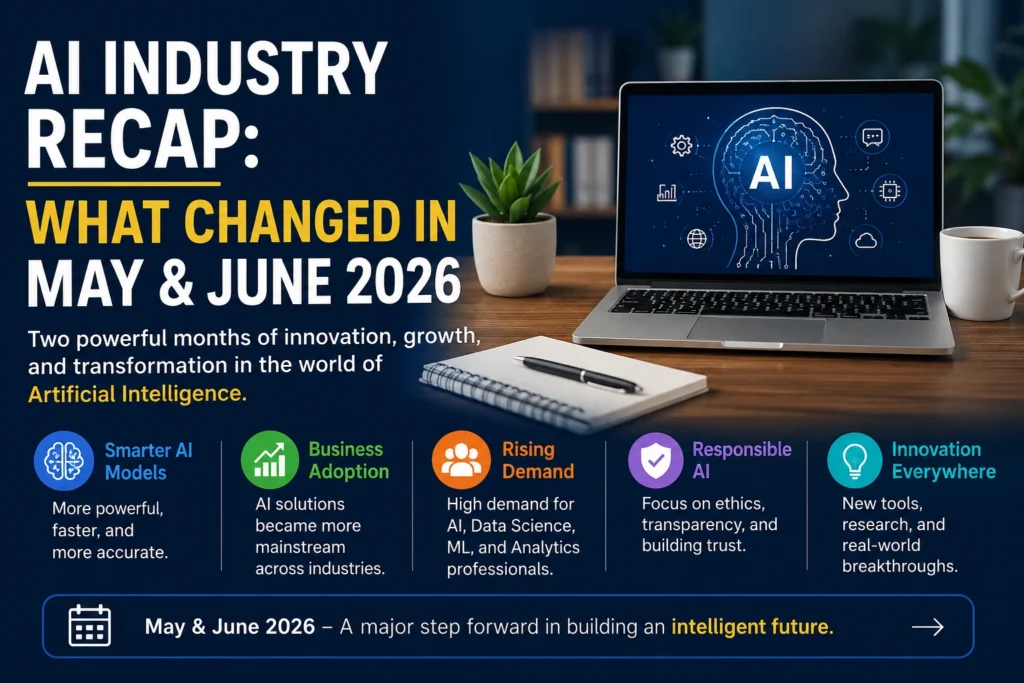
The AI industry continued its rapid evolution during May and June 2026, bringing notable changes that affected businesses, professionals, and technology users worldwide. Artificial intelligence is no longer viewed as a future innovation—it has become a practical tool that helps organizations improve efficiency, enhance customer experiences, and make smarter decisions. Over these two months, several trends emerged that highlighted how deeply AI is becoming embedded in everyday operations. From advanced automation and intelligent business tools to growing demand for AI-related skills, the industry demonstrated that innovation is accelerating faster than ever before.
1. AI Moved Further Into Everyday Business Operations
One of the most noticeable shifts during May and June was the increasing use of AI in routine business activities. Organizations adopted intelligent systems to handle customer support, automate documentation, analyze large datasets, and streamline internal workflows. Rather than using AI for isolated tasks, companies began integrating it across multiple departments to improve overall productivity and operational efficiency.
2. Smarter AI Systems Improved Decision-Making
AI platforms became more capable of providing insights instead of simply processing information. Businesses used these systems to identify opportunities, reduce risks, and understand market behavior. As companies collected more data than ever before, AI became an essential tool for transforming raw information into meaningful recommendations that support strategic planning.
3. Data Science Continued to Shape Modern Enterprises
The importance of Data Science became even more evident during this period. Organizations relied on data professionals to uncover patterns, measure performance, and support long-term business goals. As competition increased across industries, companies that effectively utilized Data Science gained a stronger ability to predict trends and respond to changing customer demands.
4. Machine Learning Adoption Reached New Sectors
Machine Learning expanded beyond traditional technology companies and found applications in industries such as healthcare, manufacturing, retail, and finance. Businesses used machine learning models to improve forecasting, automate repetitive tasks, and deliver personalized services. The growing accessibility of these technologies encouraged more organizations to explore AI-powered solutions.
5. Python Remained the Preferred Choice for AI Development
Python continued to play a central role in artificial intelligence projects. Its user-friendly syntax and extensive ecosystem made it the preferred programming language for developers, analysts, and researchers. Whether building predictive models or processing large datasets, professionals consistently relied on Python to support innovation across AI and Machine Learning initiatives.
6. AI Skills Became Essential for Career Growth
The workforce experienced a noticeable shift as employers increasingly prioritized AI-related skills. Knowledge of AI, Data Science, Machine Learning, and Python became highly desirable across multiple job roles. Professionals recognized that understanding these technologies could provide a significant advantage in an increasingly digital and automated business environment.
7. Business Analytics Became More Predictive
Business Analytics tools have evolved significantly during these months. Instead of focusing solely on historical data, organizations began using AI-powered analytics platforms to forecast future outcomes and identify emerging opportunities. This allowed decision-makers to take proactive actions rather than simply reacting to past performance metrics.
8. Digital Marketing Leveraged AI for Better Engagement
AI continued to reshape Digital Marketing strategies by helping brands understand consumer behavior more effectively. Intelligent tools enabled marketers to create personalized experiences, optimize campaigns, and improve audience targeting. As customer expectations increased, AI-driven marketing became a valuable approach for building stronger relationships and improving conversion rates.
9. Responsible AI Became a Priority
As adoption increased, discussions around responsible AI gained momentum. Businesses focused on developing systems that are transparent, secure, and fair. Concerns regarding privacy, accountability, and ethical implementation encouraged organizations to establish stronger governance practices. These efforts reflected the growing recognition that innovation must be accompanied by responsibility.
10. Industry-Focused AI Solutions Gained Momentum
Rather than relying on generic applications, companies increasingly adopted AI solutions designed for specific industries. Healthcare organizations used AI to support clinical decisions, financial institutions strengthened fraud detection systems, and retailers improved inventory planning. These specialized solutions demonstrated the flexibility of AI in addressing unique operational challenges.
11. Continuous Learning Became More Important Than Ever
The rapid pace of technological change encouraged professionals to invest in continuous learning. Courses related to Data Science, AI, Machine Learning, Python, Digital Marketing, and Business Analytics attracted growing interest from students and working professionals alike. Organizations also supported upskilling initiatives to prepare their workforce for an AI-driven future.
Key Takeaways
- AI became more deeply integrated into business processes and decision-making.
- Demand for skills in Data Science, AI, Machine Learning, Python, Digital Marketing, and Business Analytics continued to rise.
- Organizations focused on balancing innovation with responsible AI practices.
Conclusion
May and June 2026 reinforced the idea that artificial intelligence is transforming the way organizations operate and compete. Businesses increasingly rely on AI to improve efficiency, enhance customer experiences, and unlock new growth opportunities. At the same time, the rising importance of Data Science, Machine Learning, Python, Digital Marketing, and Business Analytics highlighted the need for a skilled workforce capable of navigating this technological shift. As AI continues to evolve, its influence on industries and careers is expected to grow, making adaptability and continuous learning more important than ever.