
Introduction
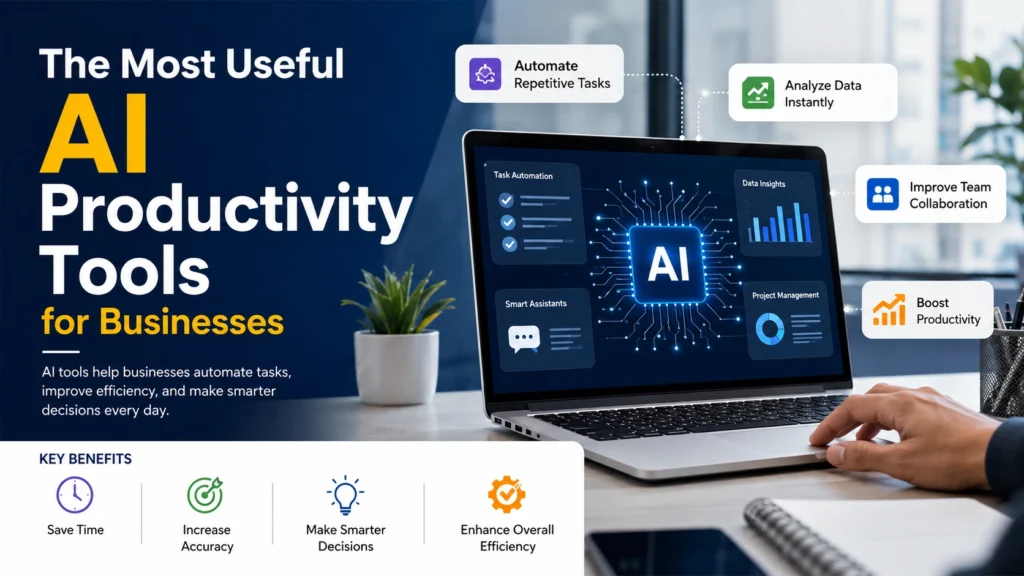
In today’s competitive business landscape, productivity is no longer measured only by how hard teams work but by how efficiently they use technology. Artificial Intelligence (AI) has emerged as a powerful solution that helps organizations streamline operations, improve communication, and make faster decisions. Businesses across industries are adopting AI-powered productivity tools to eliminate repetitive tasks, enhance collaboration, and gain valuable insights from data. These tools are not replacing human creativity; instead, they are helping employees focus on higher-value work that drives innovation and growth. As companies continue their digital transformation journey, AI productivity tools are becoming a key factor in achieving long-term success.
Key Benefits of AI Productivity Tools
- Reduce manual work through intelligent automation.
- Improve efficiency and accuracy in daily operations.
- Support smarter decisions with real-time insights.
1. Why Businesses Are Turning to AI
The growing demand for speed and efficiency has encouraged businesses to explore AI-driven solutions. Traditional workflows often involve time-consuming tasks that slow down productivity. AI tools can process information quickly, identify patterns, and complete routine activities with minimal human intervention. This allows organizations to allocate resources more effectively and improve overall performance without significantly increasing costs.
2. Automating Everyday Business Tasks
One of the most practical applications of AI is automation. Businesses spend countless hours managing emails, scheduling appointments, updating records, and handling administrative responsibilities. AI-powered systems can automate these functions, reducing workload and minimizing errors. Employees can then dedicate more time to strategic initiatives, customer engagement, and creative problem-solving.
3. Transforming Team Collaboration
Modern workplaces depend heavily on collaboration, especially in remote and hybrid work environments. AI productivity tools can organize conversations, summarize meetings, and provide actionable insights from discussions. By making information easier to access and understand, these tools help teams stay aligned on goals and projects. Improved collaboration leads to better decision-making and stronger workplace efficiency.
4. Making Data More Valuable
Data has become one of the most important business assets, but its true value lies in how effectively it is analyzed. AI-powered analytics tools can process large datasets within seconds and convert complex information into meaningful insights. Professionals with expertise in Data Science and Business Analytics often use AI technologies to identify trends, predict outcomes, and support business strategies that drive measurable results.
5. Enhancing Marketing Performance
Marketing teams are increasingly benefiting from AI-powered productivity solutions. These tools can analyze audience behavior, recommend content ideas, and optimize advertising campaigns. Instead of relying solely on manual research, businesses can use AI-generated insights to understand customer preferences and create more relevant marketing strategies. This approach improves engagement while helping organizations maximize their return on investment.
6. Improving Customer Experience
Customer expectations continue to rise, making fast and personalized service essential. AI tools help businesses respond to customer inquiries more efficiently through intelligent chat systems and automated support solutions. These technologies can handle common questions instantly while directing complex issues to human representatives. The result is a smoother customer experience and improved satisfaction levels.
7. AI and Workforce Efficiency
AI productivity tools are changing how employees manage their daily responsibilities. Intelligent assistants can prioritize tasks, organize schedules, and provide reminders for important deadlines. By reducing administrative burdens, AI helps professionals focus on work that requires critical thinking and creativity. Organizations benefit from increased productivity while employees experience a more streamlined workflow.
8. The Growing Impact of Machine Learning
Machine Learning plays a central role in many AI productivity platforms. Unlike traditional software, Machine Learning systems improve over time by learning from data and user interactions. Businesses use these capabilities to forecast trends, optimize operations, and personalize customer experiences. As Machine Learning continues to evolve, its influence on workplace productivity is expected to grow significantly.
9. Python’s Contribution to AI Innovation
Python has become one of the most influential programming languages in the AI ecosystem. Its simplicity and extensive collection of libraries make it a preferred choice for building intelligent applications. Businesses that invest in Python skills can develop custom automation solutions, create advanced analytical tools, and integrate AI into existing workflows. This flexibility makes Python a valuable asset for organizations embracing digital innovation.
10. Building Future-Ready Organizations
The future of business productivity will be closely linked to AI adoption. Companies that invest in AI technologies and employee development will be better prepared to adapt to changing market demands. Skills in AI, Data Science, Machine Learning, Python, Digital Marketing, and Business Analytics are becoming increasingly important as organizations seek to maximize the value of AI-powered tools. Developing expertise in these areas can help businesses remain agile and competitive in a rapidly evolving world.
Conclusion
AI productivity tools are redefining how businesses operate by making processes faster, smarter, and more efficient. From automating routine tasks to improving collaboration and data analysis, these technologies provide practical solutions for modern workplace challenges. Organizations that embrace AI can unlock new levels of productivity while creating opportunities for innovation and growth. As AI continues to advance, businesses that combine technology with skilled professionals will be best positioned to achieve sustainable success in the years ahead.