
Introduction
Artificial Intelligence is transforming industries at an unprecedented pace, creating new opportunities while reshaping traditional job roles. As businesses continue integrating AI-powered solutions into their operations, the employment landscape is undergoing significant changes. Some professionals are benefiting from increased demand for specialized skills, while others are facing challenges as automation takes over repetitive tasks. Understanding who is winning and who is struggling in the AI-driven economy can help professionals prepare for the future and make informed career decisions.
Key Highlights
- AI-related roles are growing rapidly across multiple industries.
- Professionals with technical and analytical skills are seeing higher demand.
- Routine and repetitive job functions are increasingly being automated.
The Rapid Growth of AI-Powered Careers
The adoption of AI technologies has accelerated across sectors such as healthcare, finance, retail, manufacturing, and education. Organizations are investing heavily in automation, predictive analytics, and intelligent systems to improve efficiency and customer experiences. This shift has created a surge in demand for professionals who can build, manage, and optimize AI solutions. As a result, AI-focused careers are among the fastest-growing opportunities in today’s job market.
Data Scientists Continue to Lead the Market
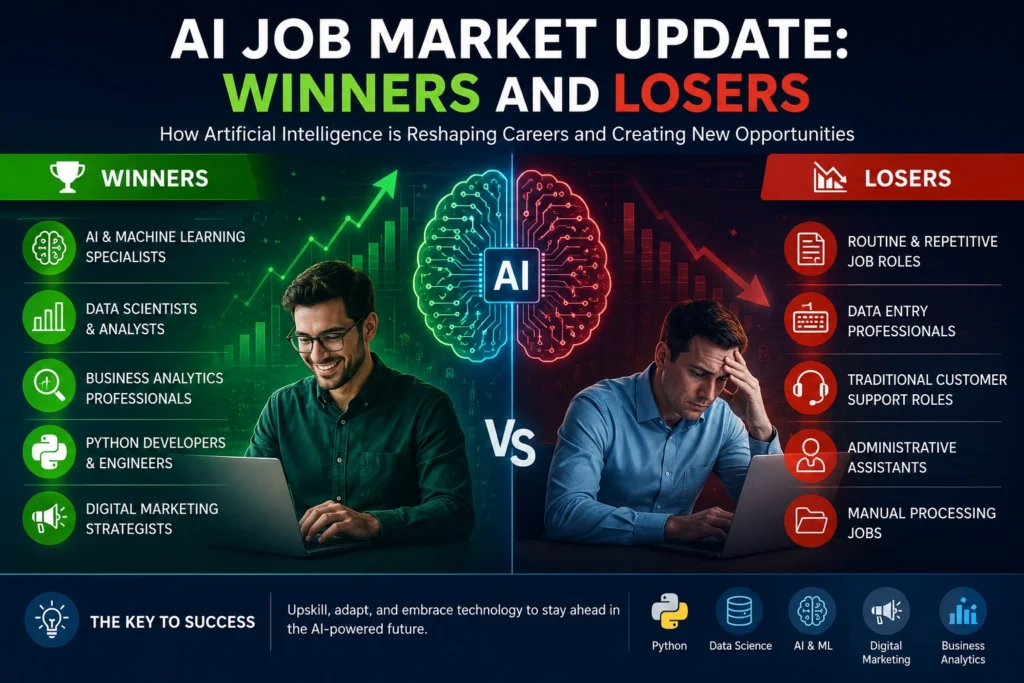
One of the biggest winners in the AI job market is the field of Data Science. Companies rely on data-driven decision-making more than ever before, and skilled data scientists are essential for extracting valuable insights from large datasets. These professionals help organizations understand customer behavior, identify trends, and improve business performance. The growing importance of data has ensured that Data Science remains a highly sought-after career path.
Machine Learning Specialists Are in High Demand
Machine Learning professionals have become critical assets for businesses implementing intelligent technologies. Their expertise helps organizations develop systems that learn from data and improve over time. From recommendation engines and fraud detection systems to predictive maintenance solutions, Machine Learning applications are expanding rapidly. Employers are actively seeking talent capable of designing and deploying these advanced models.
Python Skills Open More Career Opportunities
Programming skills remain a major advantage in the AI era, and Python continues to dominate as one of the most valuable languages. Its simplicity, flexibility, and extensive AI libraries make it the preferred choice for developers, analysts, and researchers. Professionals with Python expertise often find opportunities in software development, automation, data analysis, and AI engineering. As technology adoption grows, Python remains a strong skill for career advancement.
Business Analytics Professionals Benefit from AI Adoption
AI is not only creating opportunities for technical experts but also for professionals in Business Analytics. Organizations need individuals who can interpret AI-generated insights and translate them into strategic decisions. Business analysts play a crucial role in connecting technology with business objectives. Their ability to understand data and communicate actionable recommendations has become increasingly valuable in modern workplaces.
Digital Marketing Experiences a Major Transformation
The marketing industry is also seeing significant changes due to AI-powered tools. Professionals in Digital Marketing are leveraging AI for customer segmentation, content optimization, campaign management, and performance tracking. While automation has simplified many routine marketing tasks, it has also increased the demand for marketers who understand both technology and consumer behavior. Those who adapt to AI-enhanced marketing strategies are emerging as clear winners.
AI Engineers and Solution Architects Gain Influence
As organizations expand their AI initiatives, the need for AI Engineers and Solution Architects continues to rise. These professionals design scalable systems, integrate AI technologies into existing infrastructure, and ensure that solutions align with business goals. Their technical expertise and strategic understanding make them essential contributors to digital transformation projects. Consequently, salaries and career prospects in these roles remain highly attractive.
Administrative and Repetitive Roles Face Challenges
While many professions are benefiting from AI, some job categories are experiencing increased pressure. Administrative positions involving repetitive data entry, scheduling, and document processing are becoming more automated. AI-powered software can perform these functions faster and with fewer errors, reducing the demand for certain routine roles. Workers in these positions may need to develop new skills to remain competitive in the evolving market.
Customer Support Jobs Are Being Reshaped
Customer service is another area undergoing substantial change. AI chatbots and virtual assistants are handling a growing number of routine customer inquiries. Although human representatives remain essential for complex situations, many basic support tasks are now automated. Rather than eliminating all customer service jobs, AI is changing the nature of the work, requiring employees to focus on problem-solving, empathy, and advanced communication skills.
Upskilling Becomes the Key to Career Success
The AI revolution highlights the importance of continuous learning. Professionals who invest in relevant skills are better positioned to take advantage of emerging opportunities. Training in AI, Machine Learning, Data Science, Python, Digital Marketing, and Business Analytics can help individuals stay competitive in a rapidly changing employment landscape. Lifelong learning is no longer optional; it has become a critical component of career growth.
The Future Outlook for the AI Job Market
Looking ahead, the AI job market is expected to continue evolving. New roles will emerge as technologies become more advanced, while existing positions will adapt to changing business needs. Organizations will increasingly seek professionals who can combine technical expertise with creativity, critical thinking, and strategic decision-making. The most successful workers will be those who embrace innovation and remain flexible in their approach to learning and development.
Conclusion
The AI job market presents both opportunities and challenges. Professionals in Data Science, AI, Machine Learning, Python development, Business Analytics, and Digital Marketing are among the biggest beneficiaries of technological advancement. At the same time, roles centered on repetitive and routine tasks face growing automation pressures. The distinction between winners and losers will largely depend on an individual’s willingness to adapt, learn new skills, and embrace the changing demands of the workplace. As AI continues to reshape industries, those who invest in continuous learning will be best prepared for long-term career success.