
Introduction
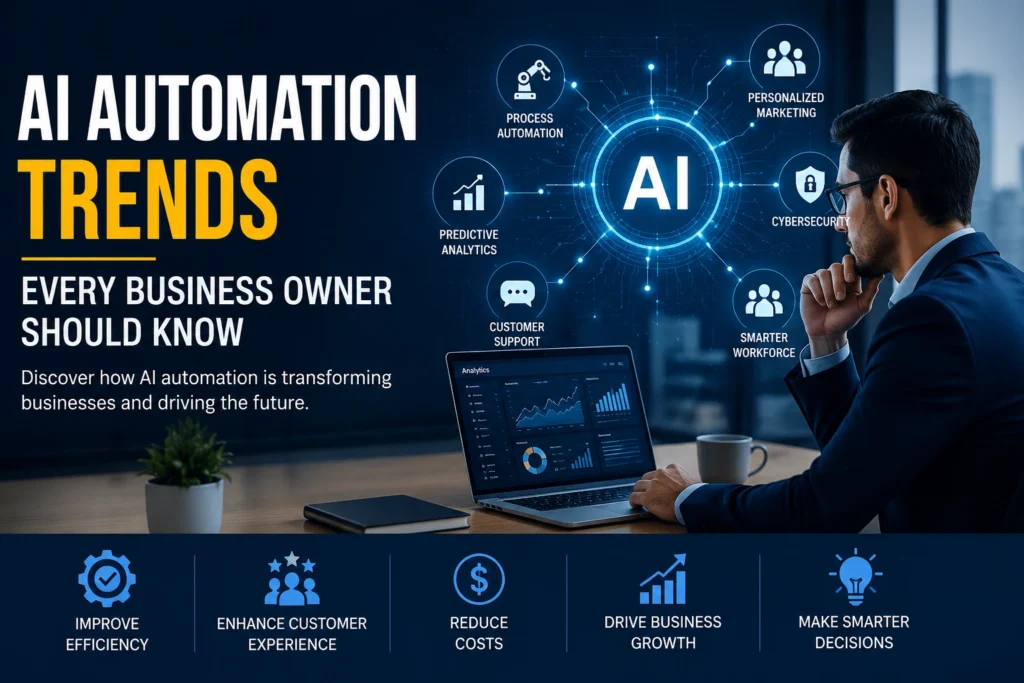
Artificial Intelligence (AI) automation has evolved from being a futuristic concept into a practical business necessity. Companies of every size are using AI-powered solutions to improve productivity, reduce operational costs, enhance customer experiences, and make smarter decisions. Whether it is automating repetitive tasks, analyzing customer behavior, or predicting future market trends, AI is helping businesses stay competitive in an increasingly digital world. Business owners who understand the latest AI automation trends can adapt more quickly to changing customer expectations and build stronger, more efficient organizations. In this blog, we explore the most important AI automation trends every business owner should know and how these innovations are shaping the future of business.
1. Intelligent Process Automation Is Becoming the New Standard
Businesses are replacing manual and repetitive workflows with Intelligent Process Automation (IPA), which combines Artificial Intelligence with robotic process automation. Instead of simply following fixed rules, AI-powered automation systems can learn from data, identify patterns, and make decisions with minimal human intervention. This helps organizations improve efficiency in finance, HR, customer service, and operations while reducing human error. As automation technology becomes more affordable, even small and medium-sized businesses are adopting these solutions to improve daily operations.
2. AI-Powered Customer Support Is Enhancing User Experience
Customer service has become one of the biggest beneficiaries of AI automation. Modern AI chatbots and virtual assistants can answer frequently asked questions, resolve common issues, and provide instant support around the clock. Unlike traditional chat systems, AI-driven assistants continuously improve by learning from customer interactions. This allows businesses to reduce response times while maintaining high levels of customer satisfaction. Human agents can then focus on handling more complex customer concerns that require personal attention.
3. Predictive Analytics Is Improving Business Decisions
One of the greatest strengths of AI automation is its ability to analyze massive amounts of data within seconds. Predictive analytics helps businesses forecast customer demand, identify market trends, and anticipate potential risks before they occur. Companies can make data-driven decisions instead of relying on assumptions. Professionals who develop expertise through courses in Business Analytics, Data Science, and Machine Learning are increasingly helping organizations transform raw business data into meaningful insights that support long-term growth.
4. Personalized Marketing Is Driving Better Results
AI automation is changing the way businesses connect with customers. Instead of delivering the same marketing message to everyone, AI analyzes customer preferences, browsing history, and purchasing behavior to create personalized experiences. Businesses can recommend relevant products, send customized email campaigns, and display targeted advertisements that improve engagement and conversion rates. Marketing professionals with knowledge of Digital Marketing and AI-powered marketing tools are becoming valuable assets as companies continue to invest in personalized customer experiences.
Key Benefits of AI Automation
- Improves productivity by automating repetitive tasks.
- Enhances customer experience through personalized interactions.
- Supports faster and more accurate business decision-making.
5. AI Is Transforming Financial Management
Financial operations are becoming more efficient with AI automation. Businesses now use AI to automate invoice processing, expense management, fraud detection, budgeting, and financial forecasting. AI algorithms can quickly identify unusual financial activities and generate reports that would normally require hours of manual work. This improves financial accuracy while allowing business owners to focus on strategic planning instead of administrative tasks.
6. Supply Chain Automation Is Becoming More Intelligent
Supply chain management has become increasingly complex, making AI automation an essential business tool. AI systems monitor inventory levels, predict product demand, optimize delivery routes, and identify potential supply chain disruptions before they affect operations. These capabilities help businesses reduce inventory costs, improve delivery performance, and maintain customer satisfaction. As global markets become more dynamic, AI-driven supply chain management will continue to play a critical role in operational success.
7. AI Is Creating Smarter Workforces
Rather than replacing employees, AI automation is helping workers become more productive by eliminating repetitive administrative tasks. Employees can spend more time solving problems, creating strategies, and delivering higher-value work. As organizations adopt AI technologies, the demand for professionals skilled in Artificial Intelligence, Python, and Machine Learning continues to grow. Learning these in-demand skills enables individuals to work effectively alongside AI systems and contribute to digital transformation initiatives across industries.
8. Cybersecurity Is Becoming More Proactive with AI
As businesses become more digital, cyber threats are also becoming more sophisticated. AI-powered cybersecurity systems continuously monitor networks, detect suspicious activities, and respond to potential threats in real time. Unlike traditional security tools, AI can identify unusual behavior patterns before a cyberattack causes significant damage. This proactive approach helps businesses protect sensitive customer data, maintain compliance, and reduce financial losses associated with security breaches.
9. AI Automation Is Supporting Better Human Resource Management
Human resource departments are increasingly using AI automation to improve recruitment, employee engagement, and workforce management. AI can screen resumes, schedule interviews, analyze employee performance, and identify training requirements more efficiently than manual processes. These technologies help HR teams hire suitable candidates faster while creating personalized learning opportunities for existing employees. Businesses that combine human expertise with AI-driven HR solutions can build stronger and more productive teams.
10. Continuous AI Learning Is Essential for Future Business Growth
AI technology is evolving rapidly, making continuous learning essential for both business owners and employees. Organizations that invest in developing AI-related skills are more likely to remain competitive in the future. Courses in Data Science, Artificial Intelligence, Python, Business Analytics, Machine Learning, and Digital Marketing help professionals understand emerging technologies and apply AI-driven solutions to real business challenges. Continuous upskilling allows businesses to adapt quickly as AI capabilities continue to expand across industries.
Conclusion
AI automation is no longer an optional technology reserved for large enterprises. It has become a practical business tool that improves efficiency, enhances customer experiences, strengthens decision-making, and supports sustainable growth. From intelligent customer support and predictive analytics to cybersecurity and workforce management, AI is transforming every aspect of modern business operations. Business owners who embrace these emerging trends and invest in AI knowledge will be better prepared to navigate future challenges and seize new opportunities. As AI continues to evolve, organizations that combine advanced technology with skilled professionals will remain ahead of the competition and drive long-term success.