
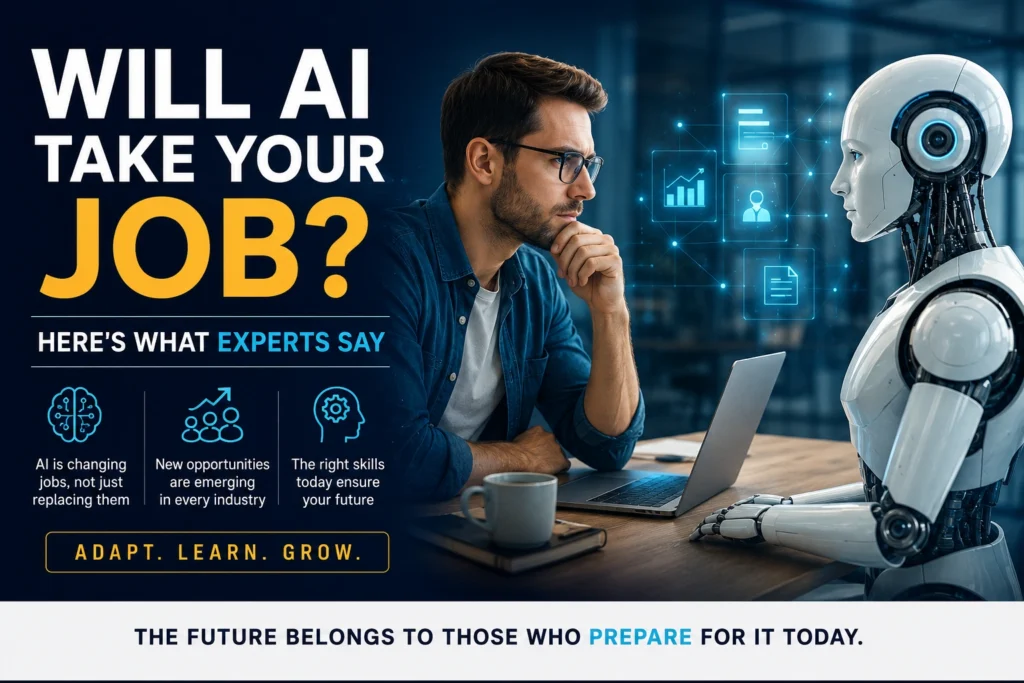
Introduction
Artificial Intelligence (AI) is transforming industries at an unprecedented pace. From automating repetitive tasks to generating content and analyzing massive datasets, AI has become an essential part of modern workplaces. This rapid advancement has also sparked an important question among professionals and students alike: Will AI take your job? While some fear that machines will replace human workers, many experts believe the future is more about collaboration than competition. AI is expected to change the way people work, but it is also creating new career opportunities that require human creativity, decision-making, and technical expertise. Understanding these changes can help individuals prepare for the future rather than fear it.
1. AI Is Changing Jobs, Not Eliminating Them
Experts agree that AI is more likely to transform jobs than completely replace them. Tasks that are repetitive, predictable, and data-driven can be automated, allowing employees to focus on strategic thinking, creativity, and problem-solving. Instead of removing entire professions, AI is reshaping job roles by taking over routine responsibilities. Employees who learn to work alongside AI tools will have a significant advantage in the evolving workplace.
2. Some Industries Will Experience Faster Automation
Certain industries are expected to adopt AI more rapidly than others. Manufacturing, customer support, finance, logistics, and healthcare are already using AI to improve efficiency and reduce operational costs. However, even in these sectors, human expertise remains essential for decision-making, innovation, customer relationships, and ethical oversight. Experts emphasize that AI performs best when combined with skilled professionals rather than replacing them entirely.
3. Human Skills Will Become More Valuable
As AI handles repetitive work, uniquely human skills will become even more important. Communication, emotional intelligence, leadership, creativity, adaptability, and critical thinking cannot easily be replicated by machines. Organizations will increasingly seek professionals who can interpret AI-generated insights, solve complex business problems, and collaborate effectively with both technology and people. Developing these skills will be essential for long-term career growth.
4. Learning AI Skills Can Future-Proof Your Career
One of the best ways to stay relevant is to understand how AI works. Learning subjects such as Artificial Intelligence, Machine Learning, Python, and Data Science can open doors to emerging career opportunities. Even professionals who are not working directly in technology can benefit from understanding AI tools and workflows. Upskilling helps individuals remain competitive while preparing them for new roles that continue to emerge as AI adoption increases.
5. New Career Opportunities Are Emerging
History has shown that technological revolutions create new professions alongside automation. AI is generating demand for AI engineers, machine learning specialists, data analysts, prompt engineers, AI consultants, and automation experts. In addition, businesses need professionals who can manage AI implementation, ensure responsible use, and interpret AI-driven insights. This means that while some traditional tasks may disappear, many exciting career paths are being created.
6. Every Industry Will Need Digital Skills
AI is no longer limited to technology companies. Retail, education, healthcare, banking, media, marketing, and manufacturing are increasingly integrating AI into daily operations. Professionals with knowledge of Business Analytics, Digital Marketing, data interpretation, and automation tools will have a competitive advantage. Combining domain expertise with digital skills makes employees more adaptable and valuable in today’s evolving job market.
Key Takeaways
- AI is transforming job roles rather than replacing every profession.
- Continuous learning and digital skills are becoming essential for career growth.
- Human creativity, critical thinking, and communication remain irreplaceable.
7. Employers Are Prioritizing Continuous Learning
Organizations understand that technology evolves rapidly, which is why continuous learning has become a priority. Companies increasingly encourage employees to upgrade their skills through professional training, certifications, and practical projects. Professionals who regularly improve their knowledge are better equipped to adapt to changing technologies and workplace expectations. Lifelong learning is becoming one of the most valuable career investments.
8. Students Should Prepare for an AI-Driven Future
Students entering the workforce today will likely spend their careers in AI-enabled environments. Building a strong foundation in programming, analytics, problem-solving, and emerging technologies can significantly improve career prospects. Learning Python, Machine Learning, Data Science, or Business Analytics provides practical knowledge that aligns with the growing demand across industries. These skills complement traditional education and increase employability in both technical and non-technical roles.
9. AI Will Create More Collaborative Workplaces
Experts predict that future workplaces will combine human intelligence with artificial intelligence. AI can quickly process information, identify patterns, and automate repetitive processes, while humans contribute innovation, empathy, ethical judgment, and strategic thinking. This partnership allows businesses to improve productivity while maintaining the human touch that customers and organizations continue to value.
10. Adaptability Will Define Career Success
The biggest advantage in the AI era will belong to people who embrace change rather than resist it. Technology will continue evolving, creating both challenges and opportunities. Professionals who remain curious, continuously update their skills, and learn to work with AI tools will be better positioned for career success. Adaptability, combined with technical knowledge and strong interpersonal skills, will become the defining characteristics of future-ready professionals.
Conclusion
So, will AI take your job? According to experts, the answer is more nuanced than a simple yes or no. AI will undoubtedly automate certain tasks and reshape many industries, but it will also create new opportunities that did not exist before. The future belongs to individuals who are willing to learn, adapt, and embrace technology as a partner rather than a threat. Investing time in developing technical skills such as Artificial Intelligence, Machine Learning, Python, Data Science, Business Analytics, and Digital Marketing, while strengthening human skills like creativity and communication, can help professionals stay competitive in an AI-driven world. Instead of fearing AI, the smarter approach is to prepare for the opportunities it will bring.