
Introduction
Artificial Intelligence has become one of the most transformative technologies of the decade, and 2026 marks an important milestone in the competition between leading AI companies. OpenAI, Google, and Anthropic are at the forefront of this race, continuously launching more capable AI models, expanding enterprise solutions, and introducing features that influence businesses, education, healthcare, software development, and creative industries. Their competition is no longer limited to building smarter chatbots—it now includes AI agents, multimodal capabilities, enterprise security, coding assistants, and scientific research. As organizations increasingly adopt AI-driven workflows, understanding the strengths and strategies of these companies has become essential for professionals, students, and business leaders alike.
OpenAI: Leading the Next Generation of AI Innovation
OpenAI continues to maintain a strong position in the AI industry by focusing on highly capable language models, multimodal intelligence, and AI agents that can perform complex real-world tasks. In 2026, OpenAI has expanded its ecosystem beyond conversational AI, offering solutions that assist with coding, content creation, research, automation, education, and business productivity. The company has consistently improved model accuracy, reasoning capabilities, and safety measures while making AI more accessible for individuals and enterprises. OpenAI’s strategy revolves around creating intelligent assistants that can understand text, images, audio, and other forms of information within a unified experience.
Google: Combining AI with a Powerful Technology Ecosystem
Google remains one of the strongest competitors because of its extensive ecosystem of products and services. Instead of treating AI as a standalone product, Google integrates artificial intelligence across Search, Workspace, Android, Cloud, Maps, and other platforms. This deep integration allows millions of users to experience AI naturally during everyday tasks. Google’s advantage lies in its enormous computing infrastructure, years of AI research, and access to vast datasets. In 2026, its AI models continue to improve productivity, content generation, software development, and enterprise automation while maintaining seamless compatibility with existing Google services.
Anthropic: Prioritizing Safe and Reliable Artificial Intelligence
Anthropic has emerged as a major player by emphasizing responsible AI development and model safety. Rather than focusing solely on raw performance, the company invests heavily in creating AI systems that produce reliable, transparent, and trustworthy responses. Businesses that require strong compliance, secure deployments, and dependable AI outputs increasingly consider Anthropic’s solutions for enterprise applications. In 2026, Anthropic has strengthened its position by delivering models capable of handling complex reasoning while minimizing inaccurate or harmful outputs, making it particularly attractive for industries with strict regulatory requirements.
Comparing AI Model Performance in 2026
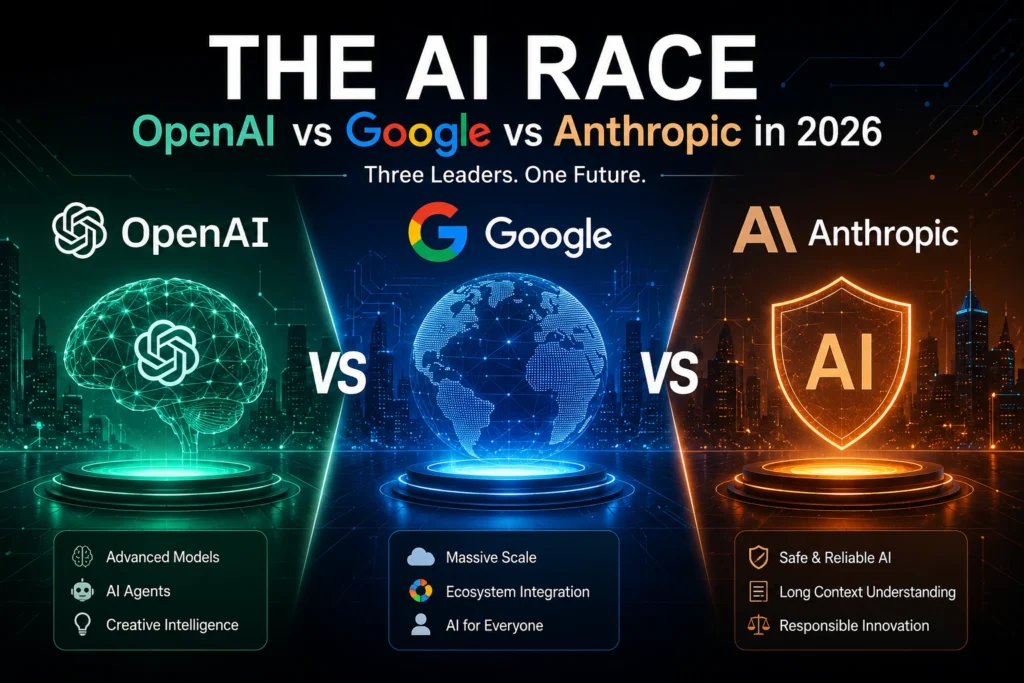
Although OpenAI, Google, and Anthropic all develop advanced AI models, their strengths differ depending on the use case. OpenAI excels in creative writing, programming assistance, and multimodal intelligence. Google benefits from its extensive product ecosystem and strong search capabilities, making it highly effective for productivity and enterprise collaboration. Anthropic focuses on reliability, long-context understanding, and safer AI interactions for professional environments. Rather than declaring a single winner, many organizations now select AI platforms based on their operational needs, security requirements, and workflow integration.
Key Areas Where the Competition Is Growing
- AI-powered business automation and intelligent agents.
- Enterprise security, compliance, and responsible AI deployment.
- Multimodal capabilities including text, images, audio, and video understanding.
Enterprise Adoption Is Driving the AI Market
The biggest battlefield in 2026 is enterprise AI. Companies are investing heavily in artificial intelligence to automate repetitive tasks, improve customer support, analyze business data, generate reports, and accelerate software development. AI platforms are becoming integrated into customer relationship management, finance, healthcare, manufacturing, and legal services. Businesses now evaluate AI solutions based on scalability, security, customization, and integration rather than simply choosing the most popular model. This shift has intensified competition among OpenAI, Google, and Anthropic as they introduce enterprise-focused features and flexible deployment options.
AI Skills Are Becoming Essential for Career Growth
As AI adoption accelerates, professionals across industries are recognizing the importance of learning relevant technical skills. Courses in Artificial Intelligence, Machine Learning, Python, and Data Science help individuals understand how AI systems are developed, trained, and deployed in real-world environments. These skills are no longer limited to software engineers; analysts, managers, marketers, and entrepreneurs are increasingly using AI tools to improve productivity and make data-driven decisions. Learning these technologies can significantly enhance career opportunities in the rapidly evolving digital economy.
Digital Marketing and Business Analytics Are Also Evolving with AI
Artificial intelligence is transforming marketing and business decision-making just as rapidly as software development. Professionals who pursue Digital Marketing and Business Analytics courses can leverage AI for customer segmentation, predictive analysis, campaign optimization, market research, and performance reporting. AI-powered analytics platforms now process vast amounts of business data within seconds, enabling organizations to make faster and more informed strategic decisions. As AI continues to evolve, combining technical knowledge with business expertise is becoming an increasingly valuable career advantage.
The Future of AI Depends on Innovation and Responsible Development
The AI race is no longer focused solely on developing larger models. Companies are now competing on efficiency, affordability, safety, reasoning capabilities, and real-world usefulness. Governments and regulatory organizations are also introducing new AI policies that encourage transparency and responsible innovation. Future AI systems are expected to become more personalized, context-aware, and capable of independently completing complex tasks. The companies that successfully balance innovation with ethical development are likely to shape the next generation of artificial intelligence.
Who Is Winning the AI Race in 2026?
Determining a single winner is challenging because each company dominates different aspects of the AI landscape. OpenAI leads in advanced conversational AI and intelligent assistants, Google leverages its unmatched technology ecosystem to deliver AI at massive scale, while Anthropic stands out for enterprise reliability and responsible AI development. The competition continues to accelerate innovation, ultimately benefiting businesses, developers, students, and consumers who gain access to increasingly capable AI technologies. Instead of replacing one another, these companies are collectively expanding the possibilities of artificial intelligence across every major industry.
Conclusion
The AI race between OpenAI, Google, and Anthropic in 2026 demonstrates how rapidly artificial intelligence is transforming the world. Each company brings unique strengths, whether it is OpenAI’s innovation, Google’s ecosystem integration, or Anthropic’s commitment to AI safety. Their ongoing competition is driving remarkable advancements in automation, enterprise productivity, software development, education, healthcare, and business intelligence. For professionals and students, staying informed about these developments and building expertise through courses such as Data Science, Artificial Intelligence, Machine Learning, Python, Digital Marketing, and Business Analytics can create exciting career opportunities in the years ahead. As AI continues to evolve, those who adapt and continuously learn will be best positioned to thrive in the future of work.