
Introduction
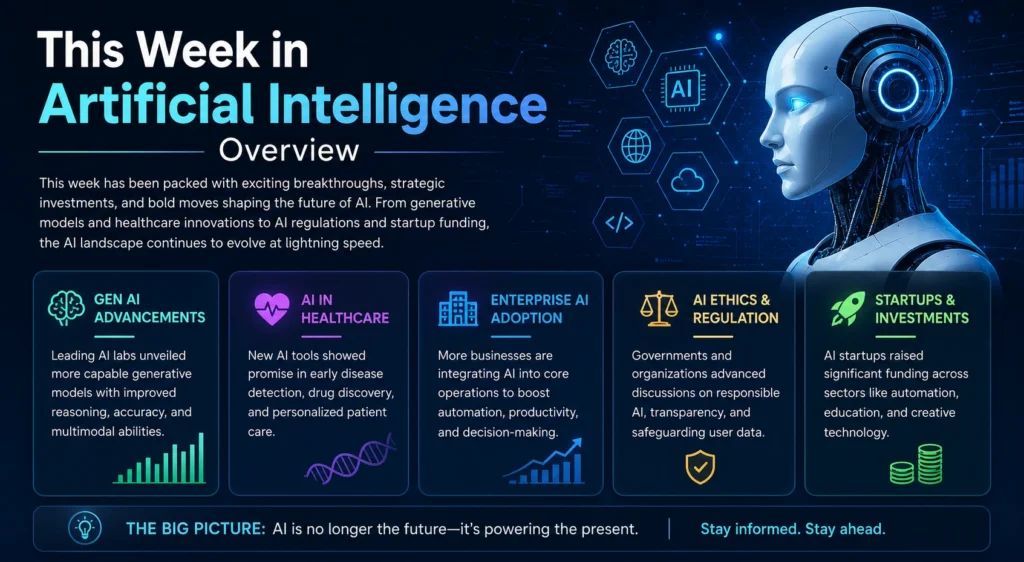
This week in artificial intelligence has been marked by rapid progress across generative AI, enterprise automation, and real-world deployment of intelligent systems. AI continues to shift from experimental use cases to core business infrastructure, impacting industries such as healthcare, finance, education, and digital marketing. Organizations are increasingly investing in AI-driven tools to improve efficiency, reduce operational costs, and enhance decision-making. Alongside these developments, skill-based learning in areas like Data Science, Machine Learning, Python, Digital Marketing, and Business Analytics is becoming more important than ever for professionals who want to stay relevant in a fast-changing job market.
1. Breakthroughs in Generative AI Models
This week saw continued improvements in generative AI systems that can create text, images, and even video content with higher accuracy and realism. Companies are focusing on improving reasoning capabilities, reducing hallucinations, and making outputs more context-aware. These advancements are not only improving user experience but also making AI tools more reliable for professional tasks such as content creation, coding assistance, and customer support automation. As a result, businesses are increasingly integrating generative AI into their workflows.
2. AI in Business Automation Expands Rapidly
AI-powered automation is becoming a central part of enterprise operations. From automated customer service chatbots to intelligent workflow management systems, organizations are using AI to streamline repetitive tasks. This week highlighted several industries adopting AI-driven solutions for inventory management, HR processes, and predictive maintenance. The shift toward automation is also increasing demand for professionals skilled in Business Analytics and Machine Learning, as companies require experts who can interpret AI-generated insights.
3. Growth of AI in Healthcare Systems
Healthcare continues to be one of the fastest-growing sectors for AI adoption. This week emphasized advancements in AI-based diagnostic tools that assist doctors in detecting diseases earlier and more accurately. AI is also being used in drug discovery, patient monitoring, and personalized treatment planning. These developments show how artificial intelligence is not just improving efficiency but also saving lives through early intervention and precision medicine.
- AI is improving diagnostic accuracy in radiology and pathology
- Predictive models are helping in early disease detection
- Hospitals are adopting AI-driven patient management systems
4. Expansion of AI in Education and Learning
Education systems are increasingly integrating AI-powered platforms that personalize learning experiences for students. This week highlighted adaptive learning tools that adjust content difficulty based on student performance. AI tutors and virtual assistants are also helping students understand complex topics more easily. As a result, demand for learning technologies and courses in Data Science, Python, and AI is growing among students and professionals seeking career advancement.
5. AI and Digital Marketing Transformation
Digital marketing is undergoing a major transformation due to artificial intelligence. This week, businesses have increasingly used AI to analyze consumer behavior, optimize ad campaigns, and generate personalized content. AI-driven tools are helping marketers identify target audiences more effectively and improve return on investment. Professionals with knowledge of Digital Marketing combined with AI tools are now highly valued in the industry.
6. Ethical AI and Regulation Discussions
A significant focus this week has been on the ethical use of artificial intelligence. Governments and organizations are discussing frameworks to ensure transparency, fairness, and accountability in AI systems. Issues such as data privacy, algorithmic bias, and responsible AI usage are gaining attention. The goal is to ensure that AI development remains aligned with human values while preventing misuse of advanced technologies.
7. AI in Software Development and Coding
AI-assisted coding tools are becoming increasingly popular among developers. This week highlighted new advancements in AI systems that can write, debug, and optimize code more efficiently. These tools are significantly reducing development time and improving software quality. For beginners, learning Python has become a key entry point into understanding how AI models are built and deployed.
8. Rise of AI Startups and Investments
Investment in AI startups continues to grow rapidly as venture capital firms focus on innovation-driven companies. This week saw increased funding in startups working on automation, robotics, and generative AI platforms. Investors are particularly interested in scalable solutions that can be applied across industries. This trend shows strong confidence in the long-term future of artificial intelligence.
9. Importance of Skill Development in AI Era
With AI transforming industries, skill development has become essential for career growth. Professionals are increasingly enrolling in courses related to Machine Learning, Data Science, Python programming, and Business Analytics to stay competitive. These skills help individuals understand data patterns, build predictive models, and apply AI tools effectively in real-world scenarios.
10. Future Outlook of Artificial Intelligence
The future of artificial intelligence looks promising as it continues to evolve at a rapid pace. This week’s developments indicate that AI will become even more integrated into everyday life, from smart homes to autonomous systems. However, success will depend on balancing innovation with responsibility, ensuring that AI benefits society as a whole while minimizing risks associated with misuse or overdependence.
Conclusion
This week in artificial intelligence demonstrates how deeply AI is shaping modern industries and daily life. From healthcare and education to marketing and software development, AI is driving efficiency, innovation, and personalization. At the same time, ethical concerns and regulatory frameworks are becoming increasingly important. As technology advances, the demand for skills in Data Science, Machine Learning, Python, Digital Marketing, and Business Analytics will continue to grow, making continuous learning essential for future success in the AI-driven world.