
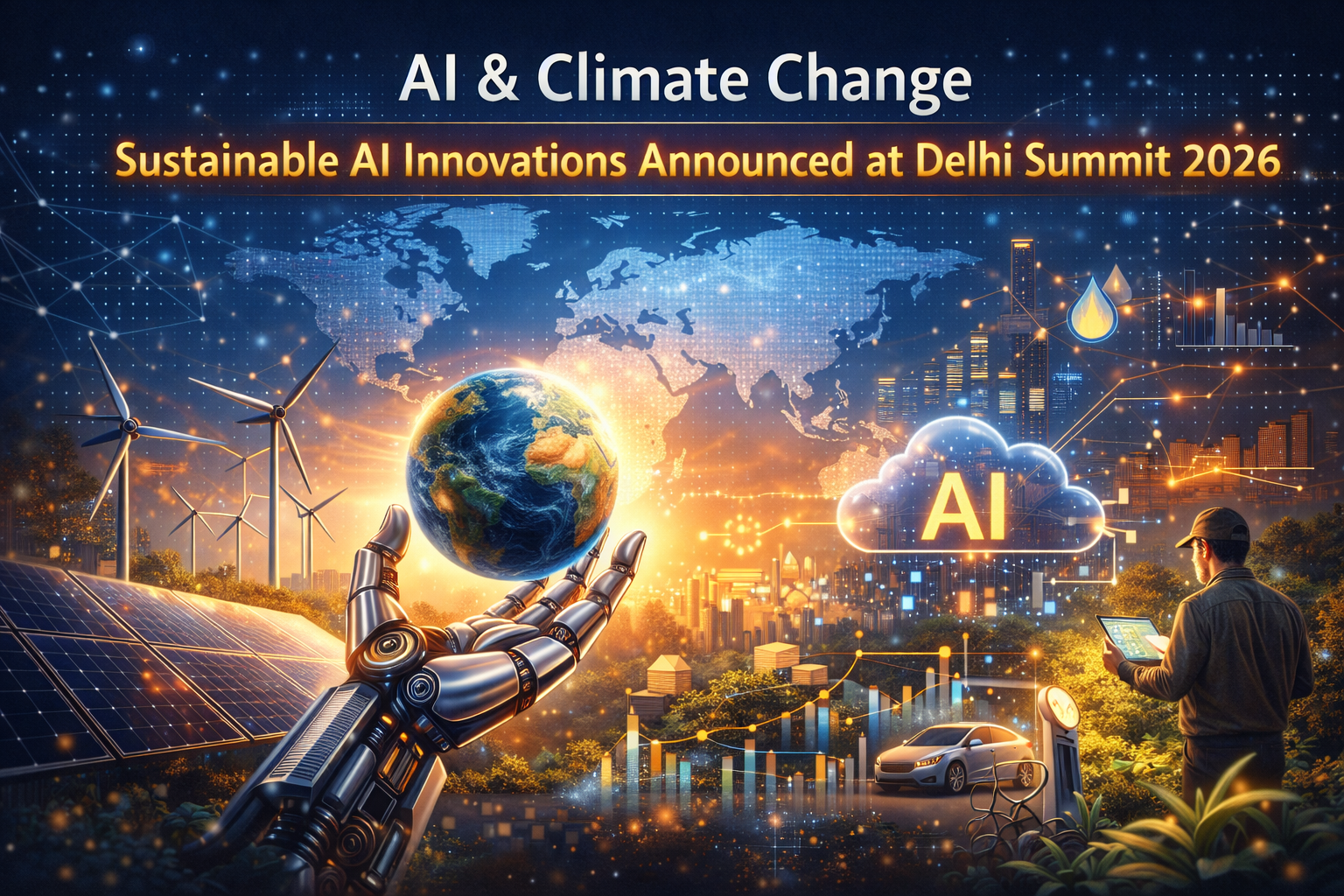
Delhi Summit 2026: Positioning AI as a Climate Action Accelerator
The Delhi Summit 2026 marked a pivotal moment in the global conversation around artificial intelligence and climate change. While AI is often associated with automation, productivity, and defense, one of the most powerful themes at the summit was the use of AI for environmental sustainability and climate resilience. Policymakers, global tech leaders, environmental scientists, and sustainability experts gathered to explore how AI-driven innovations can combat climate change, reduce carbon emissions, and accelerate green transformation.
The summit reinforced a powerful message: AI is not just a technological advancement — it is a climate action enabler. From predictive climate modeling to renewable energy optimization, AI is now central to building a sustainable future.
AI-Powered Climate Modeling & Predictive Analytics
One of the major announcements at the summit revolved around advanced AI-powered climate modeling systems. These systems use machine learning algorithms to analyze decades of environmental data, satellite imagery, ocean temperature records, and atmospheric patterns to predict extreme weather events and long-term climate shifts.
Unlike traditional climate forecasting tools, AI models can process vast datasets in real time, improving accuracy and response times. Enhanced flood prediction systems, cyclone tracking platforms, and drought forecasting tools were introduced as part of national climate resilience initiatives. These innovations aim to minimize disaster damage and improve early warning systems across vulnerable regions.
Smart Energy Grids & Renewable Optimization Through AI
Energy transformation was a central pillar of sustainable AI discussions. AI-driven smart grid systems were announced to optimize renewable energy distribution, reduce power wastage, and improve grid stability. By using predictive analytics, AI can forecast energy demand patterns and dynamically adjust supply from solar, wind, and hydro sources.
These intelligent systems help reduce dependency on fossil fuels by ensuring maximum utilization of renewable energy infrastructure. AI is also being integrated into battery storage systems, improving efficiency and balancing energy loads across regions. This marks a significant step toward achieving carbon neutrality goals.
AI in Carbon Tracking & Emission Reduction Strategies
Another strategic innovation announced at the summit was AI-powered carbon tracking platforms. These systems use real-time data analytics to measure carbon emissions across industries, transportation networks, and urban infrastructures.
With AI-enabled dashboards, policymakers and corporations can track emissions more accurately, identify high-pollution zones, and implement targeted reduction strategies. Businesses are increasingly adopting AI tools to monitor their carbon footprint and align with ESG (Environmental, Social, and Governance) compliance standards.
By leveraging AI in carbon accounting, India aims to strengthen transparency and accountability in climate action.
Sustainable Agriculture & AI-Driven Climate Resilience
Agriculture, being highly vulnerable to climate change, was a major focus of sustainable AI innovations. AI-based precision farming tools were showcased to optimize irrigation, monitor soil health, and predict crop diseases.
Machine learning algorithms analyze weather forecasts, soil data, and satellite imagery to recommend optimal planting schedules and water usage. These technologies help reduce resource wastage while improving crop yields. Climate-resilient agriculture powered by AI is expected to enhance food security while minimizing environmental impact.
The summit highlighted how AI can support farmers in adapting to changing climate conditions through real-time insights and predictive decision-making tools.
AI for Water Resource Management & Conservation
Water scarcity is a growing global challenge, and AI solutions announced at the summit addressed this issue directly. AI-powered water management systems can detect leakages, predict water demand patterns, and optimize distribution networks.
By combining IoT sensors with AI analytics, municipalities can reduce water wastage and ensure equitable distribution. Smart irrigation systems also use AI to determine precise water requirements, conserving valuable resources while maintaining agricultural productivity.
These innovations contribute significantly to sustainable urban planning and rural resource management.
Green Data Centers & Energy-Efficient AI Infrastructure
Interestingly, discussions at the summit also addressed the environmental footprint of AI itself. Data centers consume significant energy, and sustainable AI infrastructure was a priority announcement.
Tech companies introduced plans for green data centers powered by renewable energy and optimized cooling systems. AI-driven energy management tools are being deployed within data centers to reduce electricity consumption and improve operational efficiency.
This dual approach, using AI to fight climate change while reducing AI’s own carbon footprint , reflects a holistic sustainability strategy.
AI-Enabled Climate Finance & ESG Investments
Climate finance and sustainable investment strategies were another important discussion area. AI tools are being used to assess environmental risks, evaluate sustainable investment opportunities, and enhance ESG reporting accuracy.
Financial institutions are leveraging AI algorithms to analyze climate-related risks in infrastructure projects and corporate portfolios. This enables better allocation of capital toward green initiatives and climate-resilient development projects.
The summit underscored that sustainable AI innovation must be supported by intelligent financial ecosystems.
Public-Private Partnerships Driving Sustainable AI
A key highlight of the Delhi Summit 2026 was the announcement of collaborative public-private partnerships focused on climate AI research. Governments, startups, and global tech firms pledged to co-develop climate-focused AI solutions.
Innovation hubs dedicated to environmental AI research are being established to accelerate breakthroughs in renewable optimization, biodiversity monitoring, and sustainable urban planning. These collaborations are designed to combine technological expertise with policy support to scale impact.
Such partnerships are crucial for ensuring AI-driven climate innovations move from research labs to real-world deployment.
AI for Biodiversity Monitoring & Environmental Protection
Environmental conservation efforts also benefited from AI advancements announced at the summit. AI-based image recognition systems are being used to monitor wildlife populations, track deforestation patterns, and detect illegal mining activities.
Satellite data combined with AI analytics enables real-time forest health assessments and biodiversity tracking. These tools help governments enforce environmental regulations more effectively while protecting ecosystems.
AI is thus emerging as a powerful guardian of natural resources.
Global Collaboration for Climate-Centric AI Governance
International cooperation was a recurring theme during climate-focused sessions. Leaders emphasized that climate change is a global challenge requiring coordinated AI strategies across nations.
Discussions included global data-sharing frameworks, collaborative climate research programs, and standardization of AI-driven sustainability metrics. The summit positioned India as a proactive contributor to global climate AI governance.
Conclusion: AI as a Catalyst for Sustainable Transformation
The Delhi Summit 2026 firmly established artificial intelligence as a transformative force in climate action. From predictive climate analytics and smart energy grids to carbon tracking platforms and sustainable agriculture solutions, AI innovations announced at the summit demonstrate how technology can drive environmental resilience.
As climate challenges intensify worldwide, AI offers scalable, data-driven solutions capable of accelerating sustainable development goals. The summit’s announcements signal a future where AI and sustainability move forward together — not as separate agendas, but as interconnected pillars of progress.
Artificial intelligence is no longer just reshaping industries; it is reshaping our planet’s future.