
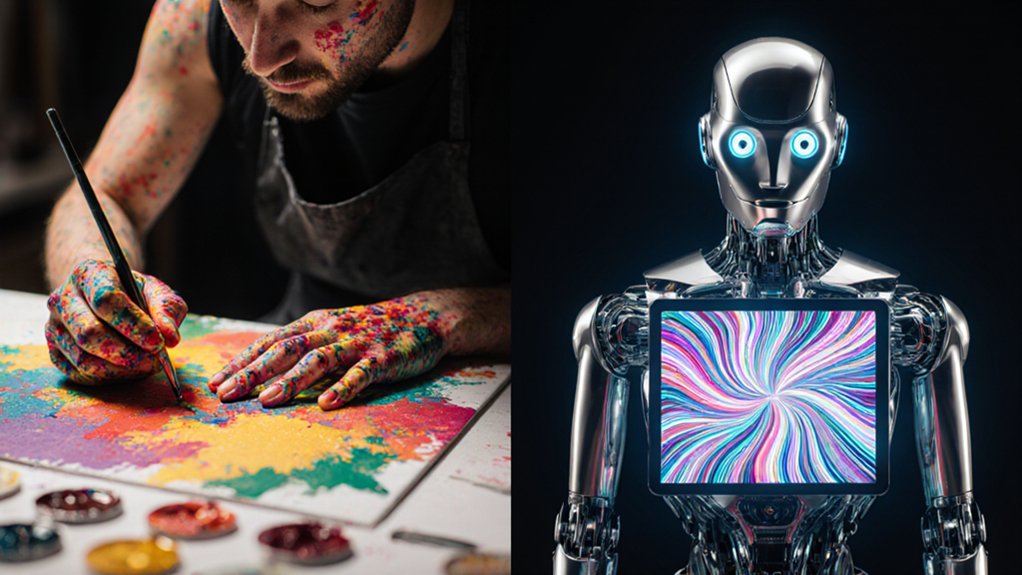
As we explore the intriguing domain of AI versus human creativity, we must ask ourselves: what truly defines creativity? While machines can generate impressive works, they lack the emotional resonance that comes from lived experiences. This distinction raises important questions about the essence of thought and expression. Can machines ever grasp the depth of human intuition? Let’s consider the implications of this unique divide and what it means for the future of artistic expression.
Key Takeaways
- AI can generate art and narratives, but lacks the emotional depth and subjective experiences that define human creativity.
- Human creativity is shaped by unique thoughts, emotions, and memories, which machines cannot replicate or truly understand.
- AI’s decision-making relies on algorithms and patterns, lacking the intuition and complex reasoning inherent to human thought processes.
- Collaboration between AI and humans can enhance creativity, blending data processing with emotional insights for innovative outcomes.
- Authenticity and originality are core to human creativity, whereas AI outputs raise questions about the genuine expression of ideas.
What Is Human Creativity?
Human creativity is a remarkable force that fuels innovation and expression in our lives. We all experience this incredible ability to engage in imaginative processes, transforming thoughts and feelings into art, music, stories, and solutions. Our creative expression not only enriches our personal experiences but also connects us to others, fostering understanding and collaboration. As we explore our unique perspectives, we often find inspiration in the world around us, drawing from our emotions, memories, and dreams. Each act of creation reflects our individuality and shared humanity, reminding us that creativity thrives in a community. By embracing our imaginative processes, we release endless possibilities, shaping our reality and inspiring future generations to do the same. Together, we celebrate the essence of human creativity.
How Does AI Creativity Compare to Human Art and Literature?
While we often celebrate the depth of human creativity, it is essential to examine how AI-generated art and literature stack up against our own creations. Machine generated art showcases impressive techniques, often mimicking styles and blending ideas in ways we might not have considered. However, we need to ask ourselves: does this truly reflect the essence of creativity? Algorithmic literature can produce engaging narratives, yet it lacks the emotional depth and personal experiences that shape our storytelling. We might appreciate the novelty of AI’s output, but it raises questions about authenticity and originality. Ultimately, while AI can offer intriguing perspectives, it still feels distinct from the rich tapestry of human creativity that embodies our unique thoughts and experiences.
What Are the Emotional Aspects of Human Creativity?
Creativity flourishes within the domain of emotion, weaving together our experiences, passions, and vulnerabilities. It’s in this intricate tapestry that we find emotional expression, allowing us to convey feelings that resonate deeply with ourselves and others. The creative process becomes a vessel for exploring and transforming these emotions into art, literature, and music. When we create, we often tap into our joys, sorrows, and fears, crafting narratives that reflect our inner worlds. This emotional connection fuels our creativity, making it uniquely human. While machines can mimic patterns and produce outputs, they lack the genuine emotional depth that drives us. In this way, our emotional landscape enriches our creative endeavors, setting us apart from artificial intelligence.
Why Does AI Struggle to Mimic Human Intuition?
Although AI can analyze vast amounts of data and recognize patterns, it struggles to mimic the nuanced intuition that humans possess. This limitation stems from the machine’s inability to engage in instinctual decision making, which often relies on emotional and experiential context. Let’s explore some key differences:
| Aspect | AI Capabilities | Human Intuition |
|---|---|---|
| Data Processing | Analyzes data quickly | Uses past experiences |
| Pattern Recognition | Recognizes trends | Understands context |
| Decision Making | Follows algorithms | Relies on gut feelings |
These machine limitations prevent AI from fully grasping the complexities of human thought. We must acknowledge that our intuition stems from a rich tapestry of experiences that machines simply can’t replicate.
How Can AI and Human Creativity Collaborate?
As we explore the potential for collaboration between AI and human creativity, it becomes clear that blending our strengths can lead to groundbreaking innovations. By forming creative partnerships, we can harness AI’s data processing abilities alongside our unique emotional insights. This synergy enables us to tackle complex problems in ways we couldn’t achieve individually.
In collaborative projects, AI can assist in generating ideas, refining concepts, or even providing inspiration through analysis of trends. We can then infuse these ideas with our human touch, ensuring they resonate on a deeper level. Together, we’re not just enhancing creativity; we’re redefining it. Embracing this collaboration opens doors to new possibilities, ultimately enriching our artistic and innovative endeavors. Additionally, through hands-on practical sessions, we can better understand how to integrate AI technologies effectively into our creative processes.
Conclusion
To summarize, while AI can produce impressive works that mimic human creativity, it lacks the emotional depth and personal experiences that define our artistic expressions. We bring intuition and unique perspectives to our creations, something machines simply can’t replicate. However, by collaborating with AI, we can enhance our creative processes, blending technology with our innate abilities. Ultimately, the true essence of creativity lies in our human experiences, making our artistic contributions irreplaceable.