
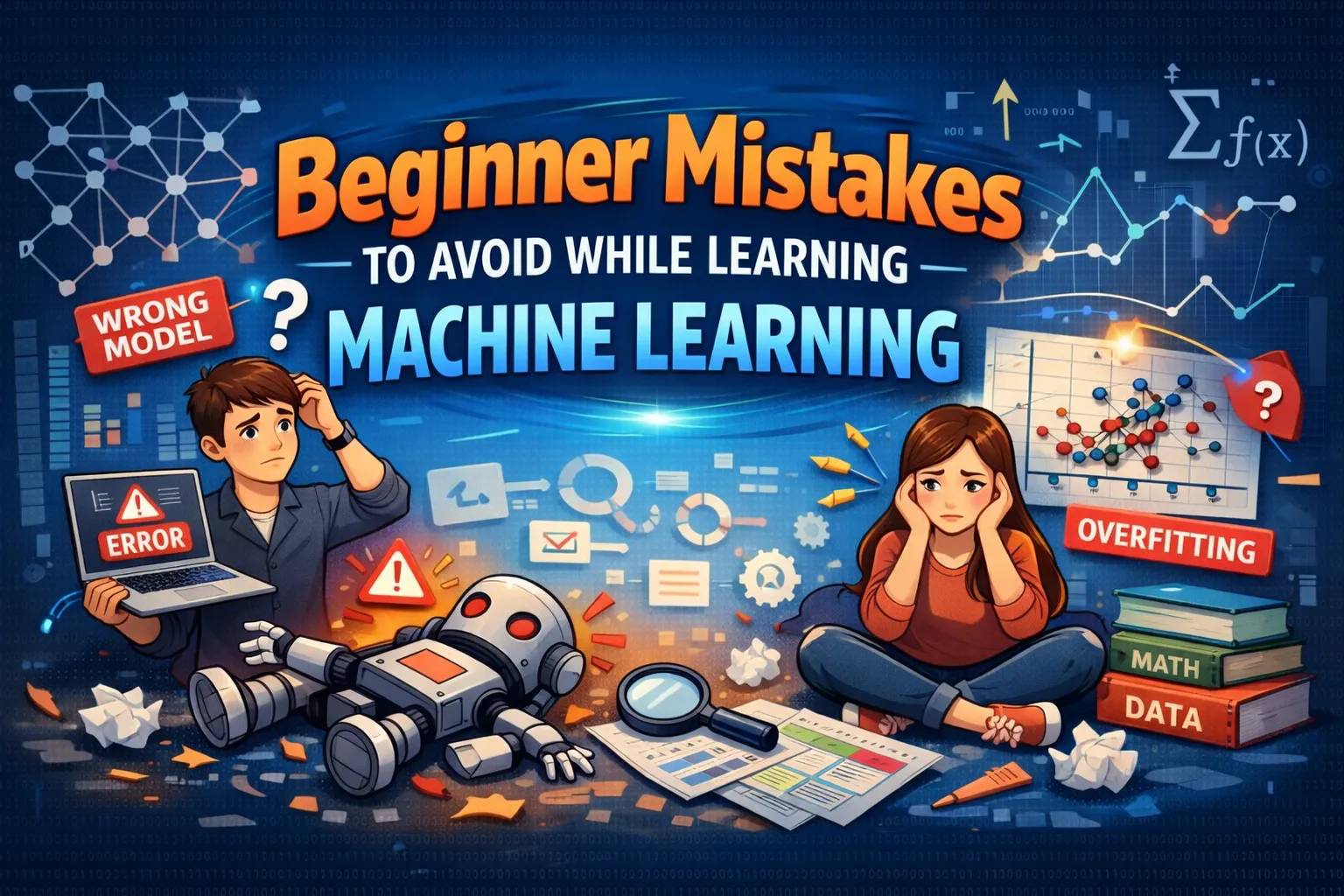
Learning Machine Learning is an exciting yet challenging journey, especially for beginners who are new to data-driven technologies. With Machine Learning being widely used in industries such as healthcare, finance, marketing, and automation, many learners start this journey with high expectations. However, without a structured approach, beginners often face confusion and slow progress. Understanding beginner mistakes to avoid while learning machine learning is essential for building strong fundamentals and achieving long-term success.
Starting with Advanced Algorithms Too Early
One of the most common beginner mistakes to avoid while learning machine learning is jumping straight into advanced algorithms without understanding the basics. Many learners begin with complex models like deep learning or ensemble methods before learning foundational concepts such as supervised learning, regression, classification, and data preprocessing. Machine Learning is not just about applying algorithms; it is about understanding how data influences model behavior. Without mastering the fundamentals, learners struggle to interpret results and fix errors effectively.
Neglecting Mathematics and Statistics Fundamentals
Another major mistake beginners make while learning Machine Learning is ignoring mathematics and statistics. Although Machine Learning tools allow models to be built with minimal coding effort, mathematical concepts like probability, linear algebra, gradients, and optimization play a crucial role behind the scenes. Beginners who skip these topics often find it difficult to understand why models behave the way they do. Developing mathematical intuition improves decision-making and strengthens Machine Learning skills over time.
Focusing Only on Coding Instead of Problem Understanding
Many beginners assume that Machine Learning is only about writing code and using libraries. This is one of the critical beginner mistakes to avoid while learning machine learning. Successful Machine Learning solutions begin with understanding the problem, defining objectives, and choosing the right evaluation metrics. Beginners often apply complex algorithms when simpler models would work better. A problem-first approach leads to better model performance and practical results.
Avoiding Real-World and Messy Datasets
Another common beginner mistake is practicing only on clean and well-structured datasets. In reality, real-world data is often incomplete, noisy, and inconsistent. Beginners who avoid dealing with such data struggle when working on actual projects. Data cleaning, feature engineering, and handling missing values are essential skills. Working with real-world datasets helps learners understand beginner mistakes to avoid while learning machine learning in practical environments.
Misunderstanding Overfitting and Model Generalization
Overfitting is a concept that many beginners overlook while learning Machine Learning. Beginners often focus on achieving high accuracy on training data without considering how the model performs on new, unseen data. This results in poor real-world performance. Understanding cross-validation, regularization, and the bias-variance trade-off helps learners build models that generalize well. Recognizing this issue is critical to avoiding common learning mistakes.
Lack of Hands-On Practice and Project Work
Relying only on tutorials and theoretical learning is another beginner mistake to avoid while learning machine learning. Machine Learning concepts become clearer through hands-on practice and experimentation. Without building projects, learners struggle to retain knowledge and apply it effectively. Working on small projects helps reinforce concepts, improve problem-solving skills, and build confidence.
Comparing Learning Progress with Others
Many beginners lose motivation by comparing their progress with that of experienced professionals. Machine Learning is a vast field, and mastery takes time. Comparing learning speed often leads to frustration and self-doubt. Understanding that progress should be measured against personal growth is an important step in overcoming beginner mistakes to avoid while learning machine learning.
Skipping Model Evaluation and Deployment Basics
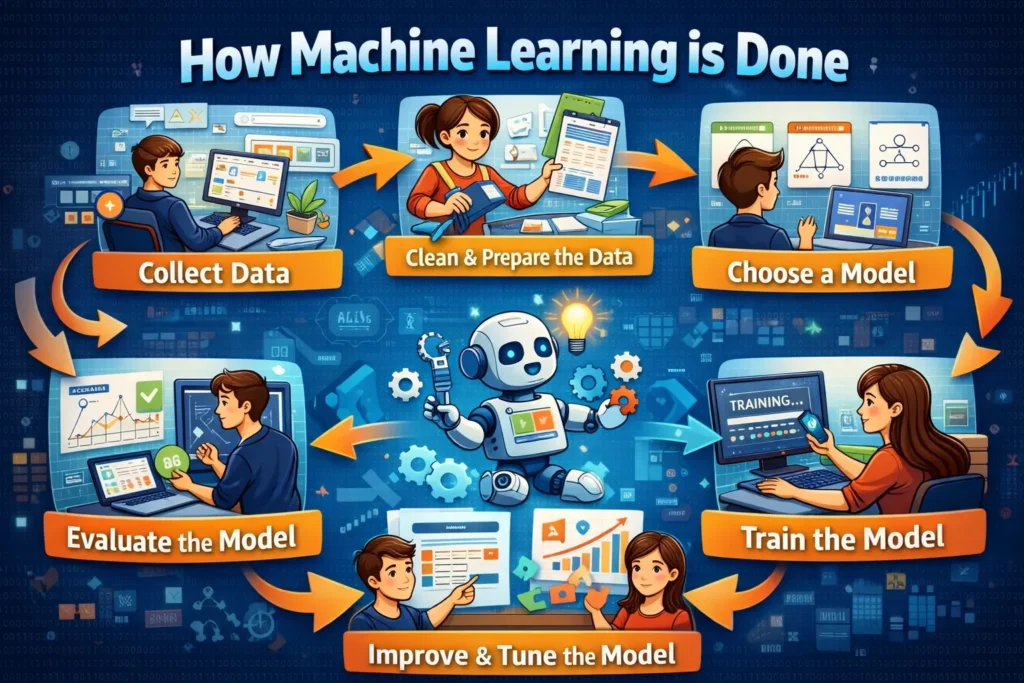
Some beginners believe that training a model is the final step in the Machine Learning process. In reality, evaluation, interpretation, and deployment are equally important. Beginners who skip these aspects struggle to apply their knowledge in real-world scenarios. Learning how to evaluate model performance and deploy solutions prepares learners for industry requirements.
Conclusion: Learning Machine Learning with the Right Approach
Machine Learning becomes more manageable when learners avoid common beginner mistakes. By understanding beginner mistakes to avoid while learning machine learning, beginners can build strong foundations, gain practical experience, and grow steadily. A balanced learning approach that includes fundamentals, real-world practice, continuous improvement, and patience leads to long-term success in the Machine Learning field.