
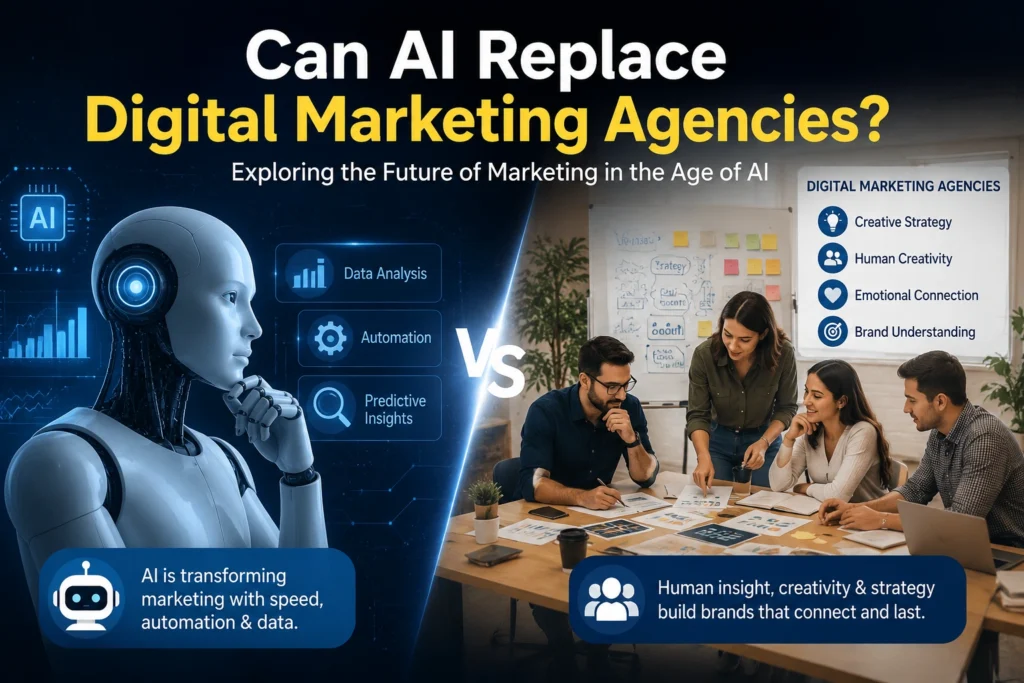
Introduction
Artificial Intelligence (AI) is transforming almost every industry, and digital marketing is no exception. From creating content and analyzing customer behavior to automating campaigns and generating insights, AI-powered tools are changing how businesses connect with their audiences. As these technologies become more advanced, many business owners and marketers are asking an important question: Can AI replace digital marketing agencies? While AI has made marketing faster, smarter, and more efficient, the complete replacement of agencies is still a topic of debate. Understanding the strengths and limitations of AI helps businesses make informed decisions about how to use technology without losing the value of human creativity and strategic thinking.
The Growing Influence of AI in Digital Marketing
AI has become an essential part of modern digital marketing because it can process large amounts of information within seconds. Businesses use AI to understand customer preferences, predict buying behavior, personalize marketing messages, and improve advertising performance. Automation tools reduce repetitive tasks, allowing marketers to focus on strategy and creativity. As AI continues to evolve, companies are integrating it into email marketing, social media management, search engine optimization, and customer support. This growing adoption has raised questions about whether AI can eventually perform every task that marketing agencies currently handle.
What Digital Marketing Agencies Actually Do
Digital marketing agencies offer much more than running advertisements or posting content online. They develop complete marketing strategies based on business goals, competitor analysis, customer research, branding, and long-term growth plans. Agencies also manage SEO, content creation, paid advertising, website optimization, influencer campaigns, and performance tracking. Most importantly, they combine data with human creativity to create campaigns that connect emotionally with audiences. AI can assist in many of these activities, but understanding brand identity and creating original marketing strategies still requires experienced professionals.
Where AI Performs Better Than Humans
AI is exceptionally good at handling repetitive, data-driven tasks. It can analyze millions of data points much faster than humans and identify trends that might otherwise go unnoticed. AI-powered platforms can recommend the best time to publish content, optimize advertising budgets, generate reports, and automate customer interactions through chatbots. Businesses that use AI effectively often save time, reduce operational costs, and improve campaign efficiency. Professionals who study AI, Machine Learning, and Python are increasingly learning how to build intelligent marketing solutions that automate these routine processes while improving decision-making.
Why Human Creativity Still Matters
Although AI can generate text, images, and marketing suggestions, it cannot fully understand human emotions, cultural trends, or the unique personality of every brand. Successful marketing often depends on storytelling, creativity, empathy, and innovative thinking. Agencies understand how to build trust with audiences, respond during crises, and develop campaigns that reflect changing consumer expectations. Human marketers can interpret market conditions, understand subtle customer feedback, and make strategic decisions that go beyond data analysis. This combination of emotional intelligence and business experience remains difficult for AI to replicate.
AI as a Powerful Assistant Rather Than a Replacement
Instead of replacing agencies, AI is becoming one of their most valuable tools. Many agencies now use AI to generate content ideas, automate keyword research, optimize advertising campaigns, and analyze customer behavior more efficiently. This allows marketing teams to spend more time on planning, creativity, and client communication. Rather than competing against AI, successful agencies are adapting by combining technology with human expertise. Businesses benefit most when AI supports professionals instead of attempting to replace them completely.
The Importance of Data Skills in Modern Marketing
The future of marketing depends heavily on understanding data. Professionals with knowledge of Data Science, Business Analytics, and Machine Learning can analyze customer behavior more effectively and create smarter marketing strategies. AI systems rely on quality data to produce accurate recommendations, making analytical skills increasingly valuable. Learning Python has also become beneficial because it allows marketers and analysts to automate workflows, process marketing data, and develop AI-powered solutions. As technology continues to advance, combining technical knowledge with marketing expertise creates a strong competitive advantage in the industry.
Challenges That Prevent AI from Fully Replacing Agencies
Despite impressive advancements, AI still faces several important limitations. AI systems rely on existing data, which means they may struggle when dealing with unexpected situations or rapidly changing market conditions. They can also generate inaccurate information or fail to understand complex brand values. Ethical concerns, privacy regulations, and the need for human oversight remain significant challenges. Businesses also require personalized consulting, relationship management, and strategic discussions that AI cannot conduct with the same level of trust and understanding as experienced marketing professionals.
Key Takeaways
- AI significantly improves efficiency by automating repetitive marketing tasks and analyzing large volumes of customer data.
- Digital marketing agencies continue to provide strategic planning, creative storytelling, and personalized business guidance that AI cannot fully replace.
- The strongest future lies in combining AI with human expertise, supported by skills in Data Science, Digital Marketing, Machine Learning, Python, and Business Analytics.
The Future of Digital Marketing Careers
The rise of AI is changing job roles rather than eliminating them. Marketing professionals are expected to work alongside intelligent tools while focusing on strategy, creativity, and customer engagement. Employers increasingly value candidates who understand both marketing principles and emerging technologies. Learning Digital Marketing together with AI, Data Science, Machine Learning, Python, and Business Analytics prepares professionals for modern business environments where technology and human expertise work together. Continuous learning will become one of the most important factors for career success in the coming years.
Conclusion
AI has undoubtedly transformed digital marketing by making campaigns faster, smarter, and more data-driven. However, replacing digital marketing agencies entirely is unlikely in the foreseeable future. While AI excels at automation, data analysis, and operational efficiency, it cannot replace human creativity, emotional intelligence, strategic thinking, and relationship-building. The future of marketing is not about choosing between AI and agencies but about combining the strengths of both. Businesses that successfully integrate AI while relying on experienced marketing professionals will be better positioned to adapt, innovate, and achieve sustainable growth in an increasingly competitive digital landscape.