
Introduction
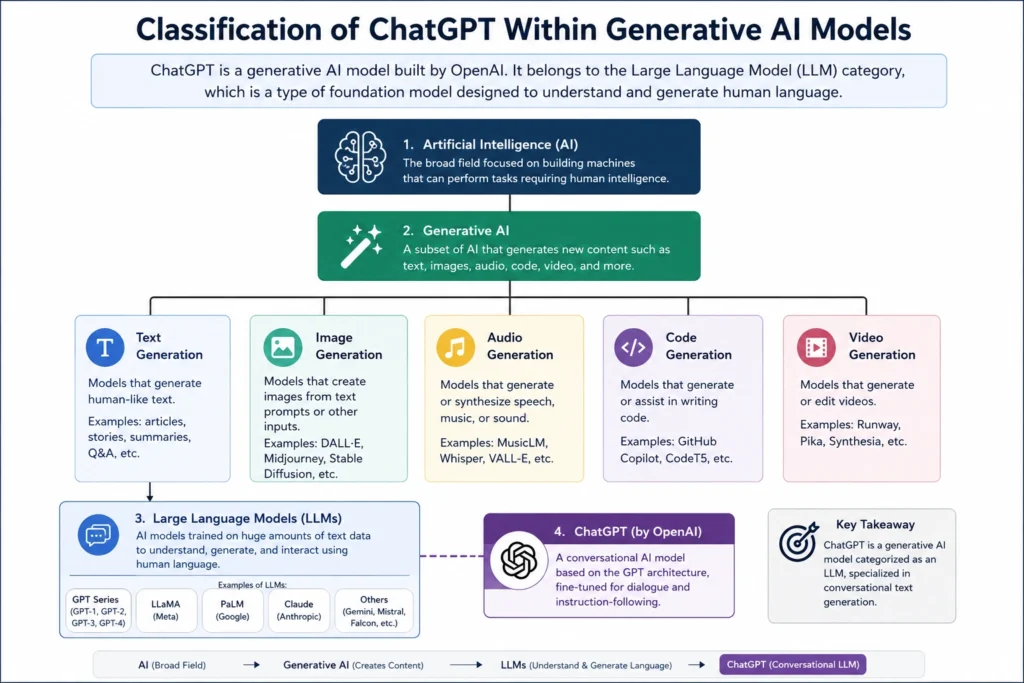
Artificial Intelligence has transformed the way people learn, work, and communicate in the digital era. One of the most popular AI tools today is OpenAI’s ChatGPT, which is widely used for content writing, coding, research, customer support, and education. Many people use ChatGPT daily, but they often wonder how it is classified within generative AI models. Understanding its classification helps learners and professionals explore the technology behind modern AI systems. ChatGPT belongs to a category of AI called Generative AI, but within that category, it also falls under several advanced AI classifications such as Large Language Models, Transformer Models, Conversational AI Systems, and Natural Language Processing technologies. This blog explains the classification of ChatGPT within generative AI models in detail while covering its working process, features, applications, benefits, and future importance.
What Is Generative AI?
Generative AI refers to artificial intelligence systems that can generate new content instead of simply analyzing existing data. These AI systems are trained on massive datasets and can create text, images, videos, music, and code based on user prompts. Unlike traditional AI models that mainly focus on prediction and automation, generative AI models produce human-like responses and creative outputs. ChatGPT is one of the best examples of generative AI because it can generate natural conversations, write articles, answer questions, summarize information, and even assist in programming tasks. The rise of generative AI has created strong demand for skills in Data Science, Artificial Intelligence, Machine Learning, Python Programming, and Business Analytics because these technologies are directly connected to AI development and implementation.
ChatGPT as a Large Language Model (LLM)
The primary classification of ChatGPT is a Large Language Model, commonly known as an LLM. Large Language Models are AI systems trained on enormous amounts of text data collected from books, websites, articles, and online conversations. These models learn grammar, sentence structure, context, and language patterns to generate human-like responses. ChatGPT uses advanced deep learning algorithms to predict the next word in a sentence, allowing it to create meaningful and intelligent replies. Because it processes massive datasets, ChatGPT can answer questions across multiple subjects, including technology, education, marketing, finance, and programming. Large Language Models are considered one of the most important breakthroughs in modern AI because they improve communication between humans and machines.
ChatGPT as a Transformer-Based AI Model
Another important classification of ChatGPT within generative AI models is that it is a Transformer-based AI system. Transformer architecture was introduced in 2017 and revolutionized Natural Language Processing. Before transformers, AI models struggled to understand long sentences and contextual relationships between words. Transformer models improved language understanding by using mechanisms called attention layers. These attention systems allow ChatGPT to focus on important words and understand the meaning of complete sentences instead of individual terms. This architecture helps ChatGPT generate accurate, context-aware, and human-like responses. The transformer model is the foundation behind many modern AI applications, including virtual assistants, translation tools, and AI writing software.
ChatGPT as a Conversational AI System
ChatGPT is also classified as Conversational AI because it is designed to communicate naturally with users. Conversational AI systems interact with humans through text or voice-based conversations. They are commonly used in chatbots, virtual assistants, customer service platforms, and educational tools. ChatGPT is specifically optimized for dialogue, meaning it can maintain context, answer follow-up questions, and continue discussions smoothly. This conversational ability makes it different from simple search engines or rule-based chatbots. Businesses today use conversational AI to improve customer support, automate communication, and provide 24/7 assistance. Students and professionals are also learning conversational AI concepts through Machine Learning and AI training programs to prepare for future careers.
Role of Natural Language Processing in ChatGPT
Natural Language Processing, commonly called NLP, is another key classification associated with ChatGPT. NLP is a branch of AI that enables computers to understand, interpret, and generate human language. ChatGPT relies heavily on NLP techniques to process user input and generate meaningful responses. Through NLP, the model can recognize grammar, context, sentiment, keywords, and language patterns. This allows ChatGPT to perform tasks such as text summarization, language translation, content creation, and question answering. NLP has become one of the fastest-growing areas in AI because businesses increasingly rely on automated communication systems and AI-powered tools for productivity and customer engagement.
Deep Learning Classification of ChatGPT
ChatGPT is also classified under Deep Learning models because it uses neural networks with multiple layers to process information. Deep Learning is a subset of Machine Learning that imitates the functioning of the human brain using artificial neural networks. These networks analyze large amounts of data to recognize patterns and improve over time. ChatGPT’s deep learning capabilities allow it to generate detailed responses, understand complex questions, and produce creative outputs. Deep Learning plays a major role in many AI technologies such as speech recognition, facial recognition, recommendation systems, and autonomous vehicles. Learning Deep Learning concepts has become essential for students pursuing careers in Artificial Intelligence and Data Science.
Training Process Behind ChatGPT
The classification of ChatGPT also depends on its training methodology. ChatGPT is trained using supervised learning and reinforcement learning techniques. Initially, the model learns from large datasets during pre-training, where it studies patterns in language. After pre-training, human trainers help fine-tune the model using reinforcement learning from human feedback. This process improves response quality, accuracy, and safety. Because of this advanced training system, ChatGPT can provide better conversational experiences compared to older AI models. Training generative AI systems requires strong knowledge of Python, Machine Learning algorithms, cloud computing, and data handling techniques, which are now commonly taught in modern AI education programs.
Applications of ChatGPT in Different Industries
The classification of ChatGPT within generative AI models becomes clearer when observing its applications across industries. In education, ChatGPT helps students understand concepts, create assignments, and learn coding. In business, it supports customer service, marketing automation, and report generation. In healthcare, AI chat systems assist with information management and patient communication. Software developers use ChatGPT for debugging and code generation. Digital marketers rely on AI tools for content writing and SEO optimization. The widespread adoption of ChatGPT has increased demand for professionals skilled in AI, Data Analytics, Business Intelligence, and Digital Marketing because organizations now integrate AI into everyday operations.
Advantages of ChatGPT Within Generative AI
ChatGPT offers several advantages that make it one of the most successful generative AI models. It provides quick responses, improves productivity, automates repetitive tasks, and enhances learning experiences. Users can generate articles, emails, summaries, business ideas, and coding solutions within seconds. ChatGPT also supports multilingual communication, making it useful globally. Another major advantage is accessibility because people from different industries can use AI tools without advanced technical knowledge. Businesses benefit from reduced operational costs and improved efficiency through AI automation. These advantages explain why generative AI is growing rapidly across industries and why AI-related career opportunities continue to expand worldwide.
Limitations and Challenges of ChatGPT
Despite its capabilities, ChatGPT also has limitations and challenges. Since it learns from existing data, it can sometimes provide inaccurate or outdated information. The model may generate biased responses if biases exist in training datasets. Another challenge is the lack of real human understanding because ChatGPT predicts text patterns rather than thinking independently. Privacy and ethical concerns also exist regarding AI-generated content and data usage. Additionally, overdependence on AI tools may reduce human creativity and critical thinking skills. These challenges highlight the importance of ethical AI development and responsible usage. Professionals working in AI ethics and governance are becoming increasingly important in the technology industry.
Future of ChatGPT and Generative AI Models
The future of ChatGPT and generative AI models looks highly promising. AI systems are expected to become more intelligent, personalized, and efficient in the coming years. Future versions of ChatGPT may provide improved reasoning, emotional understanding, voice interaction, and multimodal capabilities that combine text, images, audio, and video generation. Businesses will continue integrating generative AI into customer support, education, healthcare, finance, and entertainment industries. Governments and educational institutions are also investing heavily in AI research and skill development. As generative AI expands, learning technologies such as Python, Data Science, Machine Learning, Artificial Intelligence, and Business Analytics will become even more valuable for students and professionals.
Importance of Learning Generative AI Technologies
Understanding the classification of ChatGPT within generative AI models helps learners build a strong foundation in modern AI technologies. Today, companies seek professionals who can work with AI tools, analyze data, build machine learning models, and automate workflows. Skills in Python programming, Machine Learning, Artificial Intelligence, Data Analytics, and Digital Marketing are highly relevant because they connect directly with AI-driven industries. Educational institutions and online training programs now focus heavily on practical AI learning to prepare students for future job opportunities. Generative AI is no longer a futuristic concept; it has become an essential part of modern business and technology environments.
How ChatGPT Is Different From Traditional AI Systems
Traditional AI systems were mainly rule-based and designed for specific tasks such as calculations, predictions, or automation. These systems required predefined instructions and could not generate creative content independently. ChatGPT, however, belongs to a newer generation of AI models capable of understanding language context and generating human-like responses dynamically. Unlike traditional AI, ChatGPT can create original text, answer complex questions, and engage in meaningful conversations. This difference is why ChatGPT is classified specifically under Generative AI rather than conventional AI systems. The shift from rule-based AI to generative AI represents one of the biggest technological advancements in recent decades.
Conclusion
The classification of ChatGPT within generative AI models includes several important categories, such as Large Language Models, Transformer-based AI systems, Conversational AI, Natural Language Processing models, and Deep Learning technologies. These classifications explain why ChatGPT can generate intelligent, context-aware, and human-like responses across multiple domains. Developed by OpenAI, ChatGPT has transformed industries including education, business, healthcare, marketing, and software development. While it offers significant advantages in productivity and automation, it also presents challenges related to accuracy, ethics, and responsible usage. As generative AI continues to evolve, understanding ChatGPT’s classification becomes essential for students, professionals, and businesses looking to succeed in the AI-driven future. Learning skills related to Artificial Intelligence, Machine Learning, Python, Data Science, and Business Analytics will help individuals stay competitive in a rapidly changing technological world.