
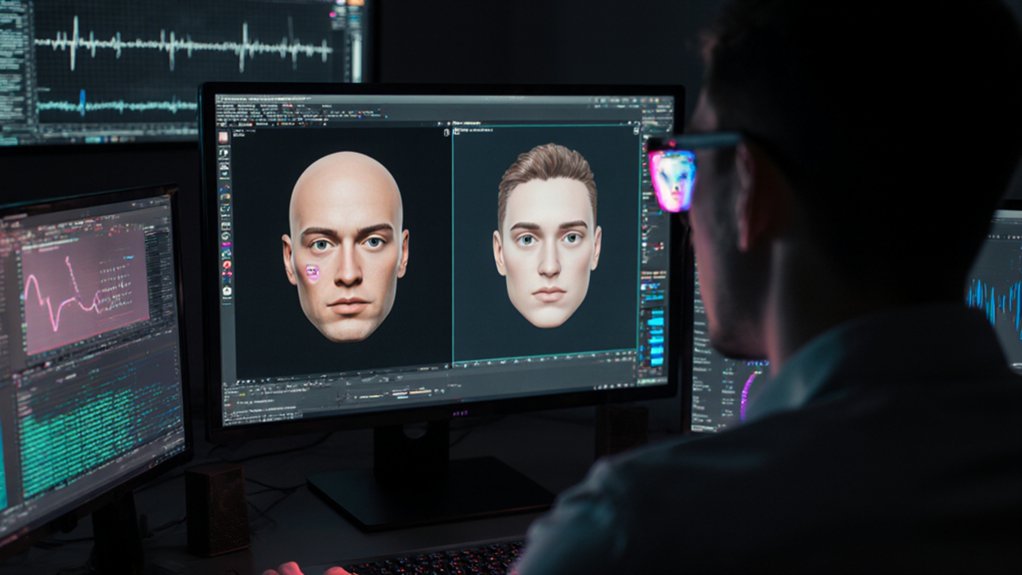
As we look ahead to 2026, the rise of deepfake technology raises critical questions about authenticity in digital media. We need to contemplate how advancements in detection will help us navigate this complex landscape. With new tools and techniques at our disposal, identifying fake videos and audio will become more manageable. But what challenges will remain in our fight against misinformation? Exploring these developments is essential for understanding our digital future.
Key Takeaways
- Enhanced detection algorithms in 2026 will enable real-time analysis of videos and audio to identify potential deepfakes instantly.
- Multi-modal detection techniques will combine various data sources for improved accuracy in spotting deepfake content.
- Users should examine facial expressions for inconsistencies and check for unnatural movements or odd blinking patterns.
- Analyzing audio quality for mismatches or odd modulations can help in identifying manipulated audio content.
- Credibility of the platform sharing the content should be investigated to assess the likelihood of deepfake dissemination.
What Are Deepfakes and How Do They Work?
Deepfakes are a fascinating yet controversial technology that allows us to create hyper-realistic digital content by manipulating audio and video. The origins of deepfake technology trace back to advancements in artificial intelligence and machine learning, enabling us to swap faces or alter voices with astonishing realism. While it’s exciting to explore these capabilities, we must also consider the ethical implications. Misinformation and privacy violations become significant concerns when anyone can fabricate realistic content of individuals without their consent. As we navigate this digital landscape, it’s essential we stay informed about the potential misuse of deepfakes, ensuring we maintain integrity and trust in our media. By understanding both the technology and its ethical dimensions, we can engage with it responsibly.
Key Techniques Used to Create Deepfakes
As we explore the key techniques behind deepfakes, we’ll see how Generative Adversarial Networks (GANs) play an essential role in their creation. We’ll also look at facial morphing techniques and audio synthesis methods that enhance realism. Understanding these tools helps us grasp the incredible capabilities and potential risks of deepfake technology.
Generative Adversarial Networks
While we explore the fascinating world of deepfake technology, it is crucial to understand the role of Generative Adversarial Networks (GANs) in this process. GANs leverage generative models to create highly realistic fake content through a unique process known as adversarial training. This involves two neural networks: the generator, which produces fake data, and the discriminator, which evaluates its authenticity.
Key aspects of GANs include:
- Realism: They generate images and videos that can be nearly indistinguishable from real ones.
- Adaptability: They can be trained on different datasets, allowing for diverse applications.
- Innovation: They continuously evolve, leading to increasingly sophisticated deepfakes.
Understanding GANs helps us navigate the complexities of identifying fake content effectively.
Facial Morphing Techniques
Facial morphing techniques play a pivotal role in the creation of deepfakes, allowing for the seamless alteration of a person’s likeness. By employing advanced morphing algorithms, we can blend features from one face with another, generating highly realistic representations. This technology often leverages facial recognition systems to guarantee precise alignment and detail.
| Technique | Description |
|---|---|
| 3D Morphing | Creates three-dimensional facial models to enhance realism. |
| Feature Extraction | Identifies key facial features for accurate blending. |
| Image Warping | Adjusts the geometry of images for smooth shifts. |
As we explore these techniques, we gain insight into how deepfakes manipulate visual content, making detection increasingly challenging.
Audio Synthesis Methods
How do we create convincing audio deepfakes that mimic a person’s voice with astonishing accuracy? It all comes down to advanced voice cloning and acoustic manipulation techniques. These methods allow us to generate synthetic audio that sounds remarkably authentic.
- Neural Networks: We use deep learning algorithms to analyze and replicate unique vocal patterns.
- Text-to-Speech Synthesis: This technique converts text inputs into spoken words, tailored to sound like the target individual.
- Prosody Modeling: We fine-tune the rhythm and intonation to enhance the emotional delivery of the generated speech.
Deepfake Technology Trends in 2026
As we look ahead to 2026, we can’t ignore the rise of enhanced detection algorithms that promise to combat deepfake misuse. Alongside this, user awareness campaigns will play an essential role in educating the public about the technology’s implications. Together, these trends could shape how we interact with digital content in the future.
Enhanced Detection Algorithms
While deepfake technology continues to evolve, we’re seeing significant advancements in enhanced detection algorithms that can identify manipulated media with greater accuracy. These developments are essential for improving deepfake detection and ensuring trust in digital content.
We can expect the following from these algorithm advancements:
- Real-time analysis: Algorithms will analyze videos and audio as they’re being created, flagging potential deepfakes instantly.
- Multi-modal detection: Combining various data sources, like audio and visual cues, enhances our ability to spot inconsistencies.
- Machine learning improvements: Continuous training on new deepfake techniques will keep detection methods ahead of the curve.
User Awareness Campaigns
User awareness campaigns are becoming increasingly essential in the fight against deepfakes as we move into 2026. We need to prioritize user education to help individuals recognize and respond to manipulated content. By fostering public engagement, we can create a culture of skepticism and critical thinking. Campaigns that promote understanding of deepfake technology will empower us all to question what we see and hear. Workshops, social media initiatives, and informative resources can guide us in spotting red flags—like inconsistencies in audio or video quality. Together, we can build a more informed community that resists the influence of deepfakes. Let’s work hand-in-hand to guarantee that everyone understands the implications of this technology and how to navigate it safely.
How Do Deepfakes Impact Society and Individuals?
Though deepfake technology offers fascinating possibilities for creativity and entertainment, its impact on society and individuals is multifaceted and often troubling. We’ve seen how it can erode social trust and invade personal privacy, leaving us questioning what’s real.
- Deepfakes can create false narratives that mislead the public.
- Personal privacy is compromised when individuals’ likenesses are manipulated without consent.
- The potential for blackmail and harassment increases, affecting mental health.
As we navigate this evolving landscape, we must remain vigilant. It’s vital to foster awareness and develop tools for identifying deepfakes. Together, we can work to protect our social fabric and guarantee that technology enhances, rather than undermines, our shared reality.
The Growing Threat of Misinformation From Deepfakes
As we confront the challenges posed by deepfakes, the threat of misinformation looms larger than ever. These manipulated videos and audio recordings can easily distort reality, leading to serious misinformation consequences. We’ve seen how quickly false narratives can spread, undermining public trust in both media and institutions. When people can’t differentiate between genuine content and deepfakes, skepticism grows, and our ability to engage in informed discussions diminishes. This growing threat can incite panic, manipulate opinions, and even disrupt democratic processes. It’s essential that we recognize the potential for deepfakes to shape our perceptions and actions, making it imperative to foster awareness and critical thinking. Together, we must remain vigilant against these deceptive technologies to protect our society.
Spotting Deepfakes: Tips You Need to Know
While deepfakes can be incredibly convincing, there are effective strategies we can use to spot them. By staying vigilant, we can navigate the ethical considerations and legal implications that arise from misinformation. Here are a few tips to help us identify deepfakes:
- Examine facial movements: Look for unnatural expressions or inconsistencies in lip-syncing.
- Check audio quality: Listen for odd voice modulation or background noises that don’t match the setting.
- Investigate the source: Verify the credibility of the platform or individual sharing the content.
Tools for Detecting Deepfakes
As we navigate the evolving landscape of deepfake technology, it’s essential to arm ourselves with effective tools for detection. We can explore AI-based detection tools, visual artifact analysis, and audio integrity verification to help us identify fakes. Understanding these resources will empower us to discern reality from manipulation more effectively.
AI-Based Detection Tools
Given the rapid evolution of deepfake technology, it’s vital for us to develop effective AI-based detection tools that can identify manipulated content. These tools must leverage emerging technologies to guarantee reliability and accuracy. We need to prioritize:
- User-friendly interfaces for ease of use across various demographics.
- Real-time analysis capabilities to provide immediate feedback on content authenticity.
- Collaborative efforts to establish industry standards and promote algorithm improvements.
As we address privacy concerns and the ethical implications of deepfakes, continuous learning in AI detection will be imperative. By harnessing these advancements, we can create robust solutions that help safeguard our digital environment and maintain trust in the media we consume.
Visual Artifact Analysis
AI-based detection tools play a significant role in combating deepfake technology, but we must also focus on visual artifact analysis for more precise identification. By employing visual inconsistency detection methods, we can uncover anomalies that reveal manipulated content. These discrepancies might include unnatural movements or mismatched lighting, making it easier for us to spot deepfakes.
Additionally, pixel analysis techniques allow us to examine the fine details of images and videos. By scrutinizing pixel-level data, we can identify irregularities that might indicate tampering. Combining these approaches enhances our ability to verify authenticity and protects against the spread of misinformation. As we continue to advance our understanding and tools, we’ll be better equipped to combat the challenges posed by deepfake technology.
Audio Integrity Verification
While many focus on visual cues in deepfakes, we can’t overlook the importance of audio integrity verification. The audio component can be just as misleading, and we need robust tools to detect these manipulations. By employing advanced audio fingerprinting techniques and signal processing methods, we can enhance our ability to identify fake audio.
Here are some key approaches we can use:
- Spectral analysis: Examining the frequency spectrum to spot anomalies.
- Phase correlation: Analyzing phase shifts that may indicate tampering.
- Machine learning algorithms: Training models to recognize patterns indicative of deepfake audio.
Steps to Verify the Authenticity of Media
As we navigate an increasingly complex media landscape, verifying the authenticity of content has never been more crucial. To kick off our media verification process, we should always check the source. Is it reputable? Next, we can analyze the content itself. Look for inconsistencies in audio or video quality, as they may indicate manipulation. Using reverse image search tools can help uncover the original context of images. Additionally, we can cross-reference information with trusted news outlets. Engaging in an authenticity assessment also means asking ourselves how the content makes us feel—are we being manipulated emotionally? By following these steps, we can protect ourselves from misinformation and guarantee we’re consuming reliable media in this digital age.
Understanding the Role of Social Media in Deepfake Spread
In our efforts to verify media authenticity, we can’t overlook the significant role social media plays in the spread of deepfakes. Social media algorithms prioritize engagement, often allowing viral misinformation to flourish. This can easily mislead users who might not have the tools to identify fake content.
- Deepfakes can quickly gain traction due to sensationalism.
- Algorithms amplify emotionally charged posts, increasing their reach.
- Users may struggle to differentiate between real and manipulated content.
As we navigate this digital landscape, we must remain vigilant. Understanding how social media platforms operate allows us to better recognize the potential for deepfakes to influence public perception and decisions. Staying informed is essential in combating this modern challenge.
Future Directions for Deepfake Detection and Prevention
Given the rapid evolution of deepfake technology, we must prioritize developing robust detection and prevention methods to combat its potential harms. As we move forward, let’s explore various preventive measures and ethical considerations in our approach to deepfake challenges.
| Preventive Measures | Detection Techniques | Ethical Considerations |
|---|---|---|
| Public Awareness Campaigns | AI-Powered Algorithms | User Consent |
| Media Literacy Programs | Blockchain Verification | Accountability for Creators |
| Legislation & Regulation | Anomaly Detection | Privacy Rights |
| Collaboration with Tech Firms | Real-Time Monitoring | Transparency in AI Usage |
Conclusion
As we move into 2026, we’re better equipped than ever to tackle the challenges posed by deepfakes. With advanced detection tools and greater public awareness, we can confidently navigate the digital landscape. By staying informed and utilizing available resources, we can protect ourselves from misinformation and its potential impacts. Together, we can foster a more discerning environment, ensuring that we recognize what’s real and what’s not in the media we consume. Let’s stay vigilant!