
Introduction
Artificial Intelligence is changing the way people learn, work, and interact with technology in 2026. Two of the most important branches of AI are Generative AI and Predictive AI. Many beginners often get confused between these technologies because both use machine learning and data to perform intelligent tasks. However, their goals, working methods, and applications are very different. Understanding the difference between generative and predictive AI is important for students, professionals, and businesses that want to build modern digital skills. Whether you are learning Data Science, AI, Machine Learning, Python, Digital Marketing, or Business Analytics, knowing these concepts can help you understand how modern AI systems work in real-world industries.
What Is Generative AI?
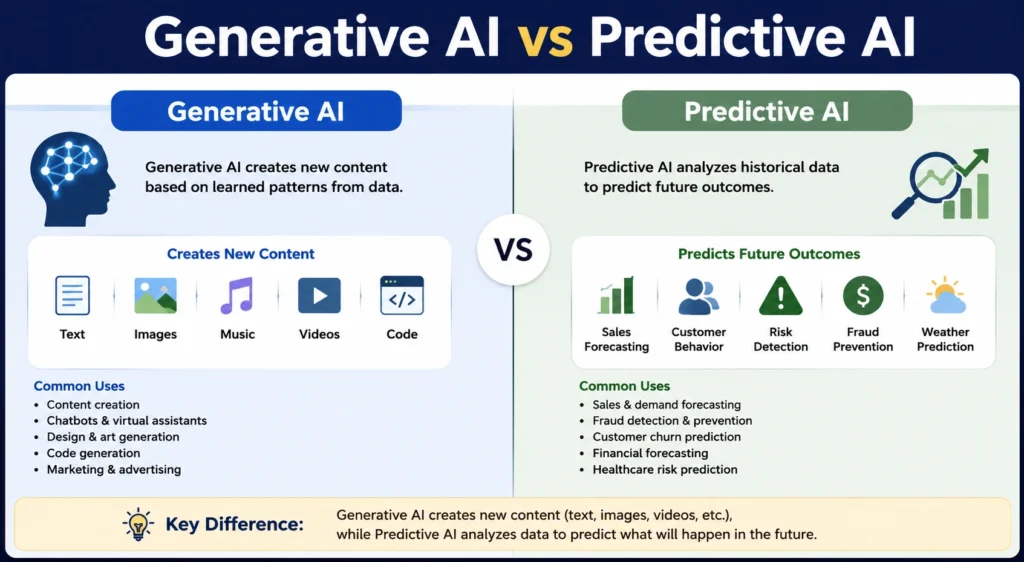
Generative AI is a type of artificial intelligence that creates new content using existing data patterns. It can generate text, images, music, videos, code, and even designs. Popular AI tools that write articles, create artwork, or generate chat responses are examples of generative AI. This technology studies large datasets and learns how humans create content. After learning patterns, it produces original outputs that look human-made. Generative AI is widely used in content creation, customer support, education, software development, and creative industries. Students learning Python and Machine Learning often use generative AI tools to improve productivity and creativity.
What Is Predictive AI?
Predictive AI is designed to analyze historical data and predict future outcomes. Instead of creating new content, it focuses on forecasting results based on trends and patterns. Predictive AI is commonly used in finance, healthcare, marketing, sales, and weather forecasting. For example, online shopping websites use predictive AI to recommend products based on customer behavior. Banks use it to detect fraud risks, while businesses use it to predict customer demand. Professionals studying Business Analytics and Data Science often work with predictive models because these systems help companies make smarter decisions.
Main Difference Between Generative and Predictive AI
The biggest difference between generative and predictive AI is their purpose. Generative AI creates something new, while predictive AI forecasts what may happen next. Generative AI focuses on creativity and content generation, whereas predictive AI focuses on analysis and prediction. For example, a generative AI chatbot can write an article or create an image, while predictive AI can estimate future sales or customer behavior. Both technologies use machine learning algorithms, but their outputs and goals are completely different.
How Generative AI Works
Generative AI works by training on massive datasets that include text, images, audio, or videos. It uses deep learning models such as neural networks and transformers to understand patterns in data. After training, the system generates unique outputs based on prompts or instructions. For instance, when a user asks an AI tool to write a blog or design a logo, the system creates fresh content using learned information. Many AI and Machine Learning courses now teach students how generative models work because demand for AI-generated content is increasing rapidly.
How Predictive AI Works
Predictive AI works by collecting historical data and analyzing it with statistical and machine learning models. It identifies relationships, trends, and patterns to forecast future events. Businesses use predictive AI to improve efficiency, reduce risks, and increase profits. For example, predictive systems can estimate customer churn, predict stock market trends, or analyze user engagement in Digital Marketing campaigns. Python programming plays an important role in predictive analytics because many data analysis tools and AI libraries are built using Python.
Real-World Applications of Generative AI
Generative AI has transformed many industries by improving creativity and automation. In education, AI tools generate study materials and personalized learning content. In marketing, businesses use generative AI to create advertisements, blogs, and social media posts. Graphic designers use AI image generators to create artwork quickly. Software developers use AI coding assistants to write and debug code. Healthcare companies also use generative AI to create medical reports and research summaries. As AI technology grows, professionals with skills in Data Science and Artificial Intelligence are becoming highly valuable in the job market.
Real-World Applications of Predictive AI
Predictive AI is extremely useful for organizations that rely on forecasting and data analysis. Retail companies use predictive analytics to estimate customer demand and manage inventory. Healthcare systems use predictive AI to detect diseases early and improve patient care. Financial institutions analyze transaction patterns to prevent fraud. Streaming platforms recommend movies and shows using predictive algorithms. In Digital Marketing, predictive AI helps businesses target the right audience and improve advertising performance. Students learning Business Analytics often study predictive models because they are essential for decision-making.
Benefits of Generative AI and Predictive AI
Both generative and predictive AI offer major benefits to businesses and individuals. Generative AI improves creativity, saves time, and automates content creation. It helps creators, marketers, and students complete tasks more efficiently. Predictive AI improves accuracy, reduces business risks, and supports better decision-making. Together, these technologies help organizations become smarter and more productive. Companies today are investing heavily in AI, Machine Learning, and Data Science training because AI-powered tools are shaping the future of work.
Important Point to Remember
- Generative AI creates new content, while Predictive AI analyzes data to forecast future outcomes.
Challenges of Generative and Predictive AI
Despite their advantages, both AI technologies also have challenges. Generative AI may sometimes produce incorrect or misleading information because it depends heavily on training data. It can also raise concerns about plagiarism and fake content. Predictive AI may deliver inaccurate predictions if the input data is poor or biased. Privacy and security issues are also important concerns in AI systems. This is why businesses need trained professionals with knowledge of Python, AI ethics, and Machine Learning to manage AI technologies responsibly.
Future of Generative and Predictive AI
The future of AI looks extremely promising as both technologies continue to evolve. Generative AI is expected to become more advanced in creating realistic content, virtual assistants, and personalized learning systems. Predictive AI will become even more powerful in healthcare, finance, cybersecurity, and business forecasting. Many industries will combine both technologies to build intelligent systems that can create content and make predictions simultaneously. Students learning Artificial Intelligence, Data Science, Business Analytics, and Digital Marketing today will have exciting career opportunities in the coming years.
Conclusion
Understanding the difference between generative and predictive AI is essential in today’s technology-driven world. Generative AI focuses on creating new content such as text, images, and videos, while predictive AI focuses on analyzing data and forecasting future outcomes. Both technologies are transforming industries by improving automation, creativity, and decision-making. From education and marketing to healthcare and finance, AI is becoming a major part of everyday life. As businesses continue adopting AI-powered systems, learning skills like Machine Learning, Python, Data Science, Digital Marketing, and Business Analytics can help students and professionals build successful careers in the fast-growing AI industry.