
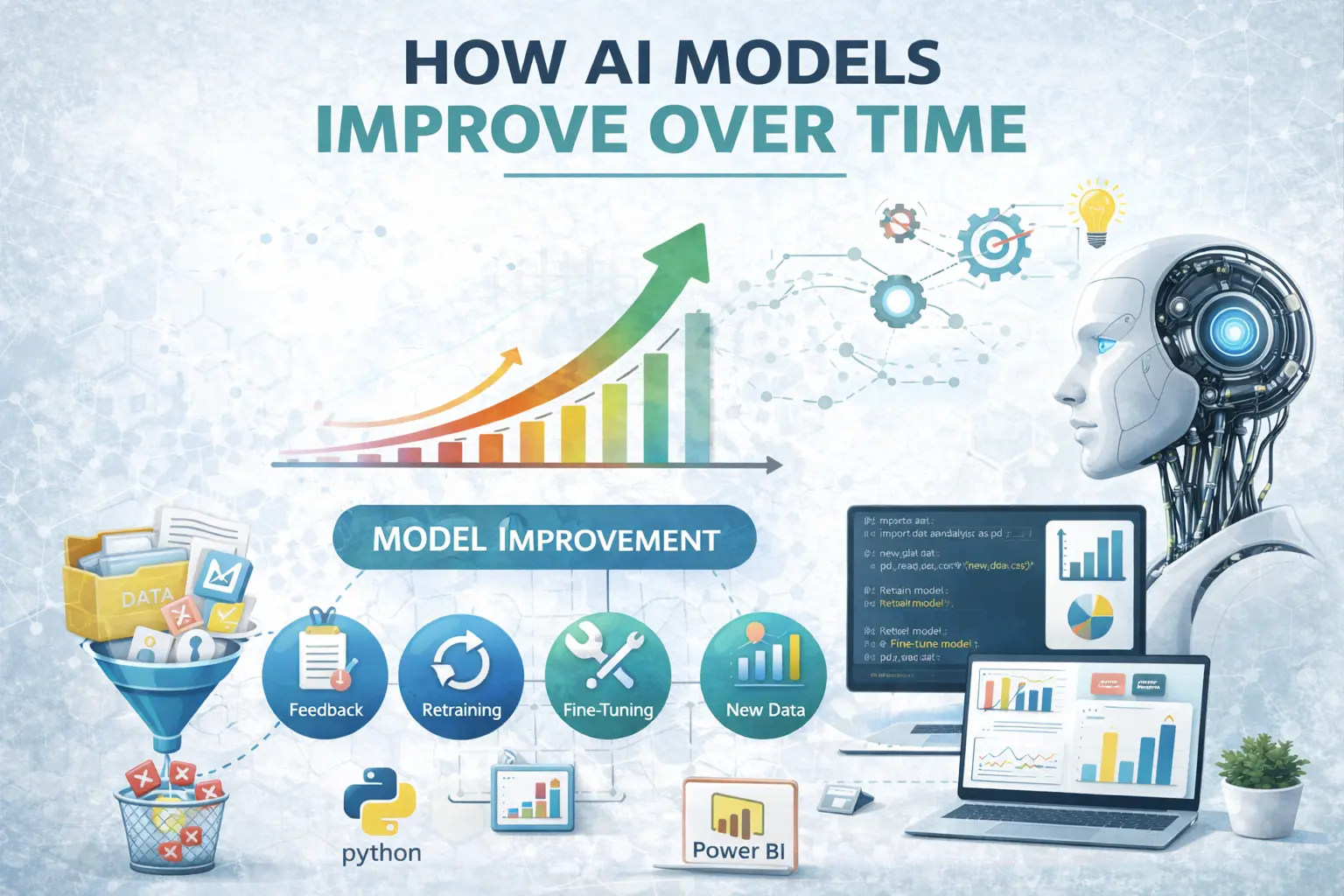
Introduction to How AI Models Improve Over Time
Artificial intelligence models are designed to learn and evolve as they process more data. Over time, these models become more accurate and efficient by identifying patterns and reducing errors. In fields like Data Science and AI, continuous improvement is essential for building systems that deliver reliable and intelligent outcomes.
Understanding the Learning Process of AI Models
AI models improve through a process called training, where they learn from data inputs and adjust their internal parameters. This process involves analyzing patterns and refining predictions based on feedback. In machine learning and data analytics, this iterative learning approach helps models become more precise with each cycle.
Role of Data in Model Improvement
Data plays a critical role in enhancing AI model performance. The more high-quality data a model receives, the better it can learn and generalize. In Data Science and Python, clean and well-structured data ensures that models can identify meaningful patterns and avoid incorrect conclusions.
Training and Retraining of Models
AI models are not trained just once; they require continuous retraining with updated data. This helps them stay relevant and adapt to changing trends. In AI and machine learning, retraining ensures that models remain accurate even as new data becomes available.
Feedback Loops and Model Optimization
Feedback loops are essential for improving AI systems. By comparing predictions with actual outcomes, models can adjust their parameters to minimize errors. In data analytics and AI, this ongoing optimization process helps refine performance and increase reliability over time.
Reducing Errors Through Fine-Tuning
Fine-tuning is the process of making small adjustments to improve model accuracy. It involves tweaking parameters and optimizing algorithms to achieve better results. In machine learning and Python, fine-tuning helps reduce errors and enhances the model’s ability to make accurate predictions.
Impact of Feature Engineering on Improvement
Feature engineering plays a major role in improving AI models. By selecting and transforming relevant features, models can better understand the data. In Data Science and data analytics, effective feature engineering leads to stronger model performance and more accurate insights.
Scalability and Continuous Learning
As AI systems grow, they must handle larger datasets and more complex tasks. Continuous learning allows models to scale efficiently and adapt to new challenges. In AI and Power BI, scalable models can process large volumes of data while maintaining performance.
Real-World Applications of Improving AI Models
AI models that improve over time are used in various industries such as healthcare, finance, and e-commerce. They help in fraud detection, personalized recommendations, and predictive analysis. In machine learning and Data Science, continuous improvement ensures that these applications remain effective and relevant.
Conclusion on AI Model Improvement
AI models are dynamic systems that evolve through data, feedback, and optimization techniques. Their ability to improve over time makes them powerful tools for solving complex problems. In fields like Data Science, Power BI, and AI, continuous model improvement is key to delivering accurate and impactful results.