
Introduction
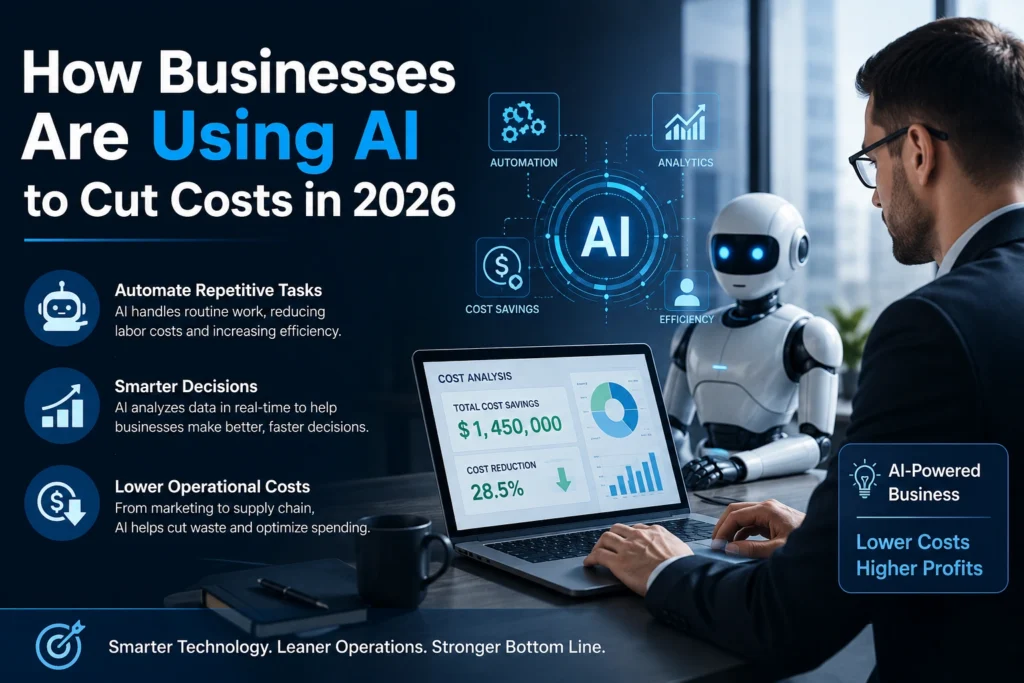
Artificial Intelligence (AI) has become one of the most valuable technologies for businesses in 2026. Companies across industries are no longer adopting AI simply to stay competitive—they are using it to reduce operational costs, improve productivity, and make faster business decisions. From automating repetitive tasks to improving customer service and analyzing business data, AI is helping organizations save both time and money. As AI technologies continue to evolve, businesses of all sizes are discovering new ways to increase efficiency without compromising quality. This growing demand has also increased interest in professional skills such as Data Science, Machine Learning, Python, and Business Analytics, as organizations seek experts who can implement AI-driven solutions effectively.
1. AI Is Reducing Manual Work Across Industries
One of the biggest reasons businesses are saving money in 2026 is AI-powered automation. Tasks that previously required multiple employees can now be completed automatically with intelligent software. Data entry, invoice processing, scheduling, document verification, and inventory updates are being handled by AI systems with minimal human involvement. This reduces labor costs while allowing employees to focus on more valuable and creative responsibilities. Businesses benefit from increased productivity, fewer errors, and faster operations, making automation one of the most cost-effective AI applications.
2. AI Is Improving Customer Support While Lowering Expenses
Customer service has changed dramatically with the introduction of AI-powered chatbots and virtual assistants. Modern AI systems can answer customer questions, process service requests, and resolve common issues 24 hours a day without requiring a large support team. Businesses can provide faster responses while significantly reducing operational expenses. Human support agents now focus mainly on complex cases, creating a better balance between automation and personalized service. This approach improves customer satisfaction while lowering staffing costs.
3. Predictive Analytics Helps Businesses Make Smarter Decisions
AI is transforming business decision-making by analyzing massive amounts of information within seconds. Predictive analytics allows companies to forecast demand, identify market trends, and anticipate customer behavior before problems arise. Professionals trained in Data Science and Business Analytics are increasingly using AI-powered tools to generate actionable insights that reduce unnecessary spending. Instead of relying on assumptions, businesses now make decisions based on accurate data, reducing financial risks and improving long-term planning.
4. AI Optimizes Supply Chain and Inventory Management
Supply chain optimization has become another major area where AI is cutting business costs. AI systems monitor inventory levels, predict product demand, and recommend ideal purchasing schedules. This prevents both overstocking and product shortages, helping businesses reduce storage expenses and avoid wasted inventory. Companies can also identify supply chain disruptions earlier and adjust operations before significant financial losses occur. AI-driven logistics management has become essential for businesses seeking greater efficiency in 2026.
5. AI Strengthens Marketing While Reducing Advertising Waste
Marketing budgets are becoming more efficient thanks to AI-powered analytics and automation. Businesses are using AI to understand customer preferences, personalize advertising campaigns, and improve targeting accuracy. Professionals working in Digital Marketing now rely on AI tools to identify the right audience, optimize advertising budgets, and measure campaign performance in real time. Instead of spending heavily on broad marketing strategies, businesses focus only on customers who are most likely to convert, resulting in lower acquisition costs and higher returns.
Key Ways AI Helps Businesses Save Money
- Automates repetitive business processes and reduces labor costs.
- Improves decision-making through real-time data analysis and forecasting.
- Optimizes marketing, customer support, and operational efficiency.
6. AI Improves Financial Management and Fraud Detection
Businesses are increasingly using AI to monitor financial transactions, detect unusual spending patterns, and identify potential fraud before it causes major losses. AI systems analyze thousands of transactions instantly, making financial monitoring faster and more reliable than traditional methods. Automated reporting also reduces the time accountants spend preparing financial documents. Organizations benefit from stronger financial security while minimizing operational costs associated with manual audits and investigations.
7. AI Supports Human Resources and Recruitment
Hiring employees can be both time-consuming and expensive. In 2026, AI is simplifying recruitment by screening resumes, ranking candidates, scheduling interviews, and identifying applicants who best match job requirements. Human resource teams spend less time reviewing applications and more time evaluating qualified candidates. Businesses reduce recruitment costs while improving hiring accuracy. AI is also helping organizations predict employee turnover and recommend strategies for improving workforce retention.
8. Machine Learning Improves Business Operations
Machine Learning is enabling AI systems to continuously improve their performance based on historical data. Manufacturing companies use Machine Learning to predict equipment failures before they happen, reducing maintenance expenses and preventing costly downtime. Retailers use AI to recommend products more accurately, increasing sales while reducing inventory waste. These intelligent systems become more effective over time, allowing businesses to achieve continuous cost savings across multiple departments.
9. Python Is Driving AI Development Across Businesses
Python remains one of the most popular programming languages for AI development in 2026 because of its simplicity and powerful ecosystem. Businesses rely on Python to build machine learning models, automate workflows, analyze business data, and develop AI applications. Professionals with Python skills are in high demand because they can create efficient automation solutions that improve productivity while reducing operational expenses. As AI adoption continues to expand, Python has become an essential skill for aspiring technology professionals.
10. AI Skills Are Becoming Essential for Future Business Growth
As businesses continue investing in AI technologies, the demand for skilled professionals is increasing rapidly. Organizations are actively hiring individuals with expertise in Artificial Intelligence, Data Science, Machine Learning, Python, Digital Marketing, and Business Analytics to lead digital transformation projects. These skills enable businesses to implement AI solutions effectively while maximizing cost savings and operational efficiency. Learning these technologies not only supports career growth but also prepares professionals to contribute to the future of intelligent business operations.
Conclusion
Artificial Intelligence is no longer a future innovation—it has become a practical business tool that delivers measurable cost savings in 2026. From automating repetitive tasks and improving customer service to enhancing marketing performance and financial management, AI is helping organizations operate more efficiently than ever before. Companies that combine AI technologies with skilled professionals in Data Science, Machine Learning, Python, Business Analytics, and Digital Marketing are building smarter, faster, and more profitable businesses. As AI continues to evolve, organizations that embrace innovation today will be better positioned for long-term success in an increasingly competitive global marketplace.