
Introduction
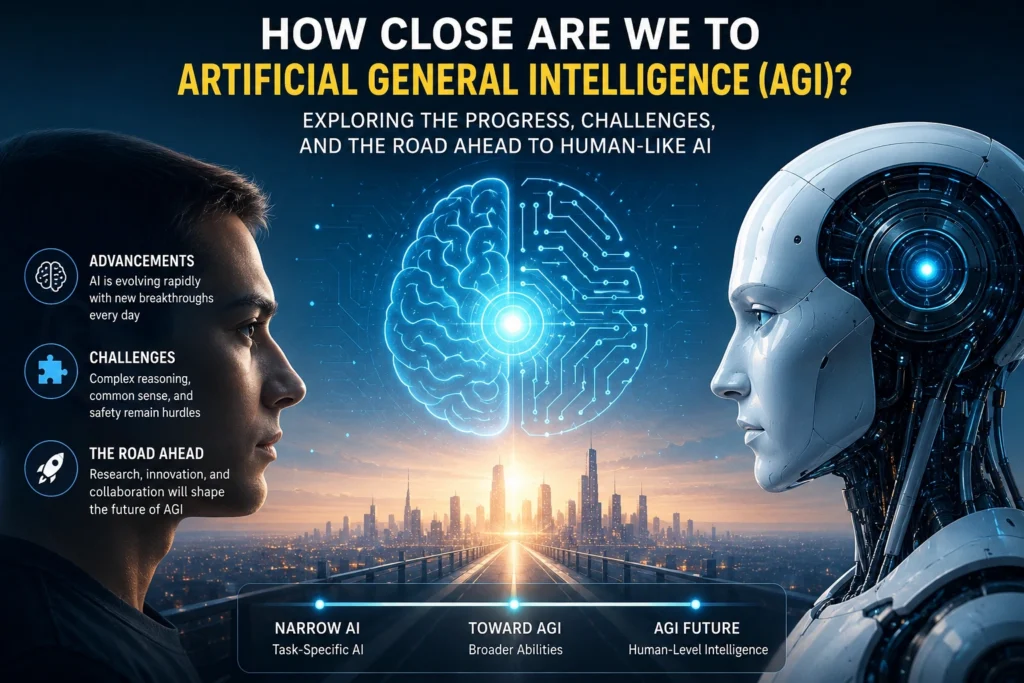
Artificial Intelligence has evolved at an extraordinary pace over the past few years, transforming industries, workplaces, and everyday life. From AI-powered chatbots and virtual assistants to intelligent automation and content generation, AI has become an essential part of modern technology. Amid these rapid advancements, one question continues to dominate conversations among researchers, businesses, and technology enthusiasts: How close are we to Artificial General Intelligence (AGI)? Unlike today’s AI systems, which are designed to perform specific tasks, AGI represents a future where machines possess human-like intelligence, capable of understanding, learning, reasoning, and adapting across multiple domains without requiring task-specific programming. Although remarkable progress has been made, achieving AGI remains one of the biggest scientific and technological challenges of our time. Understanding where we stand today helps us separate realistic expectations from science fiction.
What Is Artificial General Intelligence?
Artificial General Intelligence, commonly known as AGI, refers to an AI system capable of performing any intellectual task that a human can accomplish. Unlike current AI models, which specialize in limited functions such as language translation, image recognition, or coding assistance, AGI would be able to transfer knowledge between different tasks, solve unfamiliar problems, and continuously improve through experience. This flexibility and adaptability are what make AGI fundamentally different from the narrow AI systems that power today’s applications.
How Current AI Differs from AGI
Today’s AI models are incredibly powerful but remain specialized. They excel at processing large amounts of data, recognizing patterns, generating text, creating images, and assisting with decision-making. However, they still depend on training data and predefined objectives. They do not possess true self-awareness, independent reasoning, or human-like common sense. While these systems may appear intelligent during conversations, they cannot fully understand the world in the same way humans do. This distinction explains why experts continue to classify existing AI as Narrow AI rather than AGI.
The Rapid Progress of AI Technologies
Recent developments in generative AI, multimodal learning, robotics, and autonomous systems have significantly accelerated discussions about AGI. Modern AI models can analyze text, images, videos, and audio simultaneously, making them far more capable than earlier systems. Improvements in computing power, cloud infrastructure, and advanced neural network architectures have enabled AI to solve increasingly complex problems. Despite these breakthroughs, researchers agree that intelligence involves far more than processing information—it requires reasoning, long-term planning, creativity, and emotional understanding.
Challenges That Still Stand in the Way
Building AGI involves solving several scientific and engineering challenges that remain unsolved. Machines still struggle with common-sense reasoning, understanding context beyond training data, adapting to completely unfamiliar situations, and making reliable decisions without human supervision. Ethical concerns, safety risks, computational costs, and responsible AI development also present major obstacles. Researchers must ensure that increasingly intelligent systems remain aligned with human values while minimizing unintended consequences.
Key Challenges Include:
- Developing human-like reasoning and common-sense understanding.
- Ensuring AI systems remain safe, ethical, and transparent.
- Creating models that continuously learn without forgetting previous knowledge.
Can Machine Learning Lead Us to AGI?
Machine Learning remains the foundation of modern AI research and is expected to play a central role in the journey toward AGI. Advanced learning algorithms allow machines to recognize patterns, improve predictions, and make data-driven decisions. However, researchers believe that Machine Learning alone may not be enough. Future AGI systems may require new approaches that combine reasoning, memory, symbolic logic, neuroscience-inspired models, and advanced cognitive architectures. The path toward AGI will likely involve multiple technologies working together rather than relying on a single breakthrough.
Why Learning AI Skills Matters Today
As AI continues to reshape industries, professionals with technical knowledge are becoming increasingly valuable. Learning Artificial Intelligence, Machine Learning, Python, and Data Science equips individuals with practical skills needed to build intelligent applications, analyze complex datasets, and automate business processes. These fields not only prepare learners for current career opportunities but also provide a strong foundation for understanding future developments like AGI. Organizations across healthcare, finance, manufacturing, education, and technology are actively seeking professionals who can work alongside intelligent systems.
The Business Impact of AGI
If AGI becomes a reality, its impact on businesses could be transformative. Companies may benefit from highly autonomous systems capable of strategic planning, advanced customer support, product innovation, and complex decision-making. Professionals with expertise in Business Analytics will play a crucial role in interpreting AI-driven insights and helping organizations make smarter decisions. Similarly, Digital Marketing professionals will increasingly use intelligent systems to deliver personalized campaigns, analyze consumer behavior, and optimize marketing strategies with greater accuracy.
Expert Opinions on the Timeline
There is no universal agreement on when AGI will become reality. Some researchers believe it could emerge within the next decade, while others argue it may take several decades or even longer. Predicting technological breakthroughs is extremely difficult because intelligence is one of the most complex phenomena known to science. Most experts agree that current AI represents significant progress, but true AGI will require advances beyond today’s capabilities. Rather than focusing on exact timelines, researchers continue working toward incremental improvements that gradually expand AI’s abilities.
Preparing for an AI-Driven Future
Whether AGI arrives soon or remains a long-term goal, AI will continue transforming industries and creating new career opportunities. Individuals who invest in learning emerging technologies will be better prepared for future workplace demands. Developing expertise in Python programming, Data Science, Artificial Intelligence, Machine Learning, Business Analytics, and Digital Marketing allows professionals to adapt to evolving technologies while remaining competitive in a rapidly changing job market. Continuous learning will become one of the most valuable skills in the age of intelligent automation.
Conclusion
Artificial General Intelligence remains one of the most ambitious goals in modern technology. While today’s AI systems demonstrate impressive capabilities, they still lack the flexibility, reasoning, and adaptability that define human intelligence. Significant progress has been made, but important scientific, technical, and ethical challenges must still be overcome before AGI becomes reality. Regardless of when AGI arrives, the rapid advancement of AI is already transforming industries, creating exciting career opportunities, and reshaping the future of work. Staying informed and building skills in AI-related fields today is one of the smartest ways to prepare for tomorrow’s technology-driven world.