
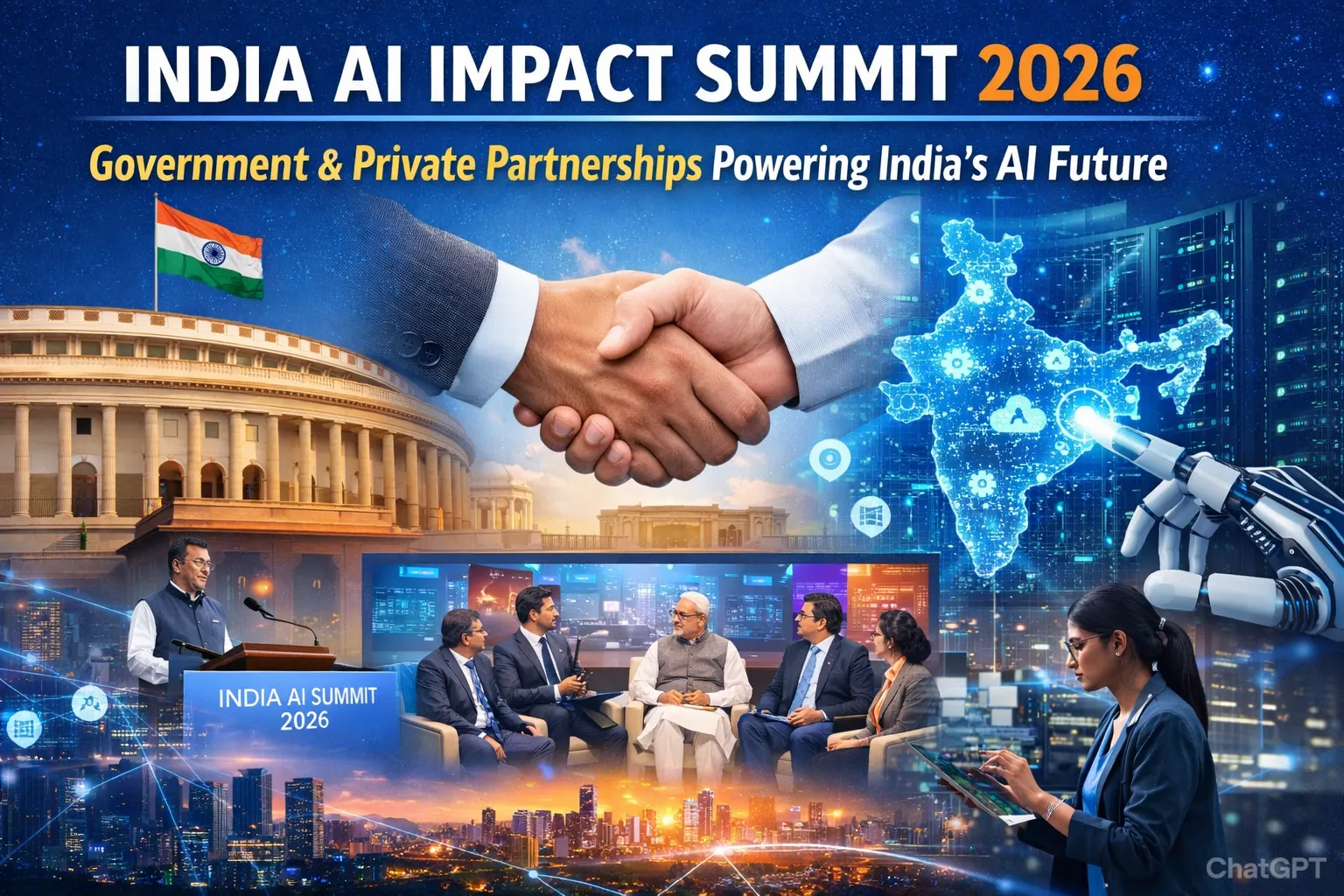
A Defining Moment at India AI Impact Summit 2026 in New Delhi
The India AI Impact Summit 2026, held in New Delhi, marked a transformative moment in the country’s technological journey. Unlike previous conferences focused only on innovation showcases, this summit demonstrated how coordinated action between the public and private sectors can accelerate national AI ambitions. The event brought together policymakers, global technology corporations, Indian startups, research institutions, venture capitalists, and academic leaders under one unified mission — positioning India as a global AI powerhouse.
The summit was not merely about futuristic discussions; it was about execution. Central ministries, state governments, multinational corporations, and domestic enterprises jointly announced initiatives that emphasized infrastructure expansion, AI governance, skill development, startup funding, and sector-specific AI implementation. The scale and structure of collaboration revealed that India’s AI story is no longer fragmented — it is strategically aligned.
Government Vision 2026: Policy as the Foundation of AI Growth
One of the strongest pillars highlighted at the summit was the proactive role of the Government of India in shaping AI development through policy clarity and infrastructure investment. The Ministry of Electronics and Information Technology (MeitY) outlined a structured roadmap focusing on compute access, data governance, AI ethics, and public digital infrastructure.
Through national programs such as Digital India and IndiaAI Mission, the government demonstrated how policy support and financial backing can create an ecosystem where innovation thrives. The IndiaAI Mission’s emphasis on building AI compute clusters, open datasets, and indigenous AI models was reinforced with fresh announcements during the summit.
Policy stability was repeatedly emphasized as the biggest driver of investor confidence. By clarifying compliance frameworks, data usage standards, and responsible AI guidelines, the government sent a strong signal to global players that India is not just a large market, but a structured AI ecosystem with long-term regulatory certainty.
Public-Private Partnerships: The Core Engine of AI Expansion
The summit made it evident that artificial intelligence cannot scale nationally without strong public-private partnerships (PPPs). Several joint ventures were announced between government agencies and private corporations to expand GPU infrastructure, build AI research labs, and fund AI startups in tier-2 and tier-3 cities.
Global technology leaders, including Microsoft, Google, and NVIDIA, expressed commitments to collaborate with Indian institutions to expand AI training programs, cloud credits, and hardware access. These partnerships were structured around knowledge transfer, capacity building, and scalable AI deployment rather than short-term sponsorship announcements.
By combining government-backed digital public infrastructure with private sector technological expertise, India is building a hybrid AI growth model. This approach reduces dependence on imports while ensuring access to world-class innovation.
AI Infrastructure Push: Compute, Data Centers, and Cloud Alliances
One of the most impactful outcomes of the summit was the announcement of new AI data centers and GPU clusters across multiple Indian states. Government-backed incentives for semiconductor manufacturing and data localization attracted commitments from private hyperscalers.
India’s infrastructure vision aligns closely with its ambition to reduce compute dependency and build sovereign AI capabilities. Companies partnered with public agencies to establish AI supercomputing facilities that will be accessible to startups, universities, and research bodies at subsidized rates.
The summit highlighted how infrastructure is no longer optional — it is foundational. Without large-scale compute access, innovation remains limited to large corporations. Through shared investment models, the government and private sector are democratizing AI experimentation across the country.
Startup Acceleration and Funding Ecosystem Strengthened
The India AI Impact Summit 2026 strongly emphasized startup enablement through blended funding mechanisms. Government-backed innovation funds were combined with venture capital commitments to support early-stage AI companies.
Dedicated AI incubators were announced in collaboration with industry leaders and public universities. These centers aim to provide mentorship, compute credits, compliance guidance, and market access. The partnership structure ensures that startups are not just funded but strategically supported throughout their growth journey.
By aligning policy incentives with private capital, India is creating a pipeline of AI startups capable of competing globally. This collaboration ensures that innovation is not confined to metropolitan hubs but spreads across emerging tech clusters nationwide.
Responsible AI and Governance Framework Through Collaborative Input
Another major theme of the summit was responsible AI development. The government introduced updates to the New Delhi AI Governance Framework 2026, developed with consultation from private tech leaders, legal experts, and ethics researchers.
The collaborative drafting process ensures that policies are practical rather than restrictive. Private firms contributed technical insights into algorithmic transparency, bias mitigation, cybersecurity risks, and AI audit systems. In turn, regulators provided clarity on compliance expectations and accountability standards.
This shared governance model ensures India’s AI growth does not come at the cost of privacy, security, or social equity. It positions the country as a responsible AI innovator on the global stage.
Sector-Specific Collaborations: Healthcare, Agriculture, and Education
The summit also showcased joint government-private initiatives targeting real-world sectors. In healthcare, AI diagnostics tools were piloted in partnership with public hospitals. In agriculture, AI-based crop advisory systems were integrated into government platforms to support farmers with predictive analytics and climate data.
Education saw major announcements regarding AI curriculum integration in public universities, with private edtech companies contributing learning platforms and certification frameworks. This blended approach ensures scalable impact across millions of citizens rather than isolated pilot projects.
Skill Development and AI Workforce Expansion
Addressing India’s demographic advantage, the summit highlighted massive upskilling programs backed by both ministries and global technology companies. Industry-aligned certification programs, AI bootcamps, and scholarship initiatives were launched to prepare students and working professionals for AI-driven careers.
The public-private model ensures curriculum relevance while maintaining affordability. Government subsidies lower access barriers, while corporate expertise guarantees alignment with real industry requirements. This coordinated effort directly supports India’s goal of becoming the world’s largest AI talent hub.
Global Significance: India’s Collaborative AI Model as a Blueprint
What made the India AI Impact Summit 2026 stand out globally was its collaborative execution model. Rather than positioning government and corporations as separate forces, the summit demonstrated how both can operate as strategic partners.
International observers recognized India’s approach as scalable and inclusive. By combining regulatory clarity, infrastructure investment, private innovation, startup enablement, and workforce development, India presented a comprehensive AI ecosystem model that other emerging economies may adopt.
Conclusion: A Partnership-Driven AI Future for India
The India AI Impact Summit 2026 was not simply an event; it was a structural shift in how India approaches artificial intelligence development. Government leadership provided direction and stability, while private enterprises delivered speed, innovation, and technological depth.
This synergy between public institutions and private corporations has laid the foundation for India’s AI decade. If the announcements and partnerships unveiled at the summit are executed effectively, India will not only strengthen its domestic AI ecosystem but also emerge as a global leader in responsible, inclusive, and scalable artificial intelligence.
The summit clearly proved one thing: India’s AI future will be built together, not alone.