
AI and the Concept of Naive Bayes in Machine Learning
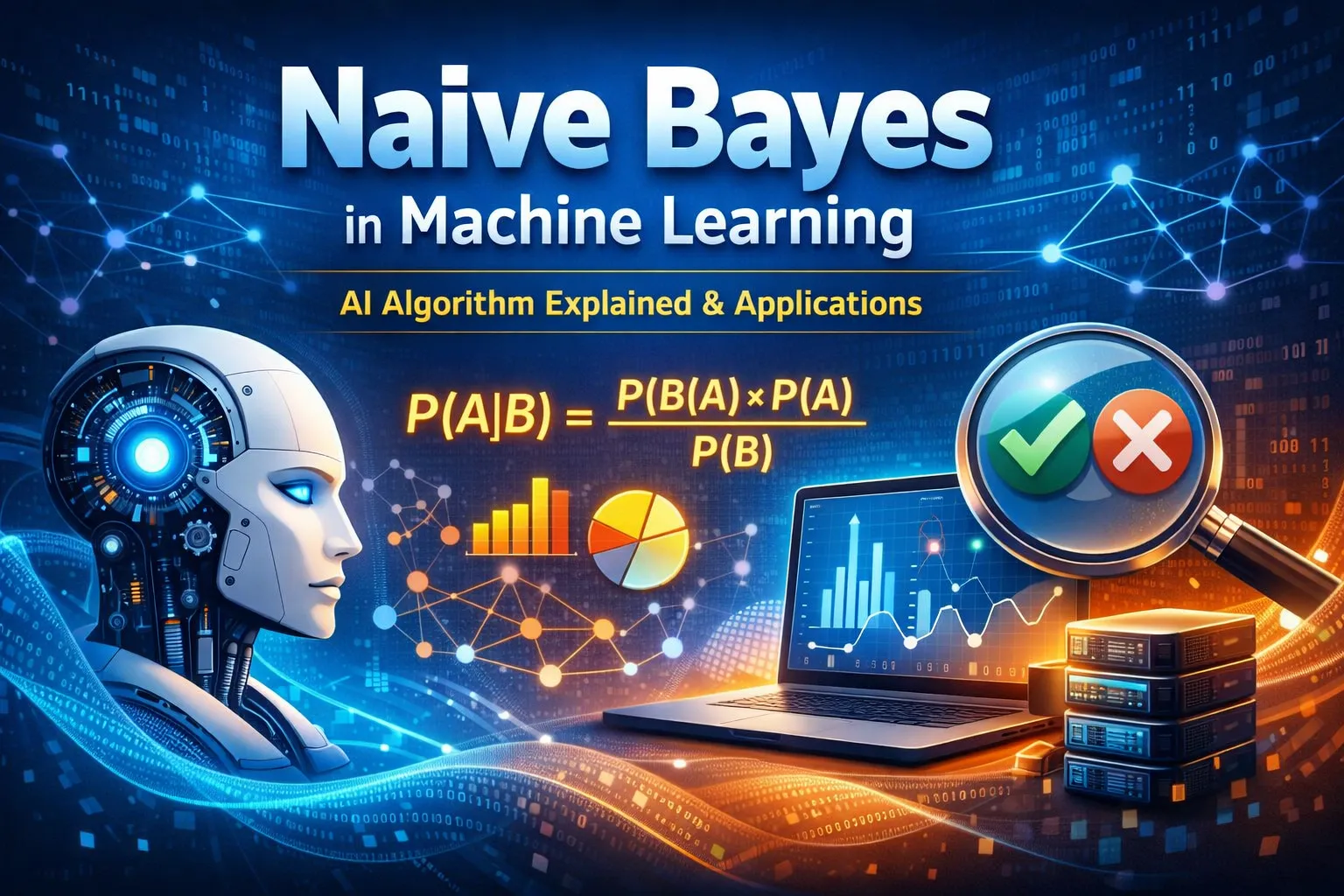
Naive Bayes is one of the most widely used probabilistic algorithms in machine learning, playing a significant role in AI-driven decision-making systems. It is based on Bayes’ Theorem and operates under the assumption of feature independence, which means that each feature contributes independently to the final prediction. Despite its simplicity, Naive Bayes delivers powerful results in real-world AI applications such as text classification, spam detection, and sentiment analysis.
AI Foundations Behind the Naive Bayes Algorithm
The mathematical foundation of Naive Bayes relies on probability theory, where AI systems calculate the likelihood of an outcome based on prior knowledge. Bayes’ Theorem allows the algorithm to update predictions as new data becomes available, making it highly adaptive. This capability enables AI models to make fast and reliable predictions even when trained on relatively small datasets.
AI-Based Working Mechanism of Naive Bayes
The working of Naive Bayes in AI involves calculating the probability of each class for a given input and selecting the class with the highest probability. The algorithm evaluates prior probability, likelihood, and posterior probability to arrive at a decision. Because of its lightweight structure, AI systems using Naive Bayes can process large volumes of data efficiently without heavy computational requirements.
AI Applications Where Naive Bayes Performs Best
Naive Bayes is extensively used in AI-powered applications such as email spam filtering, document categorization, recommendation systems, and medical diagnosis. Its ability to handle high-dimensional data makes it especially suitable for natural language processing tasks. Many AI-driven search engines and content moderation systems rely on Naive Bayes for quick and accurate classification.
AI Advantages of Using Naive Bayes in Machine Learning
One of the major advantages of Naive Bayes in AI is its simplicity and speed. The algorithm is easy to implement, scales well with large datasets, and performs exceptionally well for categorical data. AI models using Naive Bayes also require less training data compared to complex algorithms, making it ideal for real-time analytics and predictive modeling.
AI Limitations and Challenges of Naive Bayes
Although effective, Naive Bayes has certain limitations in AI implementations. The assumption of feature independence rarely holds in real-world scenarios, which can affect accuracy. Additionally, zero-frequency issues may arise when a feature value does not appear in the training dataset. Despite these challenges, AI practitioners often apply smoothing techniques to improve performance.
AI Role of Naive Bayes in Modern Data Science
In modern data science workflows, Naive Bayes continues to be a valuable AI algorithm due to its interpretability and efficiency. It is often used as a baseline model to compare performance with more advanced techniques. Many AI learning platforms and training institutes introduce Naive Bayes early to help learners understand probabilistic reasoning.
AI Future Scope of Naive Bayes Algorithm
With the growth of AI and big data, Naive Bayes remains relevant for applications requiring fast and scalable solutions. It integrates well with hybrid AI systems and ensemble models to enhance prediction accuracy. As automation and intelligent systems expand across industries, Naive Bayes will continue to be an essential algorithm in the AI ecosystem.