
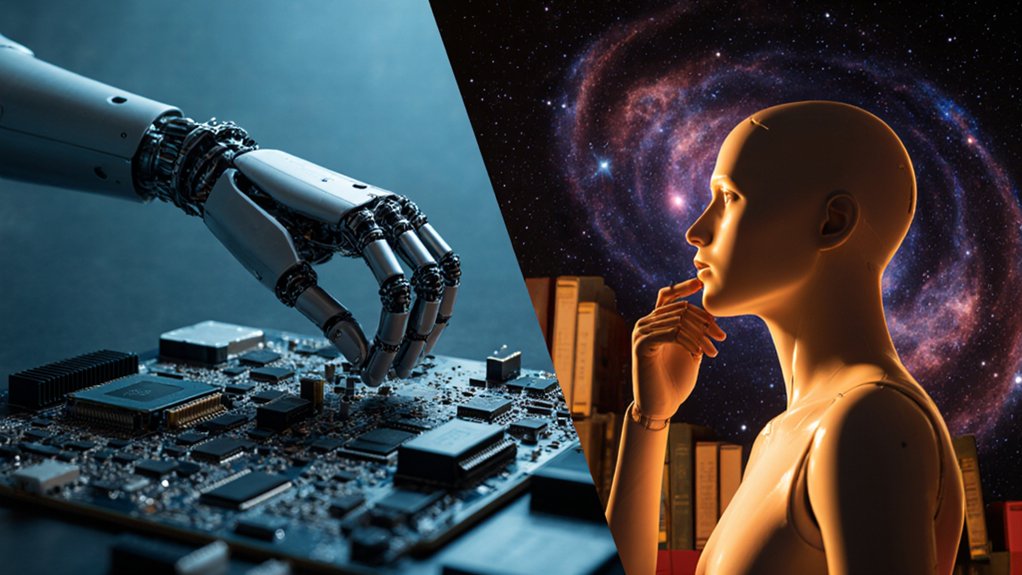
Narrow AI and General AI represent two distinct paths in artificial intelligence development. While Narrow AI excels at specific tasks, such as voice recognition, it lacks the broader understanding and adaptability of General AI. Understanding these differences is vital, especially as technology evolves. What implications do these capabilities have for the future of AI, and how will they shape our interactions with machines?
Key Takeaways
- Narrow AI specializes in specific tasks, while General AI aims to replicate human-like cognitive abilities across various activities.
- Narrow AI operates within predefined parameters, whereas General AI exhibits adaptability and learning in different contexts.
- Narrow AI can outperform humans in certain tasks but lacks reasoning, while General AI can understand and solve problems across diverse situations.
- Real-world applications of Narrow AI include medical imaging and chatbots, while General AI enhances autonomous transportation and personalized education.
- Understanding these differences is crucial for grasping AI’s current capabilities and future potential impacts on society.
What Is Narrow AI and How Does It Work?
Narrow AI, often referred to as weak AI, specializes in performing specific tasks with high efficiency and accuracy. It operates within predefined parameters, utilizing algorithms and data to solve particular problems. For instance, voice assistants like Siri and Alexa recognize commands and provide information based on user requests. These systems learn from vast amounts of data, adapting their responses over time to improve accuracy. Narrow AI excels in areas such as image recognition, language translation, and recommendation systems. However, it lacks the ability to understand or process information outside its designated scope. As a result, while narrow AI can outperform humans in specific tasks, it doesn’t possess the general reasoning or cognitive abilities seen in humans or future general AI systems.
Characteristics of General AI
While narrow AI excels in specific tasks, general AI aims to replicate human-like cognitive abilities across a wide range of activities. This ambitious goal involves several key characteristics that distinguish general AI from its narrow counterpart.
- Adaptability: General AI can learn and apply knowledge in various contexts, adjusting to new situations much like a human would.
- Reasoning: It possesses the ability to reason and solve problems, making inferences based on incomplete information.
- Understanding: General AI can comprehend and generate natural language, allowing for meaningful interactions with humans.
These characteristics enable general AI to function across diverse domains, making it a powerful tool with the potential to revolutionize numerous industries.
Understanding Key Differences Between Narrow AI and General AI
Although both narrow AI and general AI are integral to the development of artificial intelligence, they serve fundamentally different purposes. Narrow AI focuses on specific tasks, like image recognition or language translation, excelling within defined boundaries. It’s programmed to perform a single function or a set of closely related functions, making it highly effective in those areas. In contrast, general AI aims to replicate human cognitive abilities, enabling machines to understand, learn, and adapt across a wide range of tasks and situations. While narrow AI can outperform humans in specific tasks, it lacks the ability to think and reason like a human. Understanding these differences is essential for grasping the current capabilities and future potential of artificial intelligence.
Real-World Examples of Narrow AI in Action
As technology evolves, numerous real-world applications of narrow AI have emerged, showcasing its effectiveness in various fields. These specialized systems excel in performing specific tasks, markedly enhancing efficiency and accuracy. For instance, in healthcare, narrow AI assists in diagnosing diseases by analyzing medical images. Similarly, in finance, it helps detect fraudulent transactions through pattern recognition. Additionally, in customer service, chatbots provide immediate responses to inquiries, improving user experience.
- Medical imaging analysis for early disease detection
- Fraud detection in financial transactions using algorithms
- Chatbots offering 24/7 customer support and information
These examples illustrate how narrow AI is reshaping industries, enabling better decision-making and streamlining processes without the need for human intervention in routine tasks.
How Does Narrow AI Impact Our Daily Lives?
Narrow AI considerably shapes daily life by providing everyday convenience tools that simplify tasks. It enhances decision-making by offering tailored assistance, making choices easier and more informed. Additionally, personalized entertainment experiences keep users engaged and satisfied, showcasing the technology’s vast impact on modern living.
Everyday Convenience Tools
While many people may not realize it, narrow AI considerably shapes our daily routines through various convenience tools. These tools enhance productivity and simplify everyday tasks, making life more manageable.
- Voice assistants like Siri and Alexa help with hands-free tasks, from setting reminders to controlling smart home devices.
- Recommendation systems on platforms like Netflix or Spotify tailor content to individual preferences, making entertainment choices easier.
- Navigation apps such as Google Maps provide real-time traffic updates and ideal routes, reducing travel time and stress.
Enhanced Decision-Making Assistance
The influence of narrow AI extends beyond everyday convenience tools, considerably enhancing decision-making processes in various aspects of life. For instance, businesses utilize narrow AI algorithms to analyze vast amounts of data, revealing trends that guide strategic planning. In healthcare, AI assists doctors in diagnosing conditions by providing evidence-based recommendations, which can lead to better patient outcomes. In finance, AI-driven tools evaluate investment risks, helping individuals make informed choices. Even in personal life, narrow AI applications suggest ideal routes for travel, saving time and reducing stress. By providing insights and recommendations, narrow AI empowers users to make smarter choices, transforming how they approach both professional and personal decisions. This impact on decision-making is profound and increasingly indispensable.
Personalized Entertainment Experiences
Artificial intelligence has revolutionized the way people experience entertainment, creating personalized experiences that cater to individual preferences. Narrow AI analyzes user data to tailor content recommendations, enhancing enjoyment and engagement. This technology impacts daily life in several ways:
- Streaming Services: Platforms like Netflix and Spotify use algorithms to suggest shows and music based on users’ viewing and listening habits.
- Gaming: AI adapts game difficulty and storylines to match players’ skill levels and choices, providing a unique experience for each individual.
- Social Media: Personalized feeds curate content that resonates with users, keeping them connected and engaged with their interests.
Through these innovations, narrow AI enhances the enjoyment of entertainment, making it more relevant and immersive for everyone.
Future Applications of General AI
As society looks ahead, the potential of General AI to transform various sectors becomes increasingly apparent. In healthcare, it could revolutionize patient care and diagnostics, while autonomous transportation might enhance safety and efficiency on the roads. Additionally, General AI could create more personalized and engaging educational experiences, shaping the future of learning.
Healthcare Revolution Potential
While technology continues to advance rapidly, the potential for General AI to revolutionize healthcare remains one of the most exciting prospects. By integrating General AI into medical systems, healthcare can become more efficient, personalized, and accessible. Some transformative applications include:
- Predictive analytics: General AI can analyze vast datasets to forecast disease outbreaks and patient health trends, enabling proactive interventions.
- Personalized treatment plans: With its capability to process individual patient data, General AI can tailor treatments to optimize effectiveness and reduce side effects.
- Enhanced diagnostics: General AI systems can assist healthcare professionals by interpreting medical images and lab results with high accuracy, leading to quicker and more reliable diagnoses.
As these innovations unfold, they’ll likely reshape patient care and improve overall health outcomes.
Autonomous Transportation Advancements
The future of transportation looks promising with the advancements brought by General AI. Self-driving vehicles are becoming increasingly sophisticated, utilizing machine learning algorithms to navigate complex environments safely. These vehicles can analyze real-time data from their surroundings, making split-second decisions to enhance safety and efficiency. Additionally, General AI’s ability to predict traffic patterns will optimize routes, reducing congestion and emissions. Public transportation systems are also set to benefit, employing AI for dynamic scheduling and real-time updates, improving user experience. As autonomous technology matures, we’ll see a reduction in accidents and improved accessibility for those unable to drive. Overall, General AI’s role in transportation stands to revolutionize how people and goods move, paving the way for a smarter, safer future.
Enhanced Educational Experiences
With the integration of General AI into educational systems, students can look forward to personalized learning experiences that cater to individual needs and learning styles. This transformative approach can markedly enhance engagement and retention. General AI can analyze data to provide tailored resources and feedback, ensuring that each student progresses at their own pace.
- Adaptive learning platforms will adjust content difficulty based on real-time assessments.
- AI-driven tutoring systems can offer instant support and answer questions outside classroom hours.
- Predictive analytics can identify students at risk of falling behind, allowing for timely interventions.
These advancements promise to foster a more inclusive and effective educational environment, equipping students with the skills they need for future success.
Understanding the Limitations of Narrow AI
Although Narrow AI excels in performing specific tasks, it faces significant limitations that hinder its versatility and adaptability. These systems are designed to solve particular problems, which means they can’t operate outside their programmed capabilities. For instance, a voice assistant can manage schedules but can’t understand human emotions or engage in complex conversations. Narrow AI lacks the ability to learn from experience beyond its designated domain, making it inflexible in dynamic situations. Additionally, it doesn’t possess common sense reasoning, which often leads to errors when faced with unexpected scenarios. This specialized focus is useful for efficiency but restricts broader applicability, limiting its potential to innovate or handle diverse challenges that require a more holistic understanding.
Challenges and Ethical Considerations for General AI
Narrow AI’s limitations highlight the complexities faced by the development of General AI. As researchers endeavor to create machines that can think and reason like humans, several challenges and ethical considerations arise:
- Bias and Fairness: General AI systems may inherit biases from training data, leading to unfair outcomes for certain groups.
- Accountability: Determining responsibility when AI makes mistakes becomes increasingly challenging, raising questions about liability and governance.
- Job Displacement: The potential for General AI to automate many jobs raises concerns about economic inequality and societal impact.
Addressing these challenges is essential for ensuring that General AI benefits humanity while traversing ethical dilemmas. As the technology evolves, ongoing dialogue among stakeholders will be vital in shaping its future responsibly.
What Does the Future Hold for AI Development?
As researchers continue to push the boundaries of artificial intelligence, the future of AI development promises to be both transformative and challenging. Innovations in algorithms and computing power are likely to enhance narrow AI applications, making them more efficient and capable. Meanwhile, the pursuit of general AI raises significant questions about safety, ethics, and societal impact. Developers must address potential biases, job displacement, and privacy concerns as they create more advanced systems. Collaborative efforts between governments, academia, and industry will be vital to guarantee responsible AI progress. As AI becomes more integrated into everyday life, its ability to augment human potential could reshape industries and redefine the nature of work, pushing society toward a new technological era. Additionally, the emphasis on hands-on practical sessions in AI training will be crucial for equipping future developers with the skills needed to navigate these challenges.
Conclusion
In conclusion, the distinction between Narrow AI and General AI highlights the evolving landscape of artificial intelligence. While Narrow AI efficiently handles specific tasks, General AI aspires to replicate human-like reasoning and adaptability. This contrast not only shapes how AI integrates into daily life but also raises important ethical questions for the future. As technology advances, understanding these differences will be essential for harnessing AI’s potential responsibly and effectively. The journey toward General AI remains an exciting frontier.