
Introduction to Reinforcement Learning Basics for Beginners
Reinforcement learning is one of the most exciting areas of modern technology, especially for those starting their journey in intelligent systems. It focuses on teaching machines how to make decisions by interacting with an environment. Unlike traditional approaches in Data Science or machine learning, reinforcement learning is based on trial and error, where systems learn from their actions and outcomes over time.
What is Reinforcement Learning?
Reinforcement learning is a type of machine learning where an agent learns to perform tasks by receiving rewards or penalties. The goal is to maximize the total reward over time. In AI systems, this approach allows machines to learn complex behaviors without being explicitly programmed. It is widely used in areas where decision-making is dynamic and requires continuous improvement.
Key Components of Reinforcement Learning
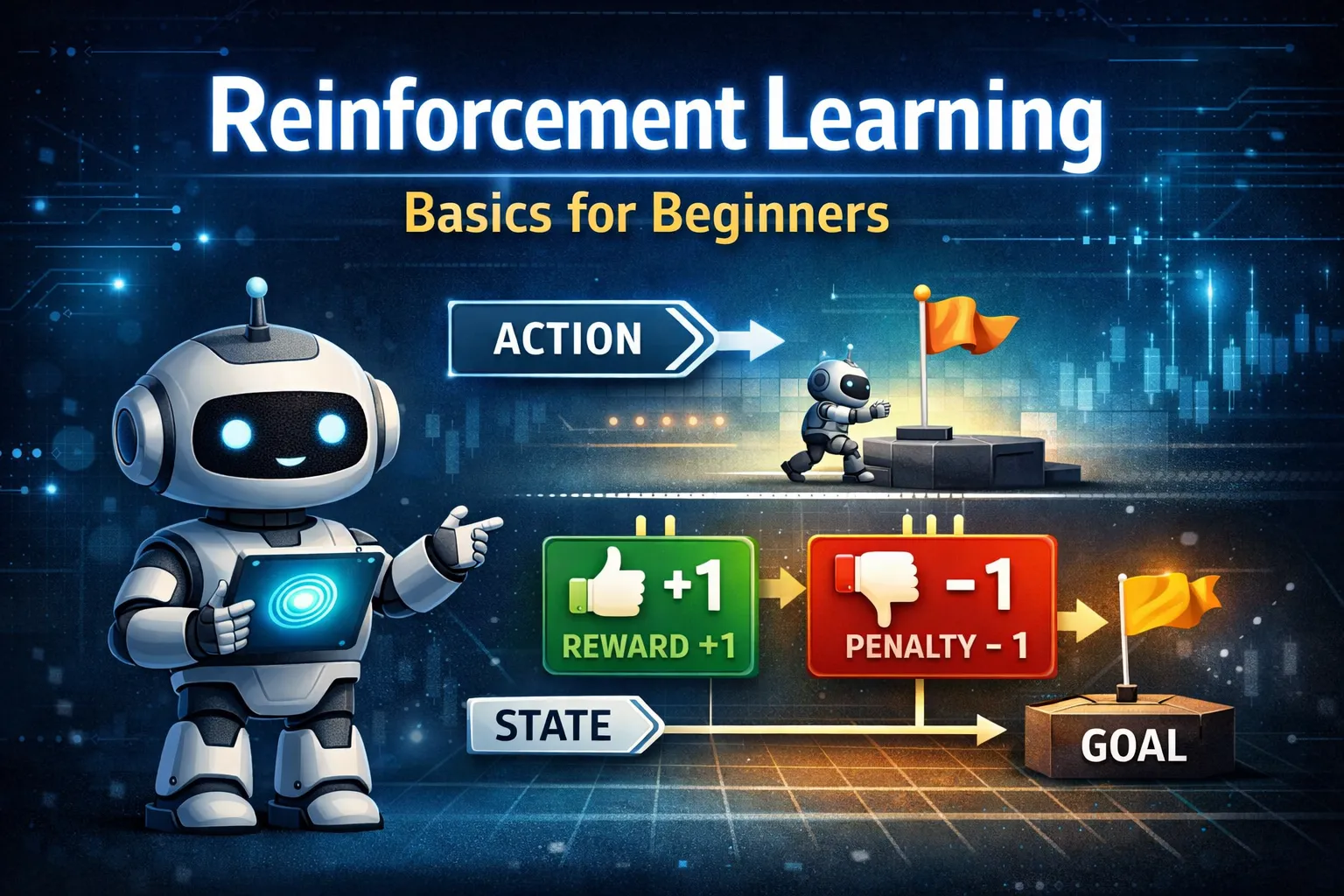
There are several important components in reinforcement learning, including the agent, environment, actions, rewards, and states. The agent interacts with the environment by taking actions, and the environment responds with feedback in the form of rewards. In Data Science and AI, understanding these components helps beginners grasp how learning happens in a step-by-step manner within such systems.
How Reinforcement Learning Works
Reinforcement learning works by allowing the agent to explore different actions and learn from the results. Over time, the agent identifies which actions lead to better outcomes and adjusts its behavior accordingly. In machine learning models, this process is often guided by policies and value functions that help determine the best possible decisions in a given situation.
Types of Reinforcement Learning
There are mainly two types of reinforcement learning: positive reinforcement and negative reinforcement. Positive reinforcement encourages the agent by rewarding good actions, while negative reinforcement discourages undesirable actions. In AI and data analytics, both approaches are used to shape the behavior of intelligent systems and improve their performance.
Examples of Reinforcement Learning in Real Life
Reinforcement learning is widely used in real-world applications. For example, it is used in self-driving cars to make driving decisions, in gaming systems where AI learns to play and win games, and in recommendation systems that adapt to user preferences. In Data Science and machine learning, these applications demonstrate how systems can learn from experience and improve over time.
Advantages of Reinforcement Learning
One of the major advantages of reinforcement learning is its ability to learn from interaction without needing labeled data. It is highly effective in solving complex problems where traditional methods may not work. In AI applications, this approach allows systems to adapt to changing environments and make better decisions continuously.
Challenges in Reinforcement Learning
Despite its advantages, reinforcement learning comes with certain challenges. It can require a large amount of time and computational power to train models effectively. Additionally, designing the right reward system can be difficult. In Data Science and data analytics, improper reward design may lead to incorrect learning and unexpected outcomes.
Reinforcement Learning vs Other Learning Methods
Reinforcement learning differs from supervised and unsupervised learning in its approach. While supervised learning relies on labeled data and unsupervised learning focuses on pattern discovery, reinforcement learning is based on interaction and feedback. In machine learning, each method has its own use cases, but reinforcement learning stands out for decision-making tasks.
Applications Across Industries
Reinforcement learning is being used across various industries to solve complex problems. In healthcare, it helps in treatment planning, while in finance, it is used for portfolio management. In robotics, it enables machines to perform tasks autonomously. These applications highlight the growing role of Data Science, AI, and data analytics in driving innovation through advanced learning techniques.
Future of Reinforcement Learning
The future of reinforcement learning looks promising as technology continues to evolve. With advancements in computing power and algorithms, it is expected to play a major role in automation and intelligent systems. In Data Science and AI, reinforcement learning will continue to drive innovations in areas such as robotics, smart systems, and real-time decision-making.
Conclusion
Reinforcement learning is a powerful concept that allows machines to learn from experience and improve over time. For beginners, understanding its basics is an important step toward mastering advanced AI techniques. As the demand for Data Science, AI, machine learning, and data analytics continues to grow, reinforcement learning will remain a key area of focus for future innovations.