
Introduction
June 2026 proved to be another landmark month for Artificial Intelligence, with innovations emerging across healthcare, education, business, cybersecurity, and scientific research. AI is no longer limited to automating simple tasks; it is now helping organizations solve complex problems, improve decision-making, and create more personalized experiences for users. Many of these developments received less attention than they deserved, yet they have the potential to shape the future of technology. Whether you are a student, professional, or technology enthusiast, understanding these breakthroughs can help you stay ahead in a rapidly changing digital world.
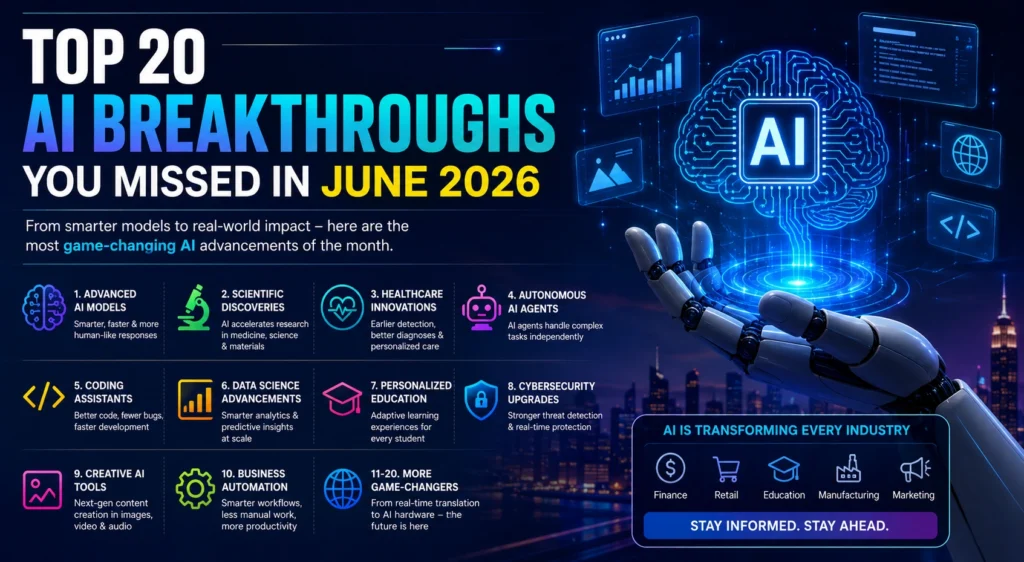
1. AI Models Became More Human-Like
One of the most significant developments in June 2026 was the improvement of AI models that can understand multiple types of information at once, including text, images, audio, and video. These advanced systems delivered more accurate responses and better reasoning abilities, making AI assistants more useful for businesses, educators, and everyday users. The ability to understand context more effectively is helping AI become a stronger partner in daily work and communication.
2. Scientific Research Moved Faster Than Ever
Researchers around the world used AI tools to process enormous datasets and identify patterns that would normally take months to discover. These systems supported innovations in medicine, climate science, and engineering. By reducing research time and increasing accuracy, AI is helping scientists focus more on solving challenges and less on manual analysis.
3. Healthcare Continued Its AI Transformation
Healthcare organizations adopted smarter AI solutions capable of assisting with disease detection and treatment planning. These technologies helped medical professionals identify health concerns earlier and make better-informed decisions. As AI becomes more reliable, its role in improving patient care and healthcare efficiency continues to grow.
4. Autonomous AI Agents Reached New Levels
A major trend during June 2026 was the rise of autonomous AI agents that can complete tasks with limited human supervision. These systems are capable of organizing schedules, conducting online research, preparing summaries, and managing routine workflows. Businesses are increasingly exploring these tools to improve productivity and reduce operational burdens.
5. Coding and Software Development Improved
AI-powered coding assistants became more advanced, helping developers write cleaner code, detect errors faster, and build applications more efficiently. For beginners learning Python and Machine Learning, these tools are making programming more accessible by providing guidance and reducing common development challenges.
6. Data Science Became More Intelligent
Organizations are collecting larger amounts of data than ever before, and AI is helping transform that information into valuable insights. Modern Data Science platforms now automate reporting, forecasting, and trend analysis, allowing businesses to make smarter decisions. This growing dependence on data is increasing opportunities for professionals with Data Science and Business Analytics skills.
Key Highlights from June 2026
- AI systems became more capable of understanding and reasoning across multiple content formats.
- Businesses increased their adoption of AI-driven automation and analytics tools.
- Healthcare, education, and research sectors benefited from faster and smarter AI solutions.
7. Personalized Learning Expanded
Education technology saw significant growth as AI-powered learning platforms became more adaptive. Students can now receive lessons tailored to their individual learning styles and progress levels. As interest in technology careers continues to rise, many learners are exploring courses in AI, Data Science, and Python to prepare for future opportunities.
8. Cybersecurity Became Smarter
Cybersecurity experts introduced AI-powered systems capable of identifying unusual activities and responding to threats more quickly. These solutions can analyze large volumes of network data in real time, helping organizations strengthen their defenses against increasingly sophisticated cyberattacks.
9. Creative Industries Benefited from AI
Generative AI tools continued to evolve, offering improved capabilities for creating content, graphics, videos, and marketing materials. Professionals working in Digital Marketing are using these tools to streamline content production, personalize campaigns, and improve audience engagement without sacrificing creativity.
10. Businesses Embraced Automation
Organizations across different sectors increased their investment in AI-powered automation. From customer service to inventory management, intelligent systems are helping companies reduce repetitive work and improve efficiency. These advancements are allowing teams to focus on strategic activities that require human creativity and decision-making.
11. AI Created New Career Opportunities
The rapid pace of AI innovation is creating demand for skilled professionals across multiple industries. Employers are actively seeking individuals with knowledge of Artificial Intelligence, Machine Learning, Data Science, Python, and Business Analytics. As businesses continue integrating AI into their operations, these skills are becoming valuable assets for long-term career growth.
Conclusion
The AI breakthroughs of June 2026 demonstrate how quickly technology is evolving and influencing the world around us. From smarter healthcare solutions and personalized education platforms to advanced automation and business intelligence tools, AI is driving innovation at an unprecedented scale. These developments are not only transforming industries but also creating exciting opportunities for individuals willing to learn new skills. As AI continues to advance, staying informed and developing expertise in areas such as Data Science, Machine Learning, Python, Digital Marketing, and Business Analytics can help professionals remain competitive in the future job market.