
Introduction
“Which Assessment Should Be Conducted for a Generative? is an important topic in today’s AI-powered world. Generative AI systems are widely used in education, healthcare, business, marketing, and technology, making proper assessment essential for ensuring accuracy, safety, fairness, and performance. Different types of evaluations help organizations understand whether AI models are reliable and suitable for real-world use. As interest in Data Science, AI, Machine Learning, Python, Digital Marketing, and Business Analytics continues to grow, learning to assess generative AI has become an important skill for students and professionals alike.
Understanding Generative AI Assessment
Generative AI assessment is the process of evaluating how well an AI system performs tasks such as text generation, image creation, coding, summarization, and content recommendations. These assessments help determine whether the model produces accurate, relevant, safe, and unbiased outputs. Since generative AI models are trained on massive datasets, they may sometimes create misleading or harmful responses. Proper assessment helps organizations identify weaknesses and improve model performance before deployment. Businesses today rely heavily on AI-powered automation, making evaluation an essential step for maintaining quality and user satisfaction.
Accuracy Assessment in Generative AI
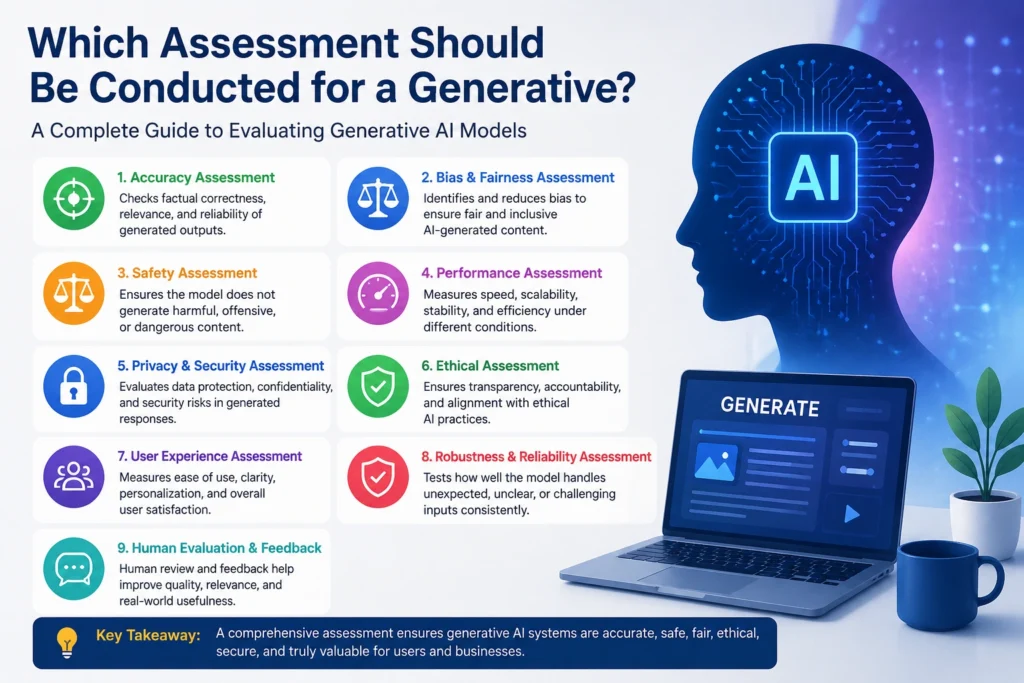
Accuracy assessment is one of the most important evaluations for generative AI systems. This assessment checks whether the generated content is factually correct and relevant to the user’s request. For example, if an AI chatbot provides wrong medical or financial information, it can create serious problems for users. Accuracy testing compares AI-generated results with trusted data sources and expert reviews. Students learning AI, Machine Learning, and Python programming often practice accuracy evaluation techniques to improve model reliability and prediction quality in real-world applications.
Bias and Fairness Assessment
Bias assessment ensures that generative AI systems do not produce discriminatory or unfair outputs. AI models learn from internet data, books, websites, and public content, which may already contain human bias. If these biases are not identified, the AI may generate harmful stereotypes or unfair recommendations. Fairness testing checks whether the AI treats different genders, cultures, regions, and communities equally. Companies and educational institutions now focus strongly on ethical AI practices because fairness and inclusivity are becoming major requirements in modern AI development and Business Analytics strategies.
Safety and Risk Assessment
Safety assessment examines whether generative AI systems can produce dangerous, offensive, or harmful content. AI models may sometimes generate misinformation, violent text, fake news, or inappropriate recommendations if not properly monitored. Risk assessment helps organizations identify possible threats and create safety filters to reduce harmful outputs. This type of evaluation is especially important for industries like healthcare, education, finance, and customer service. Many AI professionals working in Data Science and Machine Learning learn advanced safety testing methods to ensure responsible AI deployment in businesses and online platforms.
Performance and Speed Assessment
Performance assessment measures how efficiently a generative AI system works under different conditions. This includes response speed, scalability, system stability, and handling multiple users at the same time. Slow AI systems can reduce productivity and negatively affect user experience. Companies conducting Digital Marketing campaigns or AI-driven customer support often require fast and reliable AI tools for better engagement. Performance testing also checks whether the AI can continue working effectively with increasing workloads, making it a critical factor for large organizations using automation technologies.
Data Privacy and Security Assessment
Generative AI systems process large amounts of user data, making privacy and security assessments extremely important. Organizations must ensure that confidential user information is not leaked or misused by AI models. Security testing identifies vulnerabilities such as data breaches, hacking risks, and unauthorized access. Strong privacy assessments also help companies follow legal regulations and data protection policies. Professionals learning Python, cybersecurity concepts, and AI development often study secure AI practices because data privacy has become one of the biggest concerns in modern technology systems.
Ethical Assessment in Generative AI
Ethical assessment focuses on determining whether generative AI systems behave responsibly and align with social values. Ethical evaluation includes transparency, accountability, explainability, and responsible content generation. Users should understand how AI decisions are made and who is responsible for AI-generated outcomes. Ethical AI practices also help reduce misinformation and manipulation risks. Businesses increasingly prioritize ethical AI because customer trust is directly linked to transparency and fairness. Educational programs in Artificial Intelligence and Business Analytics now emphasize ethical AI learning as a key industry skill.
User Experience Assessment
User experience assessment measures how easy and useful a generative AI system is for users. Even if an AI model is technically advanced, it may fail if users find it confusing or difficult to interact with. This assessment checks interface quality, clarity of responses, personalization, and customer satisfaction. Companies using AI chatbots, virtual assistants, and automated marketing systems depend heavily on positive user experiences to improve engagement and business growth. Students studying Digital Marketing and AI technologies often learn user-centered design principles for creating better AI products.
Robustness and Reliability Assessment
Robustness assessment evaluates how consistently a generative AI model performs under different situations. Reliable AI systems should provide stable and accurate outputs even when users enter unclear, difficult, or unexpected prompts. Weak models may fail under unusual conditions or produce random answers. Reliability testing ensures that AI systems remain dependable over time. This assessment is especially important in industries where consistent decision-making is required. Machine Learning experts continuously improve AI robustness to build systems that users can trust in real-world environments.
Human Evaluation and Feedback Assessment
Human evaluation remains one of the most valuable methods for assessing generative AI systems. Human reviewers analyze AI-generated outputs for quality, accuracy, creativity, and usefulness. While automated metrics are important, human judgment provides a deeper understanding of content quality and emotional relevance. Feedback from users helps developers improve AI systems continuously. Many companies combine automated testing with human reviews to create more reliable AI models. Professionals working in AI, Data Science, and Python development often use feedback-driven improvement methods to refine AI performance over time.
Important Point to Remember
- A successful generative AI assessment should include accuracy, fairness, safety, privacy, performance, ethics, and user experience testing together because relying on only one assessment method may lead to incomplete evaluation and hidden risks.
Future of Generative AI Assessments
As generative AI technology continues to evolve, assessment methods will become more advanced and automated. Future AI systems may include built-in self-evaluation tools that continuously monitor accuracy, ethics, and security in real time. Governments and organizations are also expected to introduce stricter AI regulations and quality standards. This growing demand for AI evaluation is increasing career opportunities for professionals skilled in Data Science, Artificial Intelligence, Machine Learning, Python, and Business Analytics. Understanding AI assessment techniques will become an essential skill for future technology professionals.
Conclusion
Generative AI is transforming industries across the world, but its success depends heavily on proper assessment and evaluation. Accuracy, fairness, safety, ethics, privacy, performance, and user experience assessments all play critical roles in ensuring reliable AI systems. Without proper testing, AI models may create harmful, biased, or misleading outputs that affect businesses and users negatively. As AI adoption continues to grow, organizations must focus on responsible AI evaluation to build trust and improve efficiency. Students and professionals learning AI-related skills should understand these assessment methods because they are becoming essential in the modern technology landscape. Proper generative AI assessment not only improves system quality but also helps create safer, smarter, and more ethical AI solutions for the future.