
Introduction
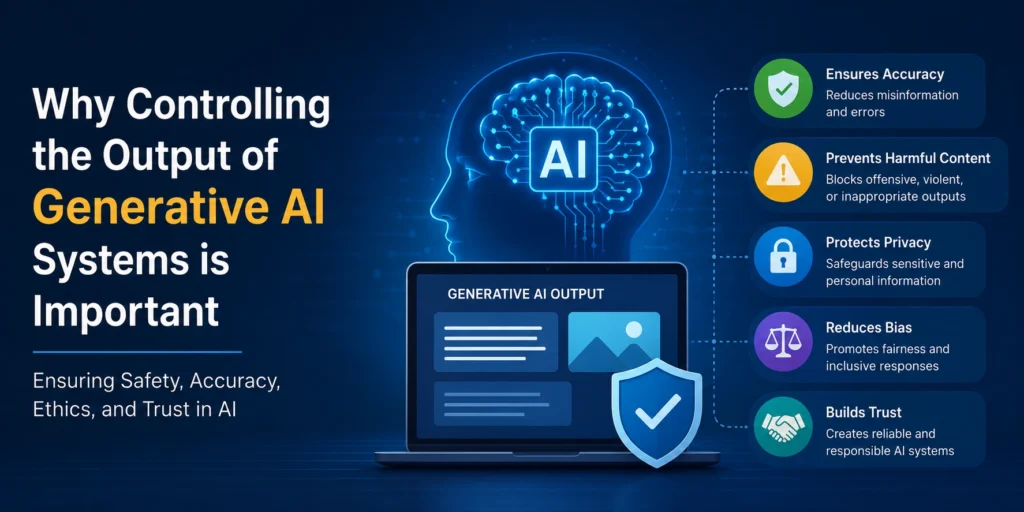
“Why is Controlling the Output of Generative AI Systems Important?” is becoming one of the most discussed topics in today’s digital world. Generative AI tools are now used in education, business, healthcare, marketing, and content creation, making daily tasks faster and more efficient. However, without proper control, AI systems can generate inaccurate, biased, or harmful content. Understanding the importance of AI output control helps businesses, students, and professionals use Artificial Intelligence responsibly while improving safety, accuracy, and trust in modern technology.
Understanding Generative AI Systems
Generative AI systems are designed to create new content based on patterns learned from massive datasets. These systems use advanced technologies like Machine Learning and Deep Learning to understand language, visuals, and human behavior. Popular AI tools can write articles, generate images, answer questions, and automate tasks. Students learning Data Science, AI, Python, and Machine Learning are increasingly studying how these systems work because AI skills are becoming valuable in almost every industry. While generative AI improves efficiency, it also creates challenges when outputs are inaccurate or uncontrolled.
The Risk of False Information
One major reason for controlling AI output is the spread of false or misleading information. AI systems sometimes generate content that sounds correct but contains incorrect facts. This issue can become dangerous in fields like healthcare, education, finance, and law, where accurate information is essential. If users blindly trust AI-generated responses, they may make poor decisions based on wrong data. Businesses and educational institutions must apply content moderation and fact-checking systems to ensure reliable AI-generated outputs that users can trust.
Preventing Harmful and Offensive Content
AI systems can unintentionally generate harmful, offensive, or inappropriate content if they are not properly monitored. This includes hate speech, abusive language, violent material, or unethical suggestions. Companies developing AI tools use safety filters and ethical guidelines to reduce these risks. Controlling AI output protects users from harmful experiences and ensures that digital platforms remain safe for students, professionals, and families. Ethical AI development is now a major topic in courses related to Business Analytics, Artificial Intelligence, and Digital Marketing because companies need professionals who understand responsible AI practices.
Protecting User Privacy and Data
Generative AI systems are trained using huge amounts of data collected from various sources. Without proper control, AI tools may accidentally expose sensitive or private information. This creates security and privacy concerns for both individuals and organizations. Businesses using AI for customer support or automation must ensure confidential information is protected. Strong data management policies and secure AI systems help prevent leaks of personal or financial information. Privacy protection is becoming a key skill in modern AI and Data Science careers because companies are prioritizing cybersecurity and responsible data usage.
Reducing Bias in AI Responses
AI systems can sometimes reflect biases present in their training data. If an AI model learns from biased or unfair information, its outputs may also become biased. This can affect hiring systems, educational platforms, marketing campaigns, and customer service tools. Controlling AI output helps developers identify and reduce discrimination or unfair treatment. Ethical AI systems should provide balanced and inclusive responses for users from different backgrounds. Professionals learning Machine Learning and Business Analytics are now focusing more on fairness and bias detection because organizations want AI systems that support equality and diversity.
Maintaining Brand Reputation
Businesses using AI-generated content must carefully control outputs to protect their brand reputation. A single inaccurate or offensive AI response can damage customer trust and create negative publicity online. Companies using AI chatbots, content generators, or marketing tools need strong monitoring systems to maintain professional communication. Digital Marketing professionals are increasingly learning how AI tools can improve campaigns while still ensuring high-quality and brand-safe content. Controlled AI outputs help companies maintain consistency, professionalism, and customer satisfaction in competitive markets.
Improving Educational and Learning Experiences
AI tools are widely used in education for tutoring, content creation, coding assistance, and personalized learning. However, students may receive incorrect explanations or misleading answers if outputs are not monitored properly. Educational institutions are encouraging learners to verify AI-generated information and use critical thinking skills. Courses related to Python, AI, and Data Science now include lessons about ethical AI usage and output validation. Controlled AI systems improve learning experiences by providing accurate, helpful, and beginner-friendly information while reducing confusion among students.
Supporting Legal and Ethical Compliance
Governments and organizations worldwide are introducing regulations to ensure responsible AI usage. Businesses must follow ethical and legal standards when deploying generative AI systems. Controlled outputs help companies avoid legal issues related to misinformation, copyright violations, discrimination, and harmful content. AI governance is becoming an important business strategy because organizations need transparency and accountability in their AI systems. Companies investing in AI technologies are also hiring professionals with knowledge of AI ethics, Machine Learning, and Business Analytics to manage compliance effectively.
Enhancing Human-AI Collaboration
Generative AI works best when humans and machines collaborate. AI can automate repetitive tasks, generate ideas, and improve efficiency, but human supervision is still necessary for quality control. Professionals must review AI-generated outputs before publishing or using them in serious situations. Human oversight ensures accuracy, creativity, and ethical standards are maintained. This balanced approach helps businesses maximize the benefits of AI while minimizing risks. Students studying Digital Marketing, Python, and Artificial Intelligence are learning how to combine human creativity with AI-powered tools for better productivity.
Building Trust in AI Technology
Trust is one of the most important factors in the success of AI technology. Users are more likely to adopt AI tools if they believe the outputs are safe, accurate, and reliable. Controlled AI systems create confidence among businesses, educators, students, and customers. Companies that prioritize responsible AI practices can build stronger relationships with users and improve long-term growth. As AI adoption continues to rise globally, trust and transparency will become critical for the future of digital innovation and automation.
Important Point About AI Output Control
- Proper control of generative AI systems helps prevent misinformation, protects privacy, reduces harmful content, improves accuracy, and ensures ethical AI usage across industries.
The Future of Responsible Generative AI
The future of generative AI depends heavily on responsible development and effective output control. As AI technologies continue evolving, companies and governments will invest more in AI safety systems, ethical frameworks, and advanced moderation tools. AI experts are working on improving transparency, reducing bias, and making AI systems more explainable for users. Students and professionals who understand responsible AI development will have strong career opportunities in fields like Data Science, Machine Learning, AI engineering, and Business Analytics. Responsible AI usage will shape the future of education, healthcare, marketing, and business operations worldwide.
Conclusion
Controlling the output of generative AI systems is essential for ensuring safety, accuracy, fairness, and trust in modern technology. While generative AI offers incredible benefits for creativity, automation, and productivity, uncontrolled outputs can create serious risks such as misinformation, bias, harmful content, and privacy violations. Businesses, educators, and developers must implement strong monitoring systems and ethical guidelines to use AI responsibly. As AI continues transforming industries, understanding output control will become a critical skill for students and professionals learning Artificial Intelligence, Data Science, Python, Digital Marketing, and Business Analytics. Responsible AI development will help create a safer and smarter digital future for everyone.