
Introduction
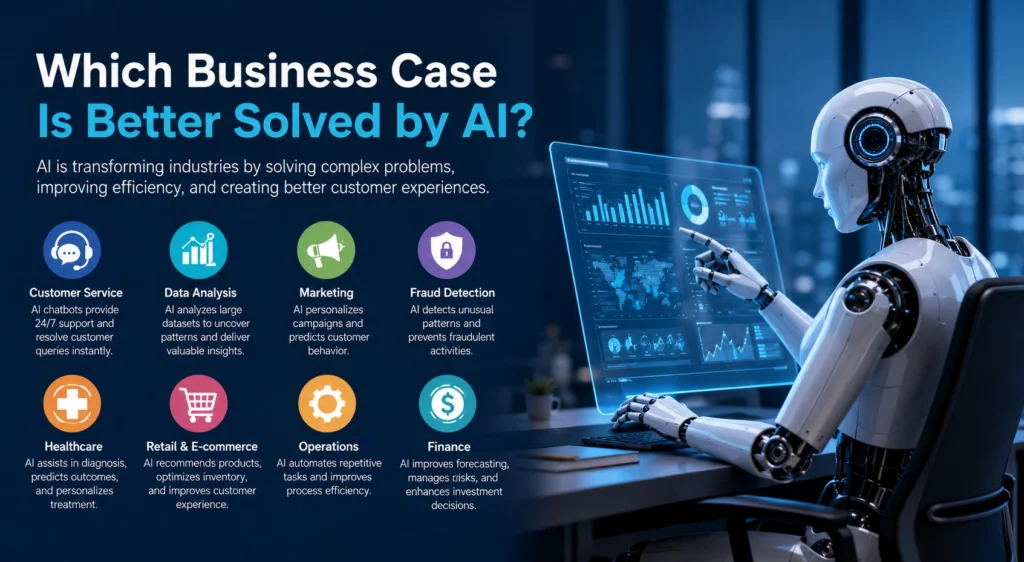
Artificial Intelligence (AI) is changing the way businesses work in 2026. From customer support to marketing and data analysis, companies are using AI tools to save time, reduce costs, and improve decision-making. Many businesses now depend on AI to automate repetitive tasks and deliver faster services to customers. But one important question remains: which business case is better solved by AI? The answer depends on the type of work involved. AI performs best in areas that require data analysis, pattern recognition, automation, prediction, and personalization. Industries like healthcare, finance, retail, education, and marketing are already seeing major benefits from AI-driven solutions. Businesses are also hiring professionals with skills in Data Science, AI, Machine Learning, Python, Digital Marketing, and Business Analytics to manage these technologies effectively. Understanding where AI works best helps organizations make smarter investments and improve productivity in a competitive market.
AI in Customer Service and Support
One of the best business cases solved by AI is customer service. AI-powered chatbots and virtual assistants can answer customer questions 24/7 without human involvement. These tools reduce waiting times and improve customer satisfaction by providing quick responses. Companies use AI to handle common questions, process orders, and even solve technical issues. Businesses save money because fewer human agents are needed for repetitive support tasks. AI systems can also learn from previous conversations and improve over time using Machine Learning techniques. Students learning AI and Python often study chatbot development because it has become a highly valuable skill in modern business environments.
AI for Data Analysis and Decision-Making
Businesses generate huge amounts of data every day, and analyzing that data manually takes time. AI is better suited for handling large datasets quickly and accurately. AI-powered analytics tools can identify trends, customer behavior, and business opportunities in seconds. This helps companies make faster and smarter decisions. Business Analytics and Data Science professionals use AI algorithms to forecast sales, understand market trends, and improve business strategies. Companies in finance, healthcare, and retail especially benefit from predictive analytics because AI can detect patterns humans may miss.
AI in Marketing and Personalization
Digital marketing is another major area where AI solves business problems effectively. AI tools can analyze customer interests and create personalized marketing campaigns. Businesses use AI to recommend products, optimize advertisements, and improve email marketing strategies. Platforms powered by AI can track user behavior and suggest content that customers are more likely to engage with. This improves customer experience and increases sales. Professionals with Digital Marketing and AI skills are in high demand because companies want experts who understand both technology and marketing performance.
AI in Fraud Detection and Cybersecurity
Fraud detection is a business case where AI performs much better than traditional systems. Banks and online payment companies use AI to identify suspicious activities instantly. AI systems monitor transactions in real time and detect unusual behavior patterns. This helps prevent fraud before major damage occurs. Cybersecurity companies also use Machine Learning models to identify hacking attempts and protect sensitive data. AI improves security because it continuously learns from new threats and adapts faster than manual systems.
AI in Healthcare and Medical Diagnosis
Healthcare businesses use AI to improve diagnosis and patient care. AI systems can analyze medical reports, detect diseases, and suggest treatment options quickly. Hospitals use AI-powered software to manage patient records and predict health risks. AI also helps doctors by reducing the time needed to study medical scans and reports. This business case proves how AI can improve both accuracy and efficiency. Students learning Data Science and Machine Learning often explore healthcare projects because the industry offers strong career opportunities and real-world impact.
AI in Supply Chain and Inventory Management
Managing inventory and supply chains is difficult for large businesses, but AI simplifies the process. AI tools can predict customer demand, track inventory levels, and optimize delivery routes. Businesses reduce waste and improve operational efficiency using AI-powered forecasting systems. Retail companies especially benefit from AI because it helps prevent overstocking and product shortages. Business Analytics professionals use predictive models to improve supply chain performance and reduce costs.
AI in Human Resource Management
Human Resource departments are also adopting AI solutions. AI can screen resumes, identify qualified candidates, and schedule interviews automatically. This reduces the workload for HR teams and speeds up hiring processes. AI tools also analyze employee performance and help companies improve workforce management. Many organizations use AI to predict employee turnover and improve retention strategies. Learning Python and AI-based automation tools can help professionals enter the growing HR technology industry.
AI in Financial Forecasting and Banking
Financial forecasting is one of the strongest examples of a business case solved by AI. Banks and financial institutions use AI to predict market trends, manage risks, and automate transactions. AI algorithms can analyze financial data much faster than humans. This helps companies make better investment decisions and reduce financial losses. Machine Learning models also improve credit scoring systems and loan approval processes. Businesses trust AI because it improves accuracy and reduces manual errors.
AI for E-Commerce and Retail Growth
E-commerce companies rely heavily on AI to improve customer experience and increase sales. AI recommendation engines suggest products based on customer behavior and purchase history. Online stores use AI chatbots, automated inventory systems, and personalized advertisements to boost engagement. AI also helps businesses understand shopping trends and customer preferences. Retailers using AI often achieve better conversion rates and higher customer satisfaction. Students interested in Digital Marketing and Business Analytics can explore AI-driven retail strategies to build future-ready careers.
Important Benefits Businesses Get from AI
Businesses that use AI gain several advantages that improve long-term growth and productivity.
- AI reduces manual work and saves time
- AI improves accuracy and minimizes human errors
- AI helps businesses make data-driven decisions
- AI enhances customer experience and personalization
- AI increases efficiency and operational performance
These benefits explain why AI adoption continues to grow across industries worldwide.
Challenges Businesses Face While Using AI
Although AI offers many benefits, businesses also face challenges when implementing AI systems. High setup costs, lack of skilled professionals, and data privacy concerns are common problems. Companies must invest in training employees and maintaining secure systems. AI models also require high-quality data for accurate performance. Without proper planning, businesses may struggle to achieve desired results. This is why professionals trained in AI, Data Science, Machine Learning, and Python are becoming increasingly important in modern organizations.
Conclusion
AI is better suited for business cases that involve automation, prediction, data analysis, personalization, and repetitive tasks. Industries like healthcare, finance, marketing, retail, and customer service are already benefiting from AI-powered solutions. Businesses use AI to improve efficiency, reduce costs, and make smarter decisions faster than traditional systems. As technology continues to grow, AI will become even more important for organizations worldwide. Students and professionals who learn skills like Data Science, AI, Machine Learning, Python, Digital Marketing, and Business Analytics can build strong careers in this rapidly expanding field. Understanding which business cases are better solved by AI helps companies stay competitive and prepare for the future of intelligent business operations.