
Introduction
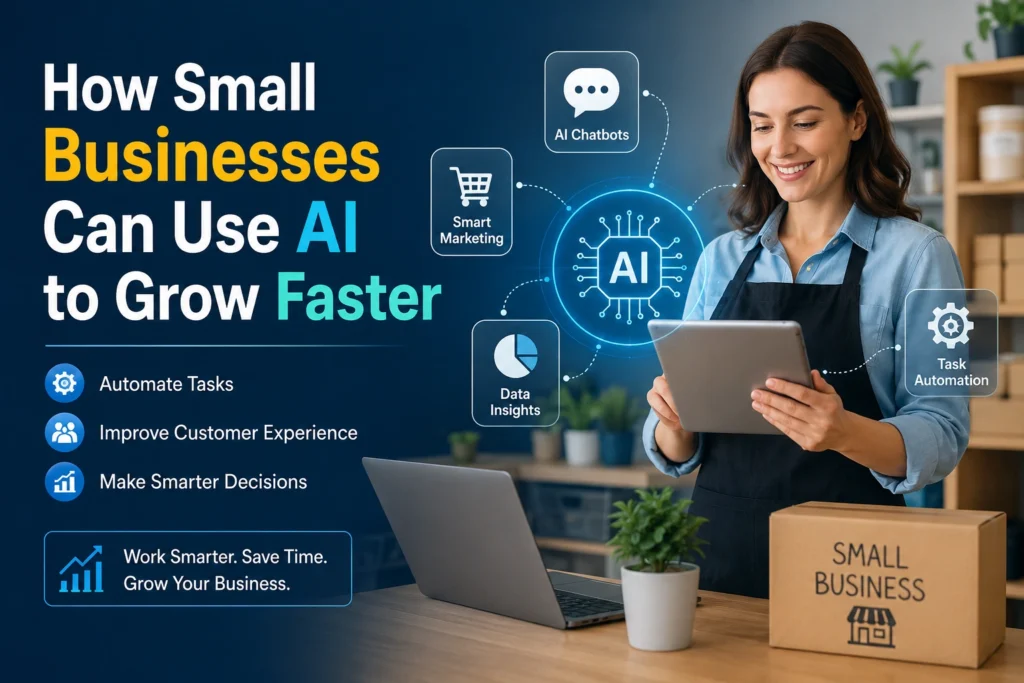
Artificial Intelligence (AI) is no longer a technology reserved for large corporations with massive budgets. Today, small businesses can use AI-powered tools to improve productivity, reduce operational costs, deliver better customer experiences, and make smarter business decisions. Whether it is a local retail store, an online startup, a marketing agency, or a service-based business, AI offers practical solutions that help companies compete with larger organizations. By automating repetitive tasks and providing valuable business insights, AI allows entrepreneurs to focus on innovation and growth. This blog explores how small businesses can use AI to grow faster, improve efficiency, and stay competitive in an increasingly digital marketplace.
1. Automating Daily Business Operations
One of the biggest advantages of AI for small businesses is automation. Business owners often spend a significant amount of time on repetitive administrative tasks such as scheduling meetings, responding to customer inquiries, organizing data, generating invoices, and managing inventory. AI-powered software can automate these responsibilities, saving both time and money. Employees can then focus on strategic activities like customer engagement, product development, and business expansion. Automation also minimizes human error, resulting in smoother business operations and higher productivity.
Key Benefits:
- Saves valuable time by automating repetitive tasks.
- Reduces operational costs and improves efficiency.
- Allows employees to focus on business growth.
2. Improving Customer Service with AI
Customer satisfaction plays a major role in business success, and AI is transforming the way businesses interact with customers. AI chatbots and virtual assistants can answer common customer questions instantly, provide product recommendations, and offer support around the clock. This means customers receive faster responses even outside business hours. AI can also analyze customer feedback and identify common concerns, helping businesses improve their products and services. Better customer experiences often lead to increased loyalty and repeat business.
3. Making Better Business Decisions with Data
Every business generates valuable data, but interpreting that information can be challenging. AI-powered analytics tools help business owners understand customer behavior, sales performance, and market trends more effectively. Instead of relying on assumptions, businesses can make decisions backed by real data. Professionals with knowledge of Business Analytics, Data Science, and Python are increasingly helping organizations transform raw business data into meaningful insights that improve planning and profitability. These skills are becoming valuable across industries as companies continue adopting data-driven strategies.
4. Enhancing Marketing Strategies
Marketing has become more competitive than ever, and AI helps small businesses reach the right audience with greater accuracy. AI tools can analyze customer interests, predict buying behavior, personalize email campaigns, optimize advertisements, and recommend the best posting times for social media. Businesses can also track campaign performance in real time and make quick improvements. As AI continues to influence digital promotion, learning Digital Marketing alongside AI technologies enables professionals to create smarter marketing campaigns that generate better returns on investment.
5. Managing Inventory More Efficiently
Inventory management is often a challenge for small businesses, especially those dealing with physical products. AI can predict customer demand based on previous sales patterns, seasonal trends, and market conditions. This helps businesses avoid overstocking or running out of essential products. Better inventory planning reduces unnecessary expenses while ensuring customers receive products without delays. AI-driven forecasting also improves supply chain management, allowing businesses to operate more efficiently.
6. Personalizing Customer Experiences
Modern customers expect personalized experiences, and AI makes this possible even for small businesses. AI systems analyze browsing history, previous purchases, and customer preferences to recommend products or services that match individual interests. Personalized recommendations improve customer satisfaction and increase sales because customers are more likely to purchase products relevant to their needs. This level of personalization helps businesses build stronger relationships with their customers and stand out from competitors.
7. Strengthening Financial Management
Managing finances accurately is essential for sustainable business growth. AI-powered accounting software can automate bookkeeping, categorize expenses, generate financial reports, and detect unusual transactions. Business owners receive real-time financial insights that help them monitor cash flow and plan future investments. AI also reduces manual accounting errors and simplifies tax preparation. As businesses become increasingly data-focused, professionals trained in Machine Learning, AI, and financial analytics are contributing to more intelligent financial decision-making across organizations.
8. Supporting Smarter Hiring and Employee Management
Hiring the right employees takes time and effort, especially for small businesses with limited HR resources. AI recruitment tools can screen resumes, identify qualified candidates, schedule interviews, and even analyze job descriptions to attract suitable applicants. AI also assists with employee training by recommending personalized learning paths based on individual performance. Businesses investing in AI-enabled workforce management often improve productivity while reducing recruitment costs and hiring time.
9. Staying Competitive in a Digital Economy
Businesses that adopt AI early often gain a competitive advantage. AI helps organizations respond quickly to changing customer preferences, improve product quality, optimize pricing strategies, and identify emerging market opportunities. Even small businesses can compete with larger companies by using affordable AI tools available today. As AI adoption continues to expand globally, professionals who develop expertise in Artificial Intelligence, Machine Learning, Python, and Data Science are likely to find increasing career opportunities while helping businesses innovate and grow.
10. Preparing for the Future of Business
AI is becoming a fundamental part of modern business operations rather than just an optional technology. Small businesses that begin using AI today will be better prepared for future market changes, technological advancements, and evolving customer expectations. Business owners should start by identifying areas where automation and AI can solve everyday challenges before gradually expanding their AI adoption. Continuous learning and upskilling remain equally important, as technologies continue evolving rapidly. Organizations that embrace innovation today are more likely to achieve long-term growth and sustainability.
Conclusion
Artificial Intelligence is transforming the way small businesses operate by making processes faster, smarter, and more efficient. From automating routine tasks and improving customer service to strengthening marketing strategies and financial management, AI offers countless opportunities for business growth. The best part is that businesses no longer need massive budgets to benefit from AI-powered solutions. As technology continues to evolve, developing knowledge in fields such as Artificial Intelligence, Machine Learning, Data Science, Python, Digital Marketing, and Business Analytics can help both professionals and businesses stay ahead in an increasingly competitive market. Small businesses that embrace AI today will be better positioned to innovate, improve customer experiences, and achieve sustainable success in the years ahead.