
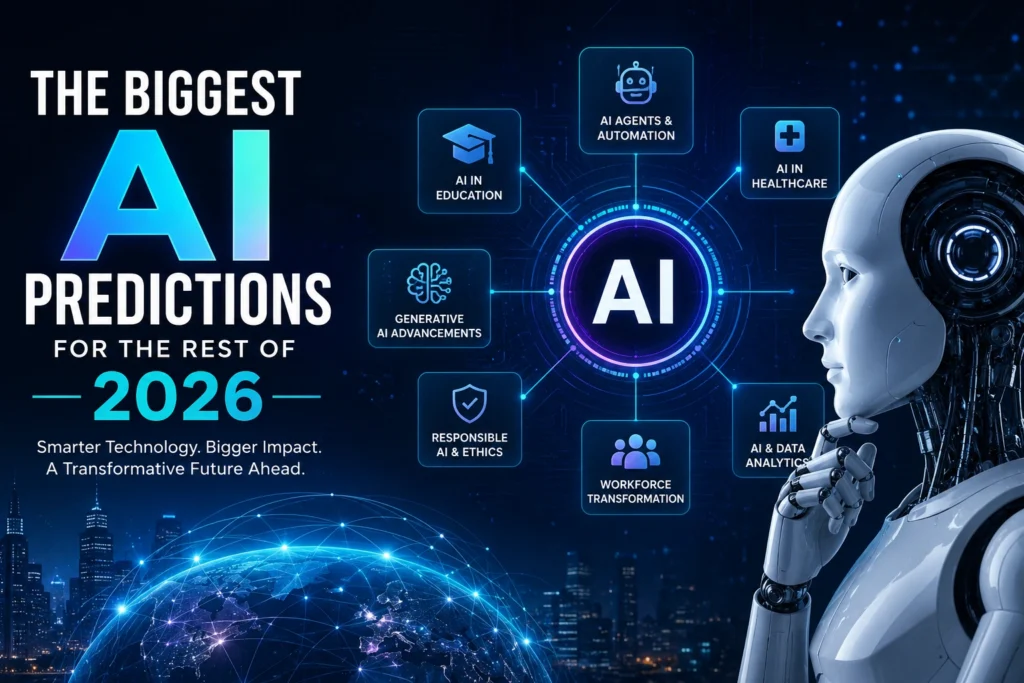
Introduction
Artificial Intelligence has already transformed the way people work, learn, communicate, and innovate in 2026. During the first half of the year, AI technologies became more powerful, accessible, and integrated into everyday business operations. As organizations continue investing heavily in intelligent automation and advanced AI systems, the remaining months of 2026 are expected to bring even more exciting developments. From smarter AI assistants and autonomous business tools to breakthroughs in healthcare and education, the future of AI looks incredibly promising. Understanding these emerging trends can help students, professionals, and businesses prepare for the next phase of digital transformation and stay competitive in a rapidly evolving world.
1. AI Agents Will Become Everyday Business Partners
One of the biggest predictions for the rest of 2026 is the rapid growth of AI agents capable of handling complete business workflows with minimal human supervision. Unlike traditional chatbots, these intelligent agents can analyze information, make decisions, coordinate multiple tasks, and interact with different software platforms. Companies are expected to rely on AI agents for customer service, scheduling, report generation, project management, and operational support. As businesses continue adopting automation, professionals with expertise in Artificial Intelligence, Machine Learning, and Python will become increasingly valuable because they can build, customize, and manage these advanced systems.
2. Personalized Learning Through AI Will Continue Expanding
Education is undergoing a significant transformation as AI creates personalized learning experiences for students of all skill levels. Instead of following the same curriculum, learners can receive customized study plans, instant feedback, and adaptive assessments based on their progress. This trend is also encouraging more people to enroll in career-focused courses such as Data Science, Artificial Intelligence, Machine Learning, Python, Business Analytics, and Digital Marketing. These programs help learners gain practical skills that match the growing demand for AI-driven industries.
3. Generative AI Will Become More Accurate and Reliable
Generative AI models are expected to become much more dependable during the remainder of 2026. Earlier challenges such as incorrect responses, inconsistent outputs, and factual errors are gradually being addressed through improved training techniques and stronger reasoning capabilities. Businesses will increasingly use AI for writing reports, creating marketing campaigns, designing presentations, generating code, and producing multimedia content. Human oversight will still be important, but AI will become a more trusted productivity partner across multiple industries.
4. AI Will Drive Smarter Marketing Strategies
Marketing professionals are already benefiting from AI-powered analytics, and this trend will accelerate in the coming months. AI will help businesses understand customer behavior, predict purchasing patterns, optimize advertising budgets, and create personalized campaigns that improve engagement. Professionals with Digital Marketing skills combined with Business Analytics knowledge will have a significant advantage because organizations increasingly seek experts who can interpret AI-generated insights and convert them into successful marketing strategies.
Key Areas Where AI Will Create Immediate Impact
- AI-powered business automation will reduce repetitive manual work.
- Personalized customer experiences will improve engagement and satisfaction.
- Demand for AI-related technical and analytical skills will continue rising.
5. AI-Powered Software Development Will Speed Up Innovation
Software development is becoming faster with the help of AI coding assistants that generate code, identify bugs, suggest improvements, and automate testing. During the rest of 2026, developers will spend less time on repetitive coding tasks and more time solving complex business problems. Learning Python alongside Machine Learning concepts will become even more beneficial because these skills form the foundation of many modern AI applications. Organizations will continue investing in developers who can effectively collaborate with intelligent coding assistants.
6. Healthcare AI Will Deliver Better Patient Outcomes
Healthcare is expected to witness major AI-driven improvements in diagnostics, medical imaging, treatment planning, and patient monitoring. AI systems can process vast amounts of medical data faster than traditional methods, helping healthcare professionals identify diseases earlier and recommend more personalized treatments. While AI will not replace doctors, it will enhance decision-making, improve efficiency, and support better patient care. Ethical AI practices and responsible data management will remain central to these advancements.
7. Businesses Will Invest More in AI Governance
As AI adoption grows, organizations will focus more on responsible AI governance. Companies will develop clear policies regarding transparency, privacy, fairness, and security to ensure AI systems operate ethically. Governments and regulatory bodies are also expected to introduce updated AI guidelines that encourage innovation while protecting users. Businesses that build trustworthy AI solutions will gain stronger customer confidence and long-term competitive advantages.
8. AI and Data Science Will Become Even More Connected
Data continues to be the foundation of every successful AI application. As companies generate larger volumes of information, professionals with Data Science and Business Analytics expertise will play a vital role in organizing, analyzing, and interpreting complex datasets. AI systems depend on high-quality data to deliver accurate predictions and meaningful recommendations. This growing relationship between data and AI will create exciting career opportunities across finance, healthcare, retail, manufacturing, and technology industries.
9. AI Will Create New Career Opportunities Rather Than Replace Everyone
Although automation may change certain job roles, the remaining months of 2026 are likely to create more new opportunities than they eliminate. Businesses need professionals who understand how to work alongside AI tools, supervise automated systems, analyze AI-generated insights, and solve complex problems that require human creativity and critical thinking. Skills in Artificial Intelligence, Machine Learning, Python, Digital Marketing, and Business Analytics
will help professionals remain competitive in the evolving employment market.
10. Multimodal AI Will Become the New Standard
The next generation of AI systems will increasingly understand text, images, audio, video, and structured data simultaneously. These multimodal capabilities will enable more natural interactions between humans and machines, making AI assistants more intelligent and versatile. Businesses will use multimodal AI for customer support, education, product design, healthcare analysis, and creative content production. As these technologies mature, users can expect faster, more accurate, and context-aware AI experiences across nearly every industry.
Why These Predictions Matter
- AI skills will become valuable across both technical and non-technical careers.
- Businesses adopting responsible AI early are likely to gain a competitive advantage.
- Continuous learning will remain the best way to stay relevant in the AI era.
Conclusion
The rest of 2026 promises to be an exciting period for Artificial Intelligence as innovation continues to reshape industries worldwide. From intelligent AI agents and multimodal systems to smarter healthcare, personalized education, and advanced business automation, AI is becoming a fundamental part of modern life. Rather than replacing human talent, AI is creating opportunities for individuals who are willing to develop future-ready skills. Learning disciplines such as Data Science, Artificial Intelligence, Machine Learning, Python, Digital Marketing, and Business Analytics can prepare professionals for emerging roles and help them thrive in an increasingly AI-driven economy. Staying informed, adapting to new technologies, and embracing continuous learning will be the key to success as AI continues to evolve throughout 2026 and beyond.