
Introduction
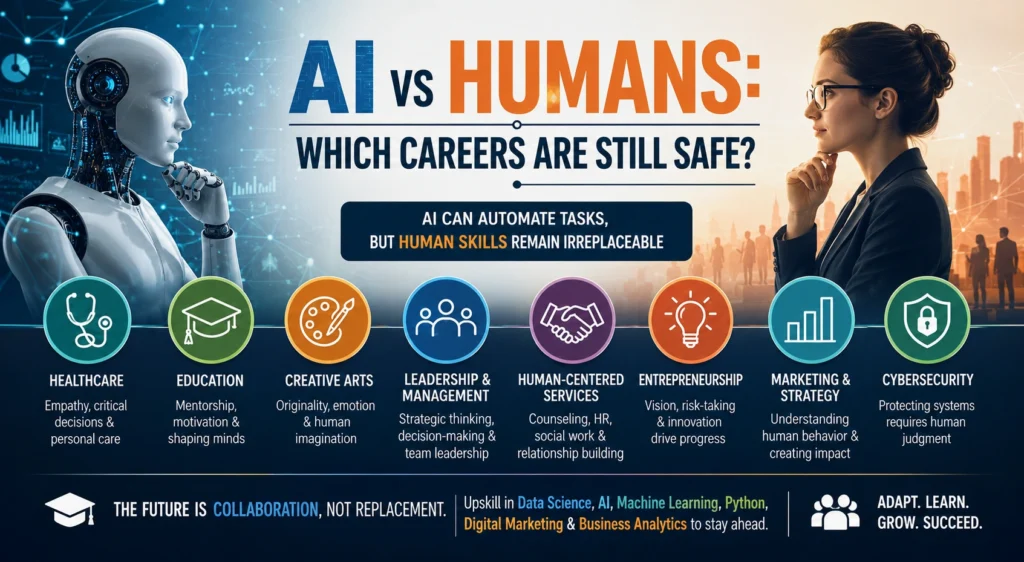
Artificial Intelligence (AI) is transforming industries at an unprecedented pace. From automating repetitive tasks to assisting professionals with complex decision-making, AI has become an essential part of modern workplaces. While many people worry that intelligent machines will replace human workers entirely, the reality is more balanced. AI is designed to improve efficiency, but there are several careers where human creativity, emotional intelligence, leadership, and critical thinking remain irreplaceable. Instead of asking whether AI will eliminate jobs, professionals should focus on understanding which careers are likely to remain secure and how they can develop future-ready skills. Learning subjects such as Data Science, AI, Machine Learning, Python, Digital Marketing, and Business Analytics can help individuals adapt to this changing landscape and build long-term career stability.
1. Why AI Cannot Replace Every Profession
Artificial intelligence performs exceptionally well when tasks follow patterns and rely on structured data. However, many professions involve unpredictable situations, emotional understanding, ethical judgment, and interpersonal communication. These qualities cannot be fully replicated by machines. Human professionals bring experience, empathy, and adaptability into their work, allowing them to solve problems in ways AI cannot. As technology evolves, the workplace will increasingly require collaboration between humans and AI rather than complete replacement.
2. Healthcare Professionals Will Continue to Be Essential
Doctors, nurses, therapists, and healthcare specialists perform much more than diagnosis and treatment. They comfort patients, communicate complex medical information, and make critical decisions based on individual circumstances. AI can assist by analyzing medical records or detecting diseases earlier, but patients continue to value human interaction and trust. Medical professionals who understand AI-powered healthcare tools will become even more valuable because they can combine technology with compassionate care.
3. Teachers and Trainers Will Shape Future Generations
Education depends on motivation, mentorship, communication, and personalized learning. AI can create quizzes, recommend study materials, and automate administrative work, but it cannot replace the inspiration and guidance provided by skilled teachers. As industries evolve, educators will also play a major role in teaching emerging technologies such as Data Science, Artificial Intelligence, Machine Learning, Python, and Business Analytics, preparing students for future careers that require both technical and human skills.
4. Creative Professionals Still Have an Advantage
Graphic designers, writers, filmmakers, musicians, and creative strategists continue to play an important role despite AI-generated content becoming increasingly common. AI can generate ideas and speed up production, but originality, storytelling, emotional connection, and cultural understanding remain human strengths. The future belongs to creators who know how to combine AI tools with their own creativity to produce unique and meaningful work that stands out from automatically generated content.
5. Business Leaders and Managers Make Strategic Decisions
Leadership requires vision, negotiation, conflict resolution, motivation, and long-term planning. While AI provides valuable insights through data analysis and forecasting, business decisions often involve uncertainty and human judgment. Managers who understand Business Analytics and AI can make more informed decisions while continuing to lead teams, build organizational culture, and inspire innovation. Their role becomes stronger when technology supports rather than replaces decision-making.
6. Skilled Technical Experts Will Stay in High Demand
As AI adoption increases, organizations require professionals who can build, maintain, monitor, and improve intelligent systems. Careers in Data Science, Artificial Intelligence, Machine Learning, Python development, cybersecurity, and cloud computing continue to grow because these technologies need skilled experts behind them. AI cannot independently create, maintain, and govern every system without human oversight. Professionals with technical expertise will remain valuable as businesses continue their digital transformation.
7. Marketing Professionals Need Human Understanding
Digital marketing has changed significantly with AI-powered content generation, campaign optimization, and customer analytics. However, successful marketing still depends on understanding customer emotions, brand identity, market trends, and cultural preferences. Marketers who combine creativity with Digital Marketing knowledge and AI-powered analytics can create more effective campaigns while maintaining authentic customer relationships. Human insight remains essential for building trust and long-term brand loyalty.
8. Entrepreneurs Will Continue to Drive Innovation
Entrepreneurs identify opportunities, solve real-world problems, and take calculated risks. Although AI can assist with market research, financial forecasting, and customer support, it cannot replace entrepreneurial vision or determination. Successful business owners combine technology with creativity and leadership to build products and services that meet changing customer needs. AI becomes a business partner rather than a replacement, allowing entrepreneurs to focus on innovation and strategic growth.
9. Human-Centered Service Careers Are More Secure
Careers involving emotional intelligence, communication, and personal interaction are among the safest from complete automation. Psychologists, counselors, social workers, customer relationship managers, HR professionals, and career coaches depend on empathy and trust to perform effectively. AI can provide recommendations and automate scheduling, but genuine human connection remains impossible to automate fully. As organizations place greater emphasis on employee well-being and customer satisfaction, these professions will continue to grow.
10. The Future Belongs to People Who Learn Continuously
The biggest advantage in the AI era is not choosing a completely “safe” career but developing the ability to learn continuously. Technology changes rapidly, making lifelong learning an essential professional skill. Courses in Data Science, Artificial Intelligence, Machine Learning, Python, Digital Marketing, and Business Analytics help individuals stay competitive while understanding how AI can improve productivity instead of threatening employment. Professionals who regularly update their skills will adapt more successfully to future workplace changes and remain valuable regardless of industry transformations.
Key Takeaways
- AI will automate repetitive tasks, but careers requiring creativity, empathy, leadership, and critical thinking remain highly valuable.
- Learning modern skills such as Data Science, AI, Machine Learning, Python, Digital Marketing, and Business Analytics improves long-term career opportunities.
- The future workplace will reward professionals who collaborate with AI instead of competing against it.
Conclusion
Artificial Intelligence is reshaping the employment landscape, but it is not replacing every profession. Instead, it is changing the way people work and encouraging professionals to develop new skills that complement technology. Careers requiring human judgment, creativity, emotional intelligence, communication, leadership, and innovation remain resilient because these qualities cannot be fully automated. Rather than fearing AI, individuals should focus on continuous learning and adaptability. By embracing modern technologies while strengthening uniquely human capabilities, professionals can build successful, future-ready careers in an AI-driven world.