
Introduction
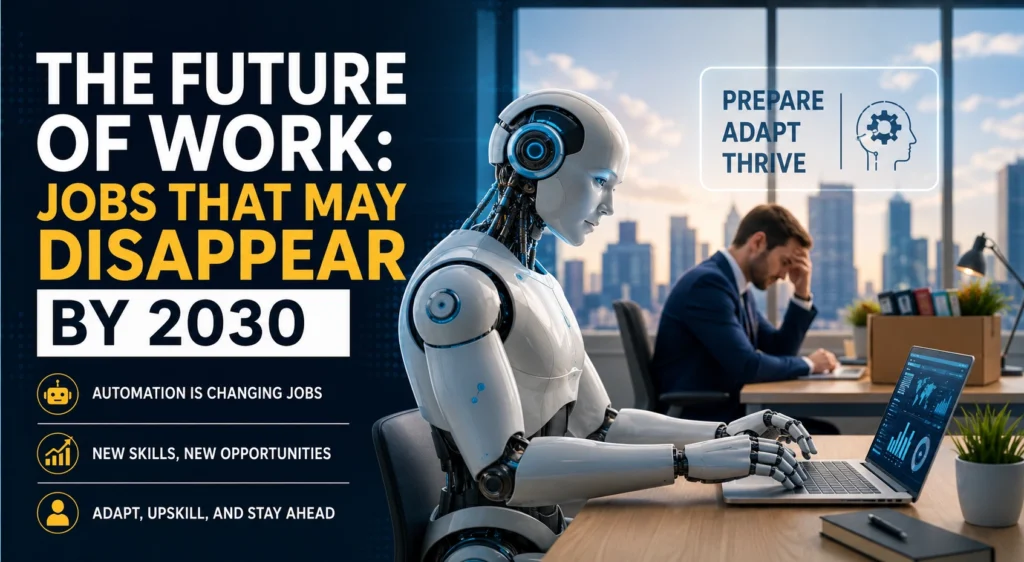
The workplace is evolving faster than ever before, and artificial intelligence, automation, robotics, and digital technologies are reshaping industries across the globe. By 2030, many routine and repetitive jobs are expected to change significantly, while entirely new career opportunities will emerge. This transformation does not necessarily mean that people will lose their livelihoods; instead, it highlights the growing importance of learning new skills and adapting to technological advancements. Professionals who continuously upgrade their knowledge will remain competitive in the modern job market. Fields such as Data Science, Artificial Intelligence (AI), Machine Learning, Python programming, Digital Marketing, and Business Analytics are becoming increasingly valuable because they prepare individuals for the technology-driven future. Understanding which jobs may decline can help students and professionals make informed career decisions and prepare for tomorrow’s workplace.
Key Takeaways
- Automation is changing repetitive jobs faster than creative and analytical roles.
- Upskilling in modern technologies can improve long-term career opportunities.
- Human creativity, leadership, and problem-solving will remain valuable.
1. Data Entry Operators
Data entry has traditionally involved manually entering information into digital systems. Today, AI-powered software and intelligent automation tools can process invoices, forms, customer records, and documents with remarkable speed and accuracy. Businesses are increasingly investing in these technologies because they reduce costs and improve efficiency. As automation continues to improve, organizations will require fewer employees for repetitive data entry tasks. However, professionals who learn Data Science or Python can transition into data management, data analysis, or automation roles that offer better career growth and higher salaries.
2. Cashiers and Billing Executives
Retail stores are rapidly adopting self-checkout systems, contactless payment methods, and AI-powered billing solutions. Customers can now complete purchases using mobile apps or automated kiosks without interacting with a cashier. While customer service will still require human involvement in many situations, traditional cashier roles are expected to decline over the coming years. Individuals working in retail can improve their future prospects by learning Digital Marketing, customer experience management, or business operations to adapt to changing industry demands.
3. Telemarketing Representatives
AI chatbots, voice assistants, and automated customer engagement platforms are replacing traditional telemarketing in many organizations. These intelligent systems can answer customer queries, recommend products, and schedule appointments around the clock. Since automated tools can handle thousands of conversations simultaneously, businesses are reducing their dependence on manual telemarketing teams. However, professionals with strong communication skills can shift into digital sales, relationship management, or Digital Marketing roles where human interaction remains highly valuable.
4. Basic Customer Support Agents
Customer support has changed dramatically with the introduction of AI-powered virtual assistants. Many routine questions regarding orders, refunds, account details, and product information are now handled automatically through chatbots. Human support representatives are increasingly focusing on complex customer issues that require empathy, judgment, and critical thinking. Learning AI fundamentals or Business Analytics can help customer support professionals move into higher-value roles involving customer experience strategy or service optimization.
5. Manufacturing Assembly Workers
Modern factories are becoming smarter through industrial robots and intelligent automation systems capable of performing repetitive assembly tasks with high precision. These technologies improve production speed while reducing errors and operational costs. Although manufacturing jobs will continue to exist, many routine positions may gradually disappear. Workers who develop skills in automation, robotics, Machine Learning, or industrial data analysis will have greater opportunities in the evolving manufacturing sector.
6. Bank Clerks
Digital banking, mobile applications, automated verification systems, and AI-powered financial services have reduced the need for many traditional banking operations. Customers now perform transactions, account management, and loan applications online without visiting physical branches. As financial institutions continue investing in technology, routine clerical positions may decline. Employees who strengthen their knowledge of Business Analytics, financial technology, and data-driven decision-making will be better positioned for future banking careers.
7. Travel Booking Agents
Online travel platforms now allow customers to compare flights, hotels, transportation, and holiday packages within minutes. AI recommendation engines further personalize travel suggestions based on customer preferences. These innovations have reduced reliance on traditional travel booking agents. Nevertheless, specialists offering customized luxury travel planning or corporate travel management will continue to find opportunities. Learning Digital Marketing can also help travel professionals build successful online travel businesses.
8. Warehouse Pickers
Warehouses are increasingly using autonomous robots, AI-powered inventory management systems, and smart logistics technologies. Automated machines can identify products, transport goods, and organize inventory more efficiently than manual processes. Although warehouse operations will continue expanding due to e-commerce growth, many repetitive picking and sorting tasks may become automated. Workers who acquire technical skills in warehouse automation, Python programming, or logistics analytics can advance into supervisory and technology-focused roles.
9. Proofreading for Basic Content
Generative AI tools can now detect grammar mistakes, improve sentence structure, and suggest writing improvements within seconds. As a result, simple proofreading work is becoming increasingly automated. However, high-quality editing that requires creativity, fact-checking, storytelling, and brand consistency still depends heavily on human expertise. Writers and editors who combine creativity with AI knowledge can remain highly competitive in content creation and digital publishing.
10. Basic Bookkeeping Professionals
Cloud accounting software and AI-driven financial platforms can automatically categorize transactions, generate reports, reconcile accounts, and identify financial trends. These capabilities reduce the amount of manual bookkeeping required by businesses. Instead of focusing solely on routine accounting tasks, finance professionals can increase their value by learning Business Analytics, data visualization, and AI-assisted financial analysis, allowing them to provide strategic business insights rather than simple record keeping.
Conclusion
The future of work should not be viewed as a threat but as an opportunity to evolve alongside technology. While automation and AI may reduce demand for several repetitive occupations, they are simultaneously creating exciting careers in technology, analytics, digital business, and innovation. Success in the coming decade will depend on continuous learning, adaptability, and the willingness to embrace new skills. Courses in Data Science, Artificial Intelligence, Machine Learning, Python, Digital Marketing, and Business Analytics provide practical knowledge that aligns with the changing employment landscape. Rather than fearing automation, professionals should prepare themselves for emerging opportunities by building skills that complement technology instead of competing with it. Those who invest in learning today will be better equipped to thrive in the workforce of 2030 and beyond.