
Introduction
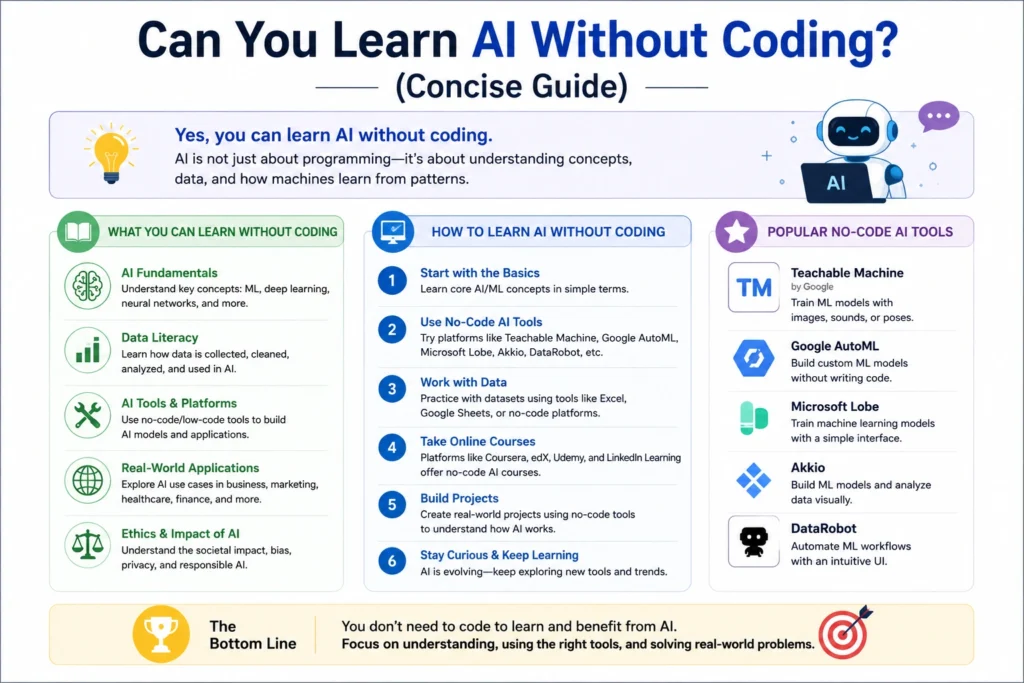
Yes, you can learn AI without coding. Artificial Intelligence can be understood through concepts, tools, and real-world applications without programming skills. Modern no-code platforms and beginner-friendly training programs make AI accessible to everyone. However, coding helps in advanced roles. You can still start your AI journey effectively without a technical background.
1. AI Basics Without Programming
You can learn AI by focusing on core ideas like machine learning, data patterns, and automation. These concepts explain how AI systems work in real life. Many beginners start with simplified learning materials instead of coding. This builds a strong foundation before moving into technical development or advanced AI engineering.
2. No-Code AI Tools
No-code AI platforms allow users to build models without writing code. Drag-and-drop tools handle technical complexity in the background. You only manage inputs and outputs. These tools make AI practical for business users, students, and professionals who want results without programming knowledge or software development experience.
3. Learning AI Through Real Use
AI is already part of daily life in apps, search engines, and recommendations. By observing these systems, you naturally understand how AI works. This method helps beginners learn AI concepts practically without coding. It is one of the easiest ways to build awareness of artificial intelligence.
4. AI in Business Applications
AI is widely used in business for marketing, analytics, automation, and decision-making. Even without coding, you can learn how to interpret AI outputs and use them for strategy. This makes you valuable in roles where understanding AI tools is more important than building them from scratch.
5. Training Institutes Offering AI Courses
Institutes like Data Science Training Institute (DSTI) provide structured AI and data science learning. Their programs include Data Science Course, Job-Oriented Data Science Training, and Online + Classroom Data Science Course. These courses focus on practical skills, tools, and industry applications, making AI learning easier for non-coders.
6. Location-Based Learning Options (DSTI)
DSTI offers AI and data science training across multiple locations, such as Saket, Laxmi Nagar, West Delhi, and Jaipur. These courses are designed for beginners and professionals. The training focuses on hands-on learning, real datasets, and career support, helping learners enter the AI and analytics field without coding knowledge.
7. Skills You Can Learn Without Coding
Without coding, you can still learn data interpretation, AI tools usage, visualization, and basic analytics. These skills help you understand how AI makes decisions. You become capable of working with dashboards, reports, and automated systems, which are widely used in modern industries and organizations.
8. Limitations of No-Code AI Learning
Learning AI without coding has limitations. You may not build advanced models or customize algorithms deeply. No-code tools simplify tasks but restrict flexibility. For higher technical roles like AI engineer or machine learning developer, programming knowledge becomes necessary for a deeper understanding and system control.
9. Career Opportunities for Non-Coders
Even without coding, you can build careers in AI-related fields. Roles like AI analyst, business intelligence associate, data reporting specialist, and AI content strategist are common. These jobs focus on using AI tools, understanding outputs, and improving business decisions rather than developing algorithms.
10. Should You Learn Coding Later?
If you want long-term growth in AI, learning basic coding like Python is helpful. It is not required at the start, but it increases job opportunities and technical understanding. You can begin without coding and gradually upgrade your skills as you become more confident in AI concepts.
Conclusion
Learning AI without coding is completely possible and practical today. You can understand concepts, use tools, and apply AI in real-world scenarios. Institutes like DSTI also support non-coders through structured courses such as Data Science and Job-Oriented Training programs. However, coding remains valuable for advanced careers and deeper expertise.