
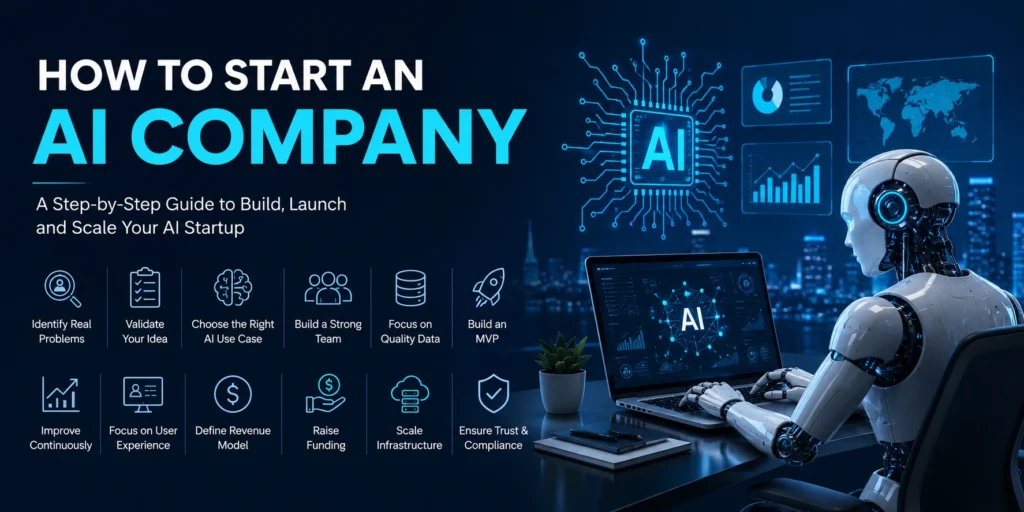
Introduction to Starting an AI Company
Starting an AI company requires identifying real problems, strong technical execution, and a clear business strategy. Today, AI startups are growing rapidly in areas like data science, machine learning, and automation. Success depends on validation, data quality, and scalability rather than just advanced technology or complex algorithms.
1. Identify a Real Problem
Every AI company starts with a real-world problem. Focus on industries like healthcare, finance, or logistics where inefficiencies exist. The goal is to solve costly or repetitive tasks using AI. Without a clear problem, even advanced technology cannot generate meaningful business value or customer demand.
2. Validate Your Idea
Before building, validate your AI startup idea with real users. Understand their pain points, current tools, and expectations. This ensures market demand exists. Many startups fail because they build AI products without confirming whether customers actually need or will pay for the solution.
3. Select the Right AI Use Case
Not every problem needs AI. Choose a use case where machine learning or automation clearly improves performance. Avoid unnecessary complexity. A well-defined AI use case increases efficiency, reduces cost, and improves chances of building a scalable startup.
4. Build a Skilled Team
To start an AI company, you need a strong team with skills in data science, machine learning, and business development. If you are non-technical, collaborate with experienced AI engineers. Execution is more important than ideas, so the team plays a key role in success.
5. Focus on Quality Data
Data is the foundation of any AI company. You need clean, structured, and relevant datasets from reliable sources. Poor-quality data leads to weak AI models and inaccurate predictions. Always prioritize data preparation before model development.
6. Build an MVP
Create a Minimum Viable Product (MVP) that solves one core problem effectively. The goal is to test your idea quickly in the real market. Early feedback helps improve both your AI model and product direction without wasting time or resources.
7. Improve AI Models Continuously
AI systems are never static. They must be trained and improved continuously using real-world data. Monitor accuracy, bias, and performance. Successful AI startups focus on constant optimization rather than one-time development.
8. Focus on User Experience
A successful AI company is not just about algorithms but also usability. Build simple, intuitive, and reliable products. Users prefer solutions that integrate easily into their workflow instead of complex systems that are difficult to use.
9. Define Revenue Model
Decide how your AI company will earn money—subscriptions, APIs, licensing, or enterprise solutions. Pricing should match the value your AI delivers. A strong revenue model ensures sustainability and attracts investors.
10. Raise Funding
AI startups often require funding for computing power, data, and hiring talent. You can start with bootstrapping and later approach investors. Strong traction, clear problem-solving, and a scalable market improve your chances of raising funds.
11. Scale Infrastructure
As your AI startup grows, scaling becomes critical. Optimize cloud usage, reduce computation costs, and improve system performance. Poor infrastructure planning can lead to high expenses and system failures during rapid growth.
12. Learn from Industry Training (Optional but Useful)
To strengthen your AI journey, structured learning can help. Institutes like Data Science Training Institute (DSTI) offer industry-focused programs such as:
- Data Science Course
- Job-Oriented Data Science Training
- Machine Learning & AI Training
- Python for Data Science
- Business Analytics & Data Visualization
- Deep Learning Fundamentals
- SQL & Data Handling Training
These programs focus on practical learning, real projects, and job-oriented skills, which can support entrepreneurs building AI startups.
Conclusion
Starting an AI company requires more than technical skills—it demands problem validation, strong data systems, continuous improvement, and a clear business model. With the right team, execution strategy, and learning support, you can build a scalable AI startup that solves real-world problems and creates long-term business value.