
Introduction
Generative AI is one of the fastest-growing technologies in the digital world today. From creating text and images to generating videos, music, and code, this technology is changing how people work, learn, and communicate. Businesses, students, marketers, developers, and creators are using generative AI tools to improve productivity and creativity. The main goal of generative AI is to create new and meaningful content using existing data and patterns. Unlike traditional AI, which mainly analyzes or predicts information, generative AI focuses on producing original outputs that look human-made. This technology is now widely used in industries like healthcare, education, finance, entertainment, software development, and digital marketing.
Understanding Generative AI
Generative AI is a branch of artificial intelligence designed to create new content instead of simply analyzing data. It uses advanced machine learning models trained on huge datasets to understand patterns, language, visuals, and structures. Once trained, these systems can generate human-like text, realistic images, audio, videos, and even programming code. Popular examples include chatbots, AI image generators, and content-writing tools. The technology is built using deep learning and neural networks, allowing machines to imitate human creativity and problem-solving abilities in many real-world situations.
The Main Goal of Generative AI
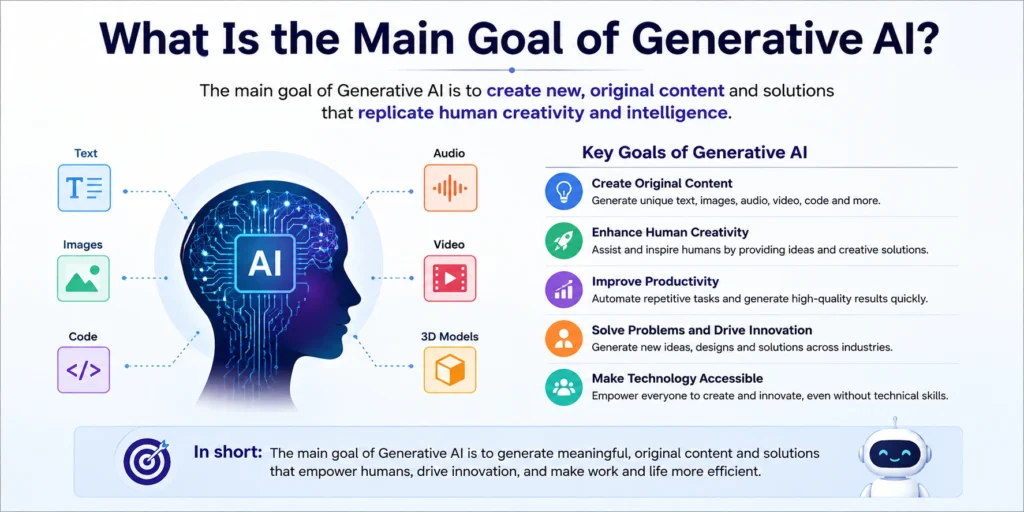
The primary goal of generative AI is to generate original, useful, and high-quality content automatically. It aims to reduce human effort while increasing speed, efficiency, and creativity. Instead of manually writing articles, designing graphics, or coding applications from scratch, users can use AI tools to complete tasks quickly. Generative AI helps individuals and businesses save time and improve productivity. It also supports innovation by generating ideas, solutions, and creative outputs that humans can further improve and customize according to their needs and goals.
How Generative AI Learns and Creates
Generative AI works by learning patterns from massive amounts of data. During training, AI models study text, images, audio, and other information to understand relationships and structures. Once the learning process is complete, the model can generate new outputs based on prompts or instructions given by users. For example, an AI writing tool can create articles, emails, or scripts after analyzing millions of text examples. Similarly, AI image generators create realistic visuals after studying thousands of photographs, illustrations, and artworks from different sources.
Generative AI and Human Creativity
One major goal of generative AI is to support human creativity rather than completely replace humans. Writers use AI to generate ideas and drafts, designers create artwork faster, and developers write code more efficiently. AI tools help users overcome creative blocks and improve workflow. Instead of spending hours on repetitive tasks, professionals can focus on strategy, innovation, and decision-making. Generative AI acts like a digital assistant that enhances human skills and provides creative support across multiple industries and professions in the modern digital economy.
Improving Productivity Through Automation
Generative AI is widely used to automate repetitive and time-consuming tasks. Businesses use AI for customer support, content creation, report generation, and marketing campaigns. Students use AI tools for research assistance, summarization, and learning support. Companies save both time and operational costs by automating workflows with AI-powered systems. The main objective is to improve efficiency while maintaining quality. Automation through generative AI allows organizations to complete tasks faster, manage larger workloads, and deliver better services to customers and clients worldwide.
Role of Generative AI in Education
Education is one of the most important sectors benefiting from generative AI. Students can use AI tools to understand complex topics, create notes, practice coding, and improve writing skills. Teachers can prepare lesson plans, quizzes, and educational materials more efficiently. Generative AI also supports personalized learning experiences by adapting content according to a student’s learning level and style. Many learners are now exploring courses in Data Science, Artificial Intelligence, Machine Learning, Python, Business Analytics, and Digital Marketing to understand and use AI technologies effectively in their careers.
Generative AI in Business and Marketing
Businesses are using generative AI to improve customer engagement and business growth. Marketing teams generate social media content, advertisements, email campaigns, and SEO articles with AI assistance. Companies analyze customer behavior and create personalized recommendations using AI-powered systems. The goal is to improve communication, branding, and customer experience while reducing manual work. Generative AI also helps startups and enterprises make faster decisions by providing data-driven insights and content solutions that support business operations in highly competitive digital markets.
Generative AI in Software Development
Software development has changed significantly with the rise of generative AI. Developers now use AI tools to write code, debug applications, generate scripts, and automate testing processes. AI coding assistants improve programming speed and help beginners learn coding more easily. Technologies like Python, Machine Learning, and Artificial Intelligence are becoming highly valuable skills in the tech industry. The main goal here is to simplify development processes, reduce coding errors, and help developers build software solutions faster and more efficiently than before.
Benefits of Generative AI
Generative AI offers many advantages across industries and professions. It increases productivity, reduces costs, improves creativity, and speeds up content generation. Businesses can automate operations while individuals can complete tasks with greater efficiency. AI also improves personalization by creating customized recommendations and experiences for users. In healthcare, it assists in research and diagnostics, while in education, it supports learning and training. The ability to generate useful outputs quickly makes generative AI one of the most powerful technologies in the modern digital world.
Challenges and Ethical Concerns
Although generative AI provides many benefits, it also comes with challenges and ethical concerns. AI-generated content can sometimes contain incorrect information, bias, or misleading outputs. There are also concerns related to copyright, privacy, and job displacement. Some people worry that excessive dependence on AI may reduce human creativity and critical thinking skills. Companies and governments are now working on responsible AI policies to ensure ethical use of generative technologies. Human supervision and proper regulations are important to maintain trust and fairness in AI systems.
Future of Generative AI
The future of generative AI looks extremely promising as technology continues to evolve rapidly. AI systems are expected to become more accurate, intelligent, and personalized in the coming years. Industries such as healthcare, finance, entertainment, education, and e-commerce will increasingly depend on AI-powered tools. Future AI applications may include advanced virtual assistants, automated business operations, realistic digital experiences, and intelligent learning systems. As demand for AI professionals grows, skills in Data Science, AI, Python, Machine Learning, and Business Analytics will become even more valuable worldwide.
Why Learning Generative AI Matters
Learning generative AI is becoming important for students, professionals, and business owners. AI knowledge helps individuals stay competitive in the modern job market, where automation and digital transformation are rapidly increasing. Understanding AI tools can improve productivity, creativity, and career opportunities. Courses in Artificial Intelligence, Data Science, Machine Learning, Python programming, Digital Marketing, and Business Analytics help learners develop practical skills for future industries. As companies continue adopting AI technologies, professionals with AI expertise will have better career growth and employment opportunities.
Conclusion
The main goal of generative AI is to create original, useful, and intelligent content that improves human productivity and creativity. Unlike traditional AI systems that only analyze data, generative AI focuses on producing new outputs such as text, images, videos, music, and code. It helps businesses automate operations, supports students in learning, improves software development, and enhances marketing strategies. Although challenges like ethics and misinformation still exist, the future of generative AI remains highly promising. As technology continues to grow, learning AI-related skills will become essential for career success and digital innovation in the modern world.