
Introduction
Generative AI is one of the most advanced technologies in the modern digital world. It is transforming industries such as education, healthcare, marketing, entertainment, and software development. The most important reason behind its popularity is its ability to create new content automatically. Unlike traditional AI systems that mainly analyze data and provide predictions, generative AI can generate text, images, music, videos, code, and many other forms of content. This unique capability has made it a revolutionary technology for businesses, students, and professionals. Understanding the key features of generative AI helps people learn how this technology works and why it is becoming an essential part of everyday life.
Understanding Generative AI
Generative AI refers to artificial intelligence systems designed to create original content based on the data they have been trained on. These systems use advanced machine learning models and deep learning algorithms to understand patterns and generate realistic outputs. Popular tools like OpenAI ChatGPT, image generators, and AI coding assistants are examples of generative AI applications. The technology learns from huge datasets and produces human-like responses or creative outputs. This ability to generate entirely new information is considered one of the most important features of generative AI.
The Core Feature of Generative AI
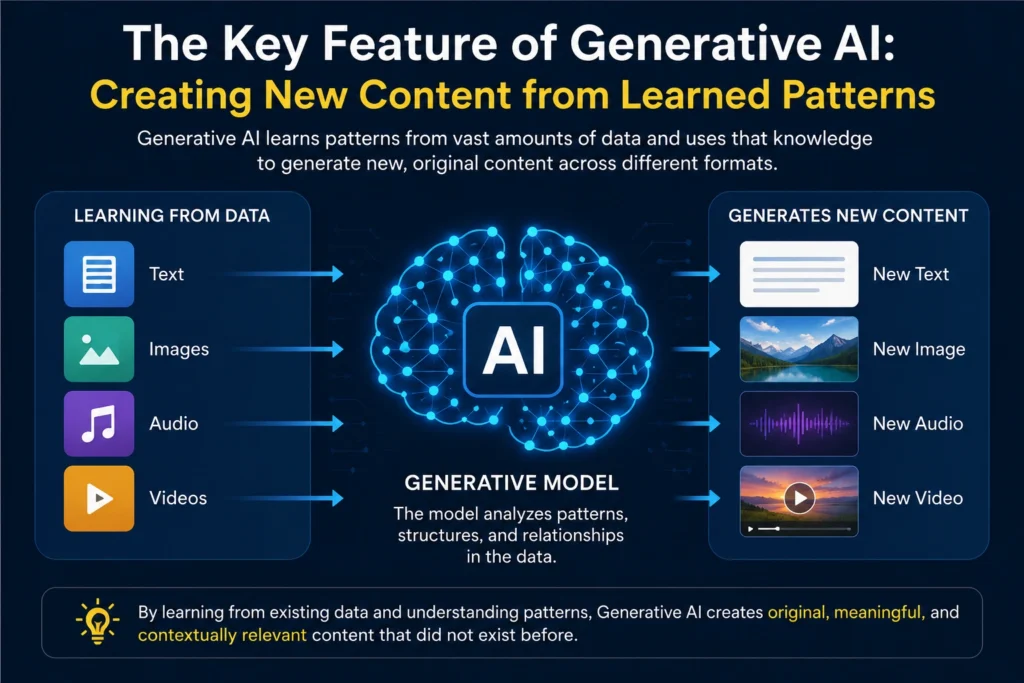
The key feature of generative AI is content generation. Traditional AI systems mostly focus on identifying patterns, classifying data, or making predictions. Generative AI goes beyond these functions by producing new and unique content. It can write articles, create realistic images, generate software code, compose music, and even design videos. This feature makes generative AI highly valuable because it automates creative and technical tasks that previously required human effort. Businesses and individuals use this capability to improve productivity and creativity.
How Generative AI Creates Content
Generative AI works by learning patterns from large amounts of training data. During training, the AI model studies language structures, image designs, sounds, or coding formats depending on the task. Once trained, the model uses probability and pattern recognition to generate outputs that resemble human-created work. For example, a text-based AI tool predicts the next word in a sentence to produce meaningful paragraphs. Image generators create visuals by understanding shapes, colors, and artistic styles. This process allows generative AI to produce realistic and useful content within seconds.
Importance of Large Language Models
Large Language Models, commonly known as LLMs, are an important part of generative AI systems. These models are trained on massive datasets containing books, articles, websites, and conversations. LLMs enable AI tools to understand context, grammar, and meaning. This allows AI systems to create natural and human-like responses. Chatbots, writing assistants, and customer support tools depend heavily on these models. The success of modern generative AI platforms is directly connected to the development of powerful language models capable of handling complex tasks accurately and efficiently.
Personalization and Creativity
Another major feature of generative AI is personalization. AI systems can generate customized outputs based on user preferences, behavior, and requirements. For example, AI writing tools can create personalized emails, blogs, or advertisements for different audiences. AI image generators can produce artwork in specific styles requested by users. This level of customization improves user experience and saves time. Generative AI also boosts creativity by helping users develop ideas, create designs, and solve problems faster. Many creators use AI as a supportive tool for innovation and inspiration.
Real-Time Content Generation
One of the strongest advantages of generative AI is its ability to create content instantly. Traditional creative processes often require hours or days of work, but AI tools can generate results within seconds. Students can receive instant study notes, businesses can create marketing content quickly, and developers can generate code snippets immediately. Real-time content generation improves productivity and efficiency across industries. This feature is especially valuable in fast-moving digital environments where businesses need quick responses and continuous content production.
Applications in Different Industries
Generative AI is being used in multiple industries because of its powerful content generation abilities. In healthcare, AI helps generate medical reports and research summaries. In education, it creates study materials, quizzes, and personalized learning experiences. In digital marketing, AI generates advertisements, social media captions, and SEO-friendly content. In entertainment, AI creates music, animations, and visual effects. Software companies use generative AI for coding assistance and debugging. The wide range of applications proves how important this technology has become in modern industries.
Benefits of Generative AI
Generative AI offers many advantages to individuals and organizations. One major benefit is increased productivity because repetitive tasks can be automated easily. Another benefit is cost reduction since businesses can create content faster with fewer resources. AI tools also improve creativity by providing fresh ideas and innovative solutions. Students and professionals use AI for learning, writing, coding, and research purposes. Additionally, generative AI supports better customer engagement through personalized communication. These benefits make AI technology highly valuable for future business growth and digital transformation.
Challenges and Limitations
Despite its advantages, generative AI also has several challenges. One common issue is accuracy because AI can sometimes generate incorrect or misleading information. Another challenge is ethical concerns related to plagiarism, copyright, and misinformation. AI-generated content may also lack emotional understanding and human judgment in certain situations. Privacy and data security are additional concerns because AI models require large amounts of data for training. Businesses and developers must address these challenges responsibly to ensure safe and ethical use of generative AI technologies.
Role of Generative AI in Education and Careers
Generative AI is creating new career opportunities and changing educational systems worldwide. Students are learning skills related to artificial intelligence, machine learning, data science, and automation. Many educational institutions now offer courses in Data Science, Artificial Intelligence, Machine Learning, Python Programming, Digital Marketing, and Business Analytics to prepare students for future careers. AI tools also help learners understand complex topics more easily through personalized explanations and interactive learning methods. As AI adoption increases, professionals with AI-related skills will have better career opportunities.
Future of Generative AI
The future of generative AI looks extremely promising. AI models are becoming smarter, faster, and more capable of handling complex tasks. Future AI systems may create highly realistic virtual environments, advanced robotic assistants, and fully automated business solutions. Companies are investing heavily in AI research to improve performance and reduce limitations. Generative AI is expected to transform industries such as healthcare, finance, education, entertainment, and software development even further. As technology continues to evolve, generative AI will become an essential tool for innovation and productivity.
Why Businesses Are Investing in Generative AI
Businesses across the world are adopting generative AI because it improves efficiency and reduces operational costs. Companies use AI tools for customer support, content creation, product design, and market analysis. AI-powered automation helps organizations save time while improving the quality of services. Marketing teams use AI to create personalized campaigns, while software companies use it for faster development processes. The ability of generative AI to handle multiple tasks simultaneously makes it a valuable investment for companies looking to stay competitive in the digital era.
Ethical Use of Generative AI
As generative AI becomes more popular, ethical use is becoming increasingly important. Developers and businesses must ensure that AI-generated content is fair, accurate, and transparent. AI should not be used to spread misinformation, create harmful content, or violate copyright laws. Responsible AI practices include proper data handling, content verification, and human supervision. Governments and organizations are also working on AI regulations to ensure safe usage. Ethical AI development will play a major role in maintaining trust and reliability in future AI systems.
Conclusion
The key feature of generative AI is its ability to create original and human-like content automatically. This powerful capability separates generative AI from traditional AI systems and makes it one of the most transformative technologies in the digital age. From writing articles and generating images to assisting in coding and education, generative AI is changing the way people work and learn. Although challenges such as accuracy and ethical concerns still exist, the future of generative AI remains highly promising. As technology advances, generative AI will continue to improve productivity, creativity, and innovation across industries worldwide.