
Introduction
“What is propositional logic in AI?” is one of the most common questions beginners ask when learning Artificial Intelligence. Propositional logic is a simple but powerful method used in AI systems to represent knowledge, solve problems, and make decisions based on facts and rules. It helps machines understand whether statements are true or false and allows AI models to process information logically. From smart assistants to recommendation systems, propositional logic plays an important role in building intelligent applications. Today, students learning Data Science, AI, Machine Learning, Python, Business Analytics, and even Digital Marketing are introduced to logical reasoning because it forms the foundation of intelligent systems. Understanding propositional logic helps beginners learn how AI thinks, reasons, and solves real-world problems in a structured way.
1. Understanding the Meaning of Propositional Logic
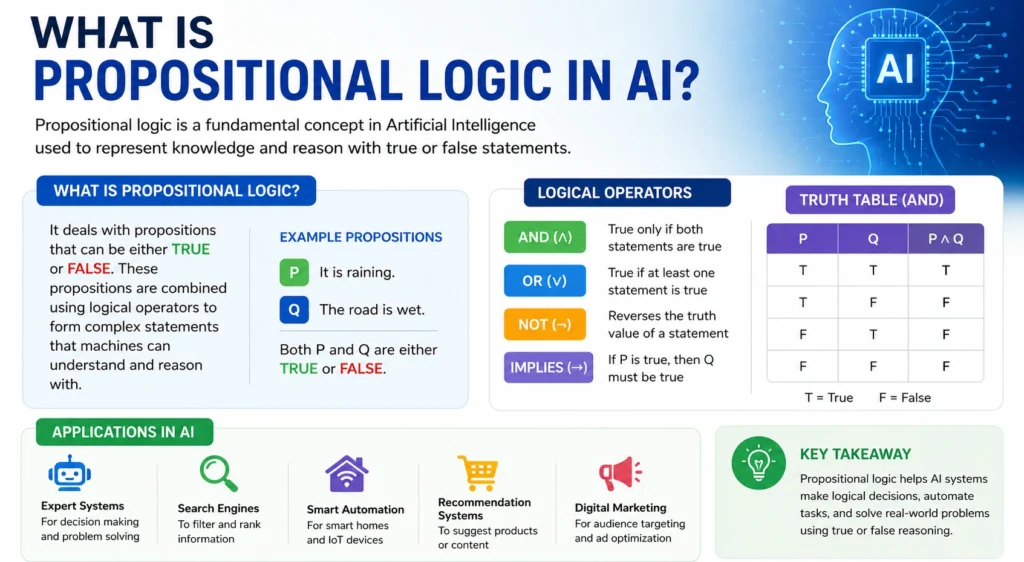
Propositional logic is a branch of logic that deals with statements called propositions. A proposition is a sentence that can either be true or false. In Artificial Intelligence, these statements are used to represent facts and knowledge. For example, “The system is online” or “The user is verified” are propositions because they have a definite truth value. AI systems use propositional logic to process information and make logical conclusions. It is considered one of the simplest forms of logical reasoning and is widely used in computer science and AI applications.
2. Why Propositional Logic is Important in AI
Artificial Intelligence depends heavily on reasoning and decision-making. Propositional logic helps AI systems analyze situations using rules and conditions. It allows machines to make conclusions from available information in a structured way. For example, if an AI system knows that “If it rains, the road becomes wet” and it detects rain, it can logically conclude that the road is wet. This logical structure improves problem-solving abilities and supports automation. Students learning Machine Learning and AI often study propositional logic first because it builds the base for advanced reasoning systems.
3. Main Components of Propositional Logic
Propositional logic consists of propositions, logical operators, and truth values. Propositions are basic statements that can be true or false. Logical operators connect different propositions and create meaningful relationships. Common operators include AND, OR, NOT, and IF-THEN. These operators help AI systems evaluate conditions and make decisions. Truth values determine whether a statement is correct or incorrect. Together, these components create logical expressions that machines can understand and process efficiently.
4. Logical Operators Used in AI
Logical operators are the heart of propositional logic. The AND operator checks whether two conditions are true together, while the OR operator checks if at least one condition is true. The NOT operator reverses the meaning of a statement, and the implication operator represents conditions such as “if this happens, then that happens.” AI systems use these operators to solve reasoning problems and evaluate complex conditions. Many beginners learning Python and AI use logical operators while writing programs and algorithms because they help computers perform intelligent actions.
5. Truth Tables and Their Role
Truth tables are used to display all possible outcomes of logical expressions. They help determine whether a statement is always true, always false, or conditionally true. In AI, truth tables simplify logical analysis and help developers understand how machines process decisions. For example, an AI chatbot may use logical rules to respond differently depending on user input. Truth tables make these conditions easier to design and test. Learning truth tables also improves analytical thinking, which is useful in Data Science and Business Analytics.
Important Points About Propositional Logic in AI
- It helps AI systems make logical decisions.
- It works with true or false statements only.
- Logical operators connect multiple conditions.
- It forms the foundation of knowledge representation in AI.
- It is widely used in reasoning systems and expert systems.
6. Applications of Propositional Logic in Real Life
Propositional logic is used in many real-world AI applications. Expert systems in healthcare use logical reasoning to suggest treatments based on symptoms. Search engines use logic to filter and organize information. Smart home devices apply logical conditions to automate tasks such as turning lights on or off. AI-powered recommendation systems also rely on logical reasoning to suggest products or content. Even in Digital Marketing, AI tools analyze user behavior and apply logical rules to improve advertising performance and customer targeting.
7. Difference Between Human Thinking and AI Logic
Humans often think emotionally and intuitively, while AI systems rely on structured logic and data. Propositional logic helps machines process information step by step without confusion. Unlike humans, AI does not guess or assume unless programmed to do so. This logical approach makes AI systems more accurate in repetitive tasks. However, propositional logic has limitations because it only works with statements that are clearly true or false. Human thinking is more flexible, while AI logic focuses on precision and consistency.
8. Advantages of Propositional Logic in AI
One major advantage of propositional logic is simplicity. It provides a clear and organized way to represent knowledge and solve problems. It improves decision-making, reduces errors, and helps AI systems work efficiently. Another advantage is that logical statements are easy to understand and test. Beginners learning AI and Machine Learning often find propositional logic easier compared to advanced mathematical concepts. It also supports automation by allowing machines to follow logical rules without human intervention.
9. Limitations of Propositional Logic
Although propositional logic is useful, it also has limitations. It cannot represent complex relationships or uncertain information effectively. Real-world situations often involve probabilities, emotions, and incomplete data, which propositional logic cannot fully handle. This is why advanced AI systems use other methods such as predicate logic, fuzzy logic, and Machine Learning models. However, propositional logic still remains an important starting point for understanding how AI systems reason and process information logically.
10. Learning Propositional Logic for AI Careers
Learning propositional logic can help students build a strong foundation in Artificial Intelligence and computer science. It improves problem-solving skills and logical thinking, which are essential for careers in AI, Data Science, Python programming, and Business Analytics. Many beginner-friendly AI and Machine Learning courses introduce logical reasoning before moving to advanced concepts. Understanding propositional logic also helps students write better algorithms, improve coding skills, and understand how intelligent systems make decisions in real-world applications.
Conclusion
Propositional logic is one of the most important foundational concepts in Artificial Intelligence. It helps machines understand facts, apply logical rules, and make accurate decisions. By using propositions, operators, and truth tables, AI systems can process information in a structured and intelligent way. Although it has some limitations, propositional logic remains essential for building reasoning systems and understanding the basics of AI technology. For beginners exploring AI, Machine Learning, Python, Data Science, Digital Marketing, and Business Analytics, learning propositional logic is a valuable step toward understanding how intelligent systems work in the modern digital world.