
Introduction
“What is Conceptual Dependency in AI?” is a common question among beginners exploring Artificial Intelligence and Natural Language Processing. Conceptual Dependency is a knowledge representation method that helps AI systems understand the real meaning of human language instead of only focusing on words and grammar. Developed to improve communication between humans and machines, this concept plays an important role in language understanding, intelligent systems, and AI-based applications. Today, students learning Data Science, AI, Machine Learning, Python, Digital Marketing, and Business Analytics often study such foundational concepts to understand how modern AI technologies work.
Understanding the Meaning of Conceptual Dependency
Conceptual Dependency in AI is a knowledge representation technique that focuses on the meaning of a sentence rather than its grammatical structure. The main purpose of this concept is to help computers understand human language in the same way humans do. Traditional language systems often fail because words can have multiple meanings, but Conceptual Dependency attempts to remove confusion by converting sentences into conceptual structures. This approach allows AI systems to understand actions, events, objects, and relationships clearly. The idea was introduced by Roger Schank in the 1970s to improve Natural Language Understanding in artificial intelligence systems. It became one of the early foundations of AI language research and helped researchers create smarter systems capable of understanding context and meaning.
How Conceptual Dependency Works in AI
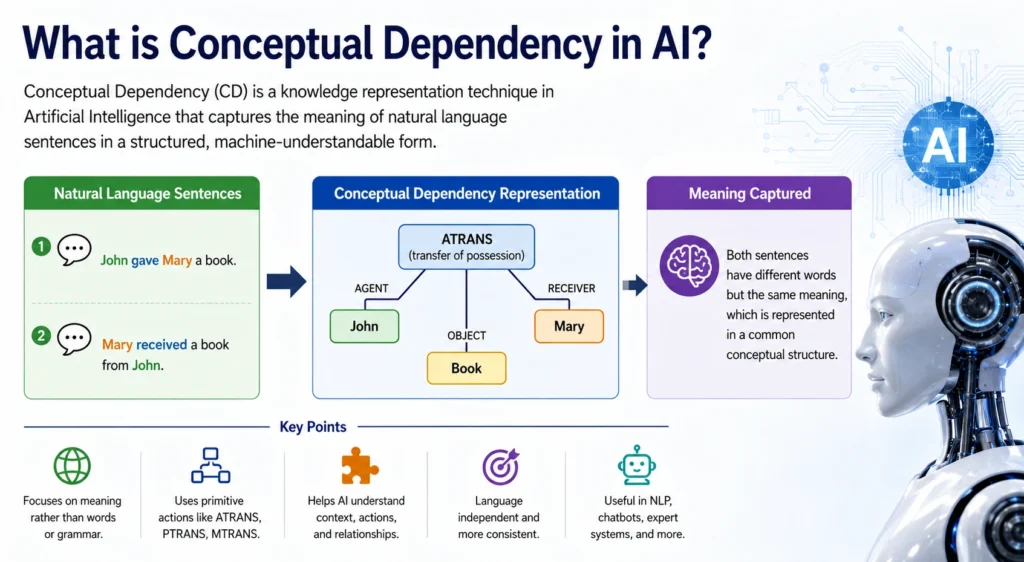
Conceptual Dependency works by transforming natural language sentences into primitive conceptual forms. These primitive actions represent universal meanings that remain the same even if different words are used. For example, the sentences “John gave Mary a book” and “Mary received a book from John” have different wording but share the same meaning. A Conceptual Dependency system converts both sentences into a common conceptual structure. This process helps machines identify the actual intention behind communication. The model uses diagrams and structured representations to connect actions, objects, and relationships. By doing this, AI systems can store knowledge more effectively and retrieve information accurately when required.
Primitive Actions Used in Conceptual Dependency
One of the key elements of Conceptual Dependency is the use of primitive actions. These actions are small conceptual units that represent basic human activities. Some common primitive actions include ATRANS for transfer of possession, PTRANS for physical movement, and MTRANS for transfer of mental information. These primitive actions make it easier for AI systems to understand the deeper meaning of language. Instead of memorizing complete sentences, machines only need to recognize the conceptual action taking place. This structure simplifies language understanding and improves consistency across different communication styles. Modern AI learning programs and Machine Learning courses often introduce such concepts to explain how knowledge representation evolved.
Importance of Conceptual Dependency in Artificial Intelligence
Conceptual Dependency plays a major role in improving Natural Language Processing and intelligent reasoning. It helps AI systems understand the meaning behind text instead of simply matching keywords. This capability is important in chatbots, virtual assistants, search engines, automated customer support, and recommendation systems. AI applications that interact with users require an accurate understanding of context, and Conceptual Dependency contributes to that goal. It also supports knowledge storage and reasoning processes because information can be organized logically. As AI technologies continue to evolve, understanding foundational concepts like Conceptual Dependency helps students and professionals build stronger analytical and technical skills in Data Science, AI, and Business Analytics.
Relationship Between Conceptual Dependency and Natural Language Processing
Natural Language Processing, commonly known as NLP, is one of the most important fields in artificial intelligence. Conceptual Dependency was developed mainly to improve NLP systems. Human language contains ambiguity, emotions, context, and multiple interpretations, which makes it difficult for machines to understand. Conceptual Dependency reduces this complexity by converting language into standard conceptual representations. This allows AI systems to identify similar meanings even when different words are used. Modern NLP technologies such as chatbots, AI writing assistants, speech recognition systems, and translation software use advanced techniques inspired by early knowledge representation models like Conceptual Dependency. Learning Python and AI programming helps students understand how these NLP systems are developed and trained.
Advantages of Conceptual Dependency in AI
Conceptual Dependency offers several advantages in artificial intelligence applications. One major benefit is language independence because the system focuses on meaning rather than specific words. Different sentences with similar meanings can be represented using the same conceptual structure. This improves consistency and reduces misunderstanding. Another advantage is improved knowledge representation, which helps AI systems reason more effectively. Conceptual Dependency also supports better information retrieval and intelligent communication. Researchers in Machine Learning and AI use such foundational models to understand how intelligent systems process human knowledge.
- Important Point: Conceptual Dependency helps AI systems understand the intent behind communication rather than simply analyzing grammar or keywords.
This feature makes AI applications smarter and more human-like in their interactions.
Limitations of Conceptual Dependency
Although Conceptual Dependency was an innovative idea, it also has some limitations. One major challenge is the complexity of representing every possible human action and thought using primitive structures. Human language is extremely diverse, and creating conceptual representations for all situations is difficult. Another limitation is scalability because large-scale systems require massive knowledge databases. Modern AI systems often use Machine Learning and Deep Learning methods instead of relying completely on Conceptual Dependency models. Despite these challenges, the concept remains important in AI history because it introduced new ways of thinking about language understanding and knowledge representation.
Real-World Applications of Conceptual Dependency
Conceptual Dependency has influenced many real-world AI applications and technologies. Early expert systems and intelligent tutoring systems used this approach to understand and process information. Modern AI applications such as virtual assistants, customer service chatbots, automated translation tools, and semantic search engines still rely on concepts related to meaning representation. Businesses using AI-powered analytics and Business Analytics platforms benefit from systems that can understand user intent and extract meaningful insights from text data. Digital Marketing professionals also use AI-based tools that analyze customer behavior, feedback, and online conversations through advanced language understanding methods. These applications show how foundational AI concepts continue to shape modern technology solutions.
Conceptual Dependency and AI Education
Students interested in Artificial Intelligence should understand Conceptual Dependency because it explains the basics of knowledge representation and language understanding. Many educational programs in Data Science, AI, Machine Learning, and Python programming include introductory concepts related to NLP and semantic analysis. Learning these concepts helps beginners understand how intelligent systems evolved. It also improves problem-solving skills and analytical thinking. Educational institutions now encourage students to explore AI technologies because industries increasingly depend on automation, data analysis, and intelligent communication systems. Knowledge of foundational AI concepts gives learners a strong base for advanced technical learning and career growth.
Future of Conceptual Dependency in Modern AI
The future of Conceptual Dependency lies in its influence on modern semantic understanding and intelligent reasoning systems. Although advanced Machine Learning and Deep Learning models dominate today’s AI industry, researchers still study conceptual representation techniques to improve explainable AI and human-computer interaction. AI systems that understand meaning, context, and emotions more accurately can provide better communication experiences. Future technologies may combine conceptual understanding with neural networks to create smarter and more reliable AI applications. As industries continue investing in Artificial Intelligence, the need for meaningful language understanding will remain important in areas such as healthcare, education, business automation, and customer experience.
Conclusion
Conceptual Dependency in AI is an important concept that helps machines understand the meaning behind human language more effectively. It improved the foundation of Natural Language Processing by focusing on concepts, actions, and relationships instead of only words. Although modern AI now uses advanced Machine Learning and Deep Learning techniques, Conceptual Dependency still plays a valuable role in understanding how intelligent systems process information. Learning this concept can help students and professionals build a stronger understanding of Artificial Intelligence, Data Science, Python, and other modern technology fields.